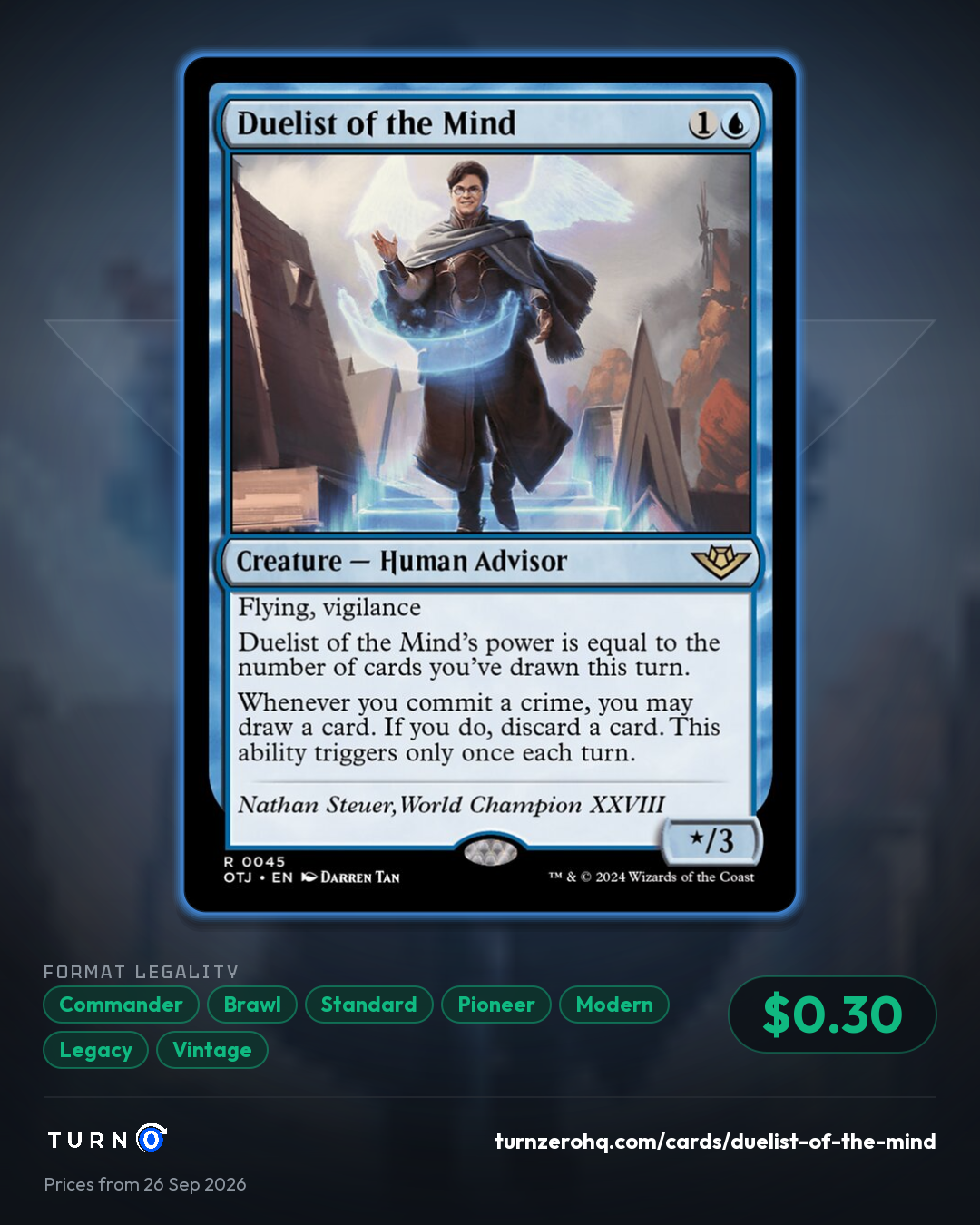
Duelist of the Mind
Tracked across real Commander games played through TurnZero HQ.
What it does
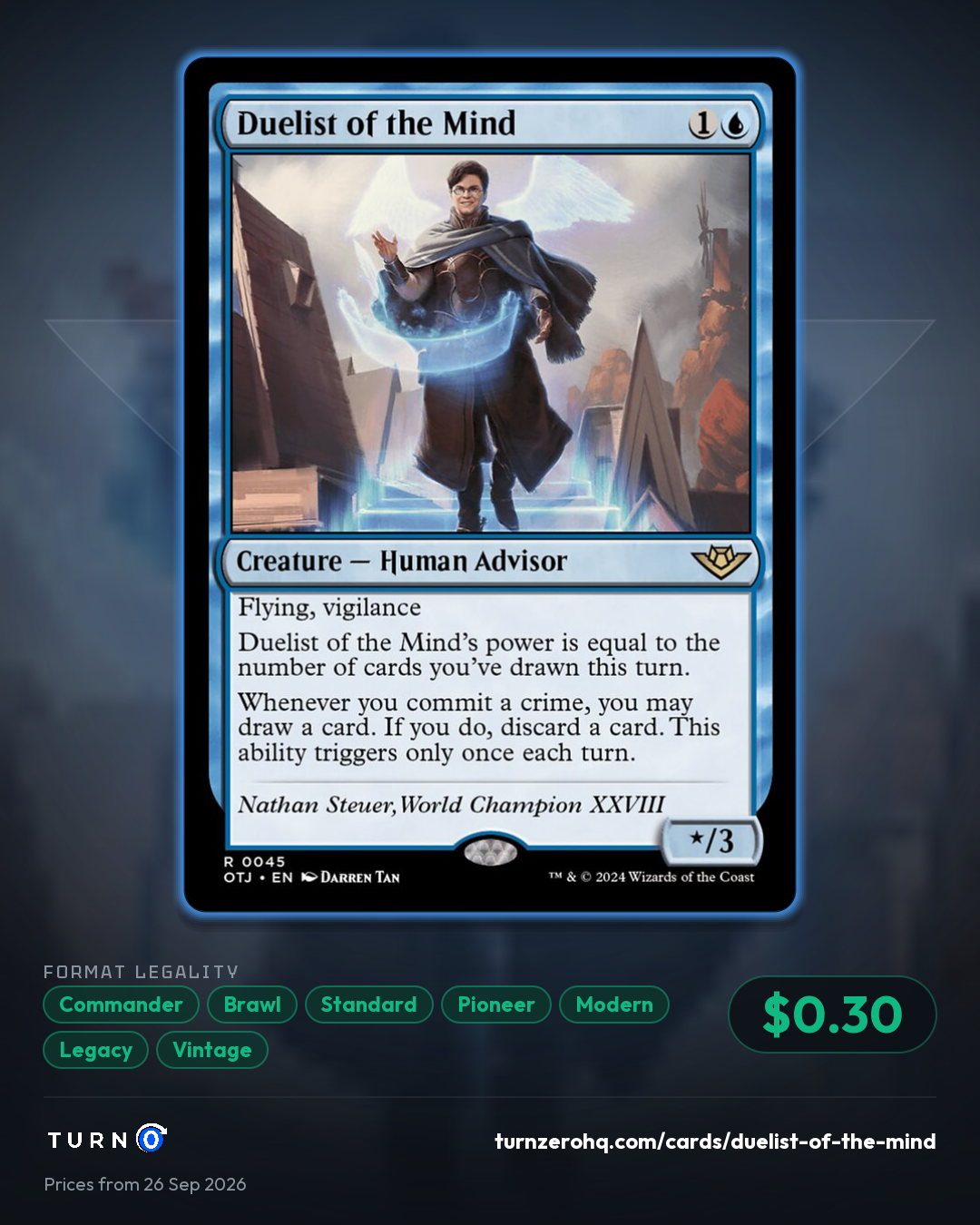
Flying, vigilance
Duelist of the Mind's power is equal to the number of cards you've drawn this turn.
Whenever you commit a crime, you may draw a card. If you do, discard a card. This ability triggers only once each turn.
Rulings
6 official rulings, in the order Wizards published them.
- 2024-04-12
Changing the target or targets of a spell or ability won’t affect whether or not the controller of that spell or ability has committed a crime. Only the initial targets chosen for that spell or ability are used to determine whether or not its controller committed a crime.
- 2024-04-12
The spell or ability that constituted a crime doesn’t have to have resolved yet or at all. As soon as you’re finished casting the spell, activating the ability, or putting the triggered ability on the stack, you’ve committed a crime.
- 2024-04-12
A player can commit only one crime per spell or ability they control. Targeting multiple opponents, permanents, spells, abilities, and/or cards with the same spell or ability doesn’t constitute committing multiple crimes.
- 2024-04-12
A player commits a crime as they cast a spell, activate an ability, or put a triggered ability on the stack that targets at least one opponent, at least one permanent, spell, or ability an opponent controls, and/or at least one card in an opponent’s graveyard.
- 2024-04-12
The ability that defines Duelist of the Mind’s power works in all zones, not just the battlefield.
- 2024-04-12
For example, an ability that triggers when you cast a spell that targets an opponent will trigger at the same time as an ability that triggers whenever you commit a crime. Those abilities can be put on the stack in either order (if you control them both), and they’ll both resolve before the spell that caused them to trigger.
Rulings are Wizards of the Coast's own, mirrored from Scryfall and refreshed nightly.
In the 99
Every deck whose current list includes Duelist of the Mind, whatever its commander.
Most played under
| Commander | Decks | Games | Win rate |
|---|---|---|---|
| The Council of Four | 1 | 3 | — |
Colors it shows up in
- Azorius 1 deck
Duelist of the Mind price history
The Outlaws of Thunder Junction #45 printing, as Scryfall reports the TCGplayer market. Updated nightly. Click any version below to chart its price.
Every recorded price change
| Date | Non-foil | Foil |
|---|---|---|
| Nov 11, 2026 | $0.26 | $0.38 |
| Nov 10, 2026 | $0.26 | $0.39 |
| Nov 9, 2026 | $0.25 | $0.39 |
| Nov 4, 2026 | $0.27 | $0.38 |
| Nov 3, 2026 | $0.28 | $0.38 |
| Nov 2, 2026 | $0.26 | $0.38 |
| Oct 30, 2026 | $0.28 | $0.38 |
| Oct 29, 2026 | $0.26 | $0.38 |
| Oct 25, 2026 | $0.29 | $0.38 |
| Oct 24, 2026 | $0.28 | $0.38 |
| Oct 21, 2026 | $0.27 | $0.38 |
| Oct 17, 2026 | $0.26 | $0.38 |
| Oct 15, 2026 | $0.27 | $0.38 |
| Oct 14, 2026 | $0.28 | $0.38 |
| Oct 12, 2026 | $0.27 | $0.38 |
| Sep 29, 2026 | $0.28 | $0.38 |
| Sep 28, 2026 | $0.30 | $0.39 |
A row is recorded only on nights the price moved, so each price held until the row above it.
Every version of Duelist of the Mind
4 printings, newest first. Prices are the market figures Scryfall publishes, refreshed nightly. A printing with no figure shows a dash rather than a zero, because Scryfall publishes none for some of them. Click a card's art to chart that version's price above.
Extended Art
- Normal
- $0.58
- Foil
- $0.71
- Normal
- $0.26
- Foil
- $0.38
Promo
Outlaws of Thunder Junction Promos
- Normal
- $0.37
- Foil
- $0.55
Promo
Outlaws of Thunder Junction Promos
- Foil
- $0.52
Prices from Scryfall, which tracks the TCGplayer and Cardmarket markets. They move daily and are a guide rather than a quote. Search TCGplayer for Duelist of the Mind. It runs a name search across every version, which covers the printings TCGplayer publishes no direct link to.
Aggregated from Commander games tracked in TurnZero HQ. Every figure counts decks and games only. No individual deck list, player or playgroup is identified. Win rates are withheld below 5 completed games, where the sample is too small to mean anything.