Hosting & Running a Night
How to Find a Commander Playgroup
Game store Commander nights are still the highest-percentage option, regional Discords are where scheduling actually happens, and online pods are a real answer rather than a consolation. The harder part is not finding three people once, it is getting the same three people back next week.
Where the Games Are
Finding a Commander game is easier than it feels from the outside, mostly because the format structurally needs four people and therefore produces a lot of groups actively looking for one more. The five places below cover nearly everyone.
A local game store's Commander night
Still the highest-percentage option, by a distance
Most stores that sell Magic run a weekly Commander night, and most of them are more welcoming than a newcomer expects, because a Commander pod needs four people and three regulars looking for a fourth are pleased to see you. Check the store's own page or social feed for the night and time rather than guessing, bring one deck, and say you are new when you sit down. The single most useful sentence is "this is a precon, roughly bracket two, is that alright for this table?"
Regional Discord servers
Where the scene actually coordinates now
Nearly every city and many stores have a Discord where games get arranged, and it is usually more current than any website. Search for your city plus Magic or EDH, ask the store whether they have one, or look for the link in the store's social profile. Larger Commander-specific communities exist too and run pods across time zones. The advantage over turning up in person is that you can ask what a table plays like before committing an evening to it.
University and workplace groups
Highest chance of becoming a real recurring group
If you have access to one, this is the best version of the whole thing, because the group already exists for other reasons and meets reliably. University Magic clubs are common and usually run Commander as the default format. Workplaces are more ad hoc but a lunchtime pod is a very stable structure once it exists, since nobody has to travel.
Online pods
The answer when the local answer is nothing
Webcam platforms and virtual tabletops have their own communities for finding a pod, and some are built specifically around forming recurring groups rather than one-off games. If you are somewhere without a store within reach, this is not a consolation prize: a remote group that meets every Thursday is a playgroup in every sense that matters.
The people you already know
Overlooked, and the way most playgroups actually start
Most playgroups are not found, they are assembled out of people who already knew each other and one of whom owned some precons. Two friends and a spare deck is a functioning start; three-player Commander is a real and good format rather than a compromise. Buying a second precon to lend is the cheapest recruitment tool in the game.
The First Night, Specifically
Bring one deck, ideally a precon, and name it when you sit down. Commander tables have a pre-game conversation about what everyone is playing as a matter of course, so saying "this is the Lorwyn precon, lightly upgraded" is not an apology, it is the normal opening move. It also protects you: a table that knows what you brought will pick a comparable deck rather than the strongest one they own.
Expect to be slow, and say so. Nobody minds a new player thinking, and every Commander player has sat through a forty-minute turn from someone who was not new at all. Ask about triggers you are unsure of rather than guessing; the format has a very high tolerance for questions and a low tolerance for someone quietly getting the rules wrong for an hour.
Turning Three Strangers Into a Playgroup
This is the part that actually decides whether you end up with a playgroup, and almost nothing written about finding one addresses it. Playing four good games with four different sets of strangers is not a playgroup; it is four evenings. What converts a table into a group is boring and structural.
Fix the day before you leave the first game. "Same time next week" while everyone is still at the table beats a group chat message on Wednesday.
Get a group chat going that night, with names attached to faces, not two weeks later.
Have a Rule 0 conversation about what the group is for early, while it is easy. A pod that agrees it is casual before anyone builds a cEDH deck avoids the conversation that ends groups.
Lend a deck to whoever has the fewest. The player without options is the one who quietly stops coming.
Keep some record of what happened. Groups that remember the game where someone won from one life have something to talk about next week.
Let three players be enough. A pod that cancels whenever the fourth is busy does not last a season.
Why a Record Helps a New Group Stick
A new playgroup has no shared history, which is the only thing that makes a recurring game feel like it matters. The fourth week is when a group either has running jokes, a rivalry and a running score, or is still four people who play cards on Thursdays.
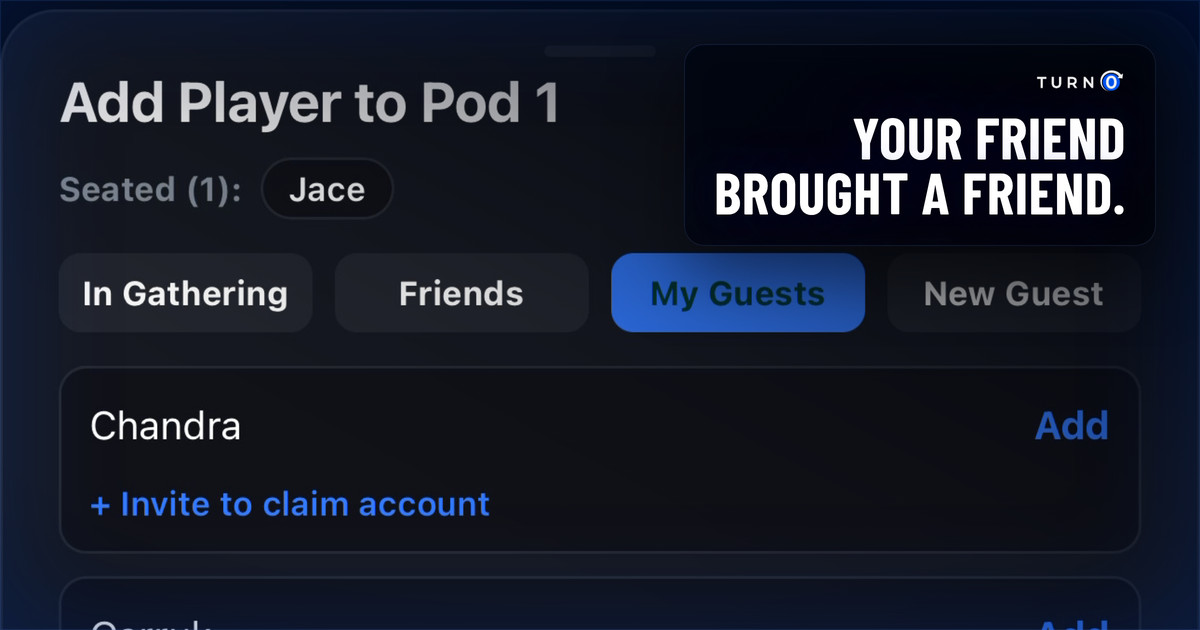
That is what TurnZero HQ is built for. Tracking games gives a brand-new group the thing it otherwise takes a year to accumulate: a record of who has won what, which decks keep beating which, per-deck ratings inside the pod, and recaps of the games worth remembering. It also solves the practical problem of a group where not everyone owns four decks, because the history is attached to the pod rather than to one person's memory of it.
Frequently Asked Questions
How do I find people to play Commander with near me?
Start with local game stores: most that sell Magic run a weekly Commander night, and turning up with one deck is enough. Check the store's page for the day and time. Then find the local Discord, which is where scheduling actually happens in most cities, and where you can ask what a table plays like before committing your evening. University clubs are worth checking if you have access to one.
Is it awkward to join a Commander night alone?
Less than you expect, because the format needs four players and groups of three looking for a fourth are common. Say that you are new and roughly what your deck is when you sit down, since Commander tables set expectations before playing anyway and you volunteering it is normal rather than apologetic. A precon is a perfectly good deck to arrive with.
What deck should I bring to a new playgroup?
A recent precon, unmodified or lightly upgraded. It is legal, it is balanced against other precons, it sits at a power level most casual tables are comfortable with, and it tells the table exactly what to expect when you name it. Arriving with a heavily tuned deck at an unknown table is the fastest way to have a bad first night.
How many people do you need for a Commander playgroup?
Four is the classic pod, but three plays well and is a much more resilient group, because a four-person group where one person is busy plays nothing. Groups that treat three as a real game rather than a cancelled one survive far longer. Five or six also works, though games run long enough that most pods split into two tables at that point.
How do you keep a playgroup together?
Regularity and low friction. A fixed day, a group chat, someone willing to lend a deck, and an early conversation about what kind of games the group wants. The groups that dissolve usually do so because scheduling became work, or because power levels drifted apart without anyone saying so until it was awkward.
Give a new playgroup a history from week one.
Track games, decks and results for your pod, and let the rivalries build themselves.
Create Free Account