Commander Glossary
Two-Headed Giant in Commander: The Rules
Two-Headed Giant (2HG) is a team variant where two players share one life total and win or lose together, most commonly adapted to Commander at 30 starting life per side. It changes life and turn order but not everything else: Commander damage is still tracked per individual player, not per team, and there's no official Wizards ruling for 2HG specifically in Commander, so groups vary on the exact life total.
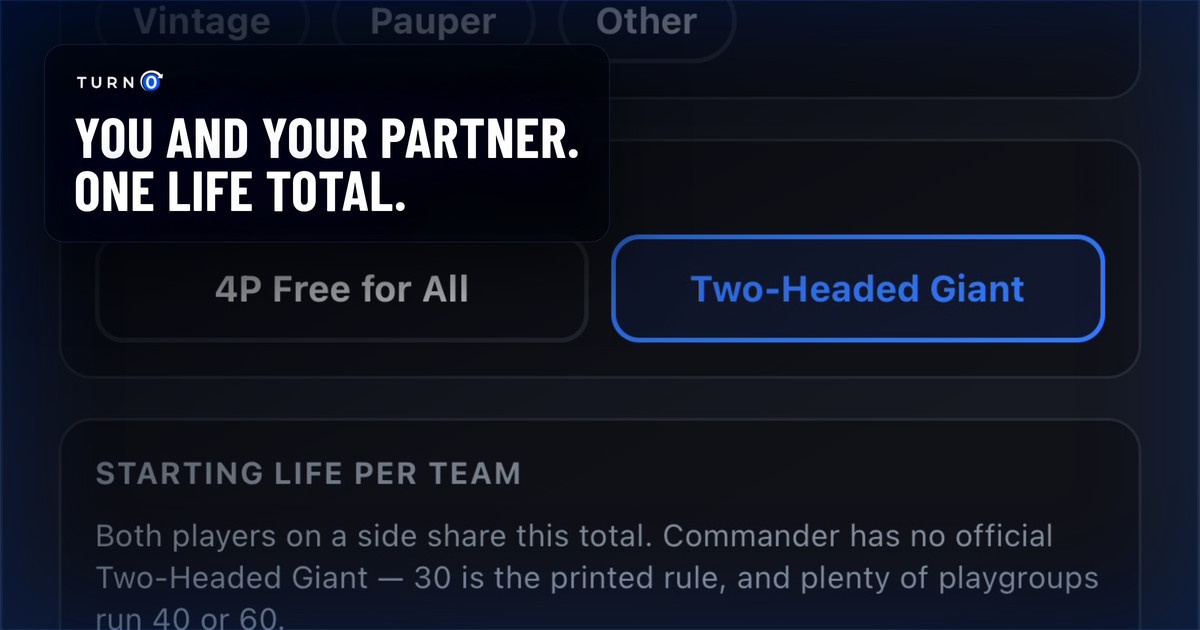
What Two-Headed Giant is
Two-Headed Giant pairs two players into one team that shares a single life total. Win or lose, they do it together, and the format is real: Wizards has published dedicated 2HG products over the years, and it's a standard team format at events like MagicFest. It's not a house rule someone invented at a kitchen table.
What makes it distinct from a normal multiplayer pod is the shared pool. In a four-player free-for-all, four life totals mean four separate games converging on one table. In 2HG, two of those four seats are collapsed into one number, so an attack on either teammate is really an attack on the team. Teammates traditionally sit next to each other at the table, both so they can coordinate combat and blocks in the moment and because seat position turns out to matter for turn order, which is the part covered below.
Commander has no official Two-Headed Giant rules of its own. Everything here is the standard 2HG variant, adapted to a Commander table by two players agreeing to bring Commander decks instead of the sixty-card decks the format was originally built around. That adaptation is common and works fine, but it also means a couple of things (starting life, chiefly) are left for your pod to decide rather than settled by a rulebook.
Starting life: 30, 40, or 60
This is the one unsettled question. Standard 2HG's printed rule is 30 life per team; Commander's normal life total is 40 per player. Adapting one format to the other means picking one, and there's no official ruling that tells you which.
30 is the most defensible default, because it's the actual printed rule for the Two-Headed Giant variant rather than a number borrowed from a different format. It also keeps games from dragging: a team fielding two full Commander boards behind 40 shared life effectively has half the life pool of an ordinary four-player pod for double the board presence on defense, which tends to stretch games out well past what a normal Commander night runs.
Whichever number you pick, agree on it before shuffling up rather than mid-game. This is exactly the kind of thing the Rule 0 conversation → exists to settle, and it takes one sentence: "we're doing 2HG tonight, are we using 30 or 40 life per team?"
How turns actually work
This is the rule newcomers get most wrong. Turns don't go around the table player by player. Each team takes one shared turn, with both teammates playing in it, and then the turn passes to the other team.
It's tempting to assume 2HG just means "four-player Commander, but two of the seats share a life total," with turns still going around the table one player at a time. That's not how it works. The official Two-Headed Giant rules (rule 810 of the Comprehensive Rules) use shared team turns: each team takes turns rather than each player, both teammates draw in the team's draw step, and each of them may play a land that turn.
A full turn cycle, seat by seat
Seating goes around the table as Team A - Player 1, Team A - Player 2, Team B - Player 1, Team B - Player 2, because teammates sit next to each other.
Team A takes one shared turn. A1 and A2 untap together, and each of them draws a card in the team's draw step (the team that goes first skips that draw on its first turn).
Both A1 and A2 may play a land and cast spells during that turn, and in combat they attack Team B together as one attacking team.
Priority belongs to teams, so B1 or B2 can respond at instant speed the whole way through, and the two of them block together as one defending team.
Then the turn passes to Team B, and B1 and B2 take their shared turn the same way. A full cycle at the table is two turns, not four.
As a result, a four-player 2HG table goes through two turns per cycle, not four, and two players act in each one. Priority belongs to teams rather than individual players, so the opposing team can still respond at instant speed the entire time. What changes is that both members of a team play at once, not who gets to react.
Turns alternate player-by-player around the table, just like a normal four-player pod.
Each team takes one shared turn. A1 and A2 untap, draw, play lands, cast spells and attack together, then B1 and B2 do the same. A full cycle is two turns, not A1, A2, B1, B2 one at a time.
Commander damage is not shared
Life is a team resource in 2HG. Commander damage is not. The 21-damage commander damage rule is still tracked per individual player, exactly as in a normal Commander game, and it doesn't stack across a team.
This is the single most common point of confusion at a 2HG table, because it's easy to assume that once life totals merge, everything about a team merges with it. It doesn't. A commander still needs to deal 21 or more combined combat damage to one specific player to kill that player outright through the commander damage rule, exactly the same threshold and the same tracking as in a normal game →.
Concretely: if your commander has dealt 15 combat damage to one opponent and 10 to their teammate, neither player has taken lethal commander damage. The 21 doesn't stack across the team just because the two players share a life total. You'd need to land 21 or more against the same individual player before that player is out on commander damage, regardless of what their teammate has taken.
Everything else about tracking commander damage carries over unchanged. It's still tracked per attacking commander, per defending player, and it still stacks up across turns rather than needing to happen in one hit. See How to Track Commander Damage → for the mechanics of keeping that grid straight, which only gets harder in 2HG since you're now watching two players' individual totals on top of one shared life number.
How a side loses
A team loses when its shared life total hits zero. Because both heads draw from the same pool, life loss is inherently a team event: damage to either player subtracts from the same number, and once that number is gone, both players on that side lose together.
Every other loss condition takes out the whole team as well. Under the official Two-Headed Giant rules, players win and lose only as a team, so if one player draws from an empty library, that player's team loses the game. Poison counters are shared by the team, and the threshold is fifteen on the team rather than ten. Commander damage follows the same rule once you combine the two variants: a player who takes 21 from one commander loses, and their team loses with them.
Building a 2HG deck
This is a rules page rather than a strategy guide, so this section stays brief. Shared life changes priorities more than it changes deckbuilding requirements.
Aggressive decks get stronger in 2HG, because they only need to punch through one shared pool instead of racing two separate opponents' life totals. A team splitting attackers between two boards can put more pressure on one number than either half could alone. Board wipes swing the other way: they hit twice as hard relative to what's actually been invested, since a single wrath answers two players' worth of board development at once rather than one.
Neither of those is a reason to build differently for 2HG specifically. It's a reason to expect faster games and swingier wipes than an ordinary four-player pod, and to plan your Rule 0 conversation accordingly.
Running 2HG at your table
Any two Commander decks can sit down and play 2HG with no special deckbuilding required. There's no partner-only mechanic and no format-specific card pool to worry about; it's the same decks you already have, played under a different set of turn and life rules. What it does need is a quick conversation up front: which starting life total, and whether both teams understand how turn order actually works before turn one.
Not agreeing on starting life before the game. 30, 40, and 60 all see real use, and there's no ruling to fall back on when a table disagrees mid-game.
Assuming turns alternate player-by-player. They don't. Say the turn order out loud before the first turn so both teammates know they play together in one shared turn.
Forgetting commander damage still needs 21 against one player. Splitting hits across a team's two players doesn't add up to a kill.
For the rest of the logistics, from picking pods to running a smooth night generally, see Hosting a Commander Night →.
Frequently Asked Questions
What is Two-Headed Giant in Commander?
Two-Headed Giant (2HG) is a team variant where players pair up two-on-two, and each team shares one life total instead of everyone tracking their own. A team wins or loses together: if the shared life total hits zero, both players on that side lose. It's a real, printed Magic variant, not a house rule, and it's commonly adapted to Commander decks even though Commander has no official 2HG rules of its own.
How much starting life does 2HG use?
Standard Two-Headed Giant's printed rule is 30 life per team. There's no official Wizards ruling for playing 2HG specifically with Commander decks, so groups vary: some keep 30, some use 40 (Commander's normal life total), and some split the difference at 60. 30 is the most defensible default since it's the actual printed rule for the variant, but agree on a number before you shuffle up.
Is Commander damage shared between teammates?
No. Life is a shared team resource, but the 21-damage commander damage rule is still tracked per individual player, exactly like a normal game. A commander needs to deal 21 combined damage to one specific player to kill them outright; it doesn't add up across both members of a team. If your commander has hit one opponent for 15 and their teammate for 10, neither has taken lethal commander damage, because those two numbers never combine.
How does turn order work in 2HG?
Each team takes one shared turn, and both teammates play during it. They untap together, each draws a card in the team's draw step, each may play a land, and they attack the other team together as one attacking team. Then the turn passes to the other team, so a full cycle at the table is two turns, not four. Priority belongs to teams, so the opposing team can respond at instant speed throughout. This is the rule newcomers get wrong most often, since it's tempting to keep passing the turn one player at a time.
Can any two Commander decks play 2HG, or do you need to build for it?
Any two decks can sit down and play 2HG with zero deckbuilding changes. Shared life does change which strategies are strongest, though: aggressive decks get better since they only need to punch through one pool instead of two separate ones, and board wipes hit twice as hard relative to the two players' combined investment in the board.
Does a team lose if only one player would lose?
Yes. Under the official Two-Headed Giant rules, players win and lose only as a team, so if either player loses the game, for example by drawing from an empty library, the whole team loses. A team also loses when its shared life total reaches zero, and poison counters are shared, with fifteen on the team as the threshold. Commander damage works the same way once you combine the two variants: a player who takes 21 from one commander loses, and their team loses with them.
Track shared life and per-player commander damage without doing the math yourself.
TurnZero HQ supports Two-Headed Giant as a real pod type: shared life totals per team, commander damage still tracked per individual player, turns handled correctly for both heads.
Create Free Account