2026 Comparison
Best MTG Collection Tracker Apps
Our pick is TurnZero HQ's My Library, because it is a real inventory and also tracks what the cards did once they were in a deck, per version of that deck. For a dedicated tracker instead, ManaBox is the best free all-rounder, Delver Lens is the fastest way to enter a big collection, Dragon Shield reads cards through sleeves, Moxfield and Archidekt are the picks if the collection exists to feed your decklists, and Deckbox still owns trading and want lists. Most players still end up running two tools, just for a different reason than they used to.
Our pick
TurnZero HQ
Our pick: the collection tracker that also knows what the cards did
My Library rolls every card TurnZero HQ has evidence you own into one inventory: total cards, distinct cards, and total value, split out by how each copy got there — sitting in a deck, scanned in from a pile, or logged by hand for the ones in no deck at all. Add cards by searching the full card catalog or by pointing the camera at a stack, sort them into folders that each carry their own count and value, and prices sync from a nightly catalog import so the value is never more than a day stale. The value is charted over time across 1M to All, with the biggest 30-day movers in the collection listed under it. That is a genuine inventory, not a side effect of deckbuilding. What it does that nothing else on this page does: every deck edit snapshots a version, every game is tagged with the version that was actually on the table, and win rate and deck MMR split per version, so cutting eight cards produces an answer instead of an impression. Track the pile and what it has actually won in the same account.
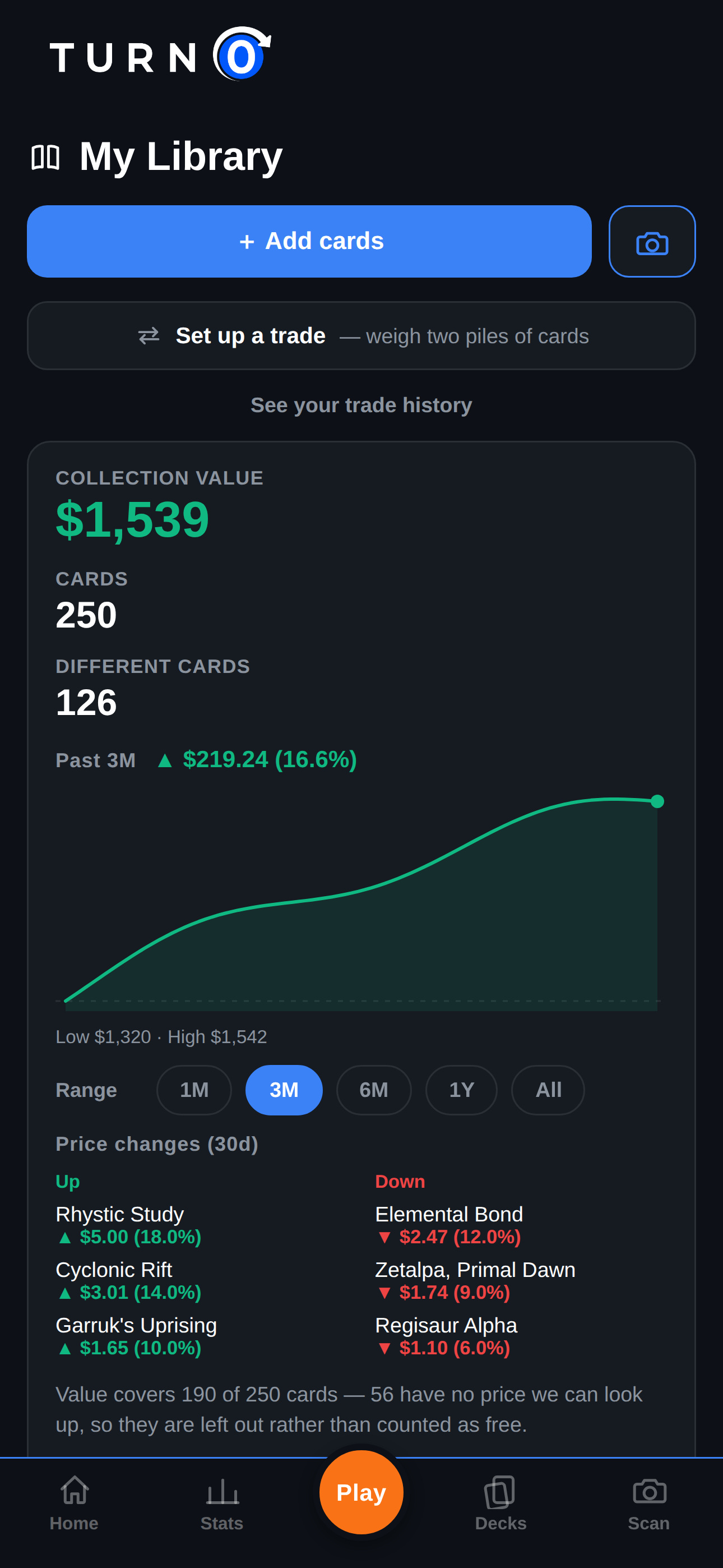
Collection value charted over time, with the past month's biggest movers under it
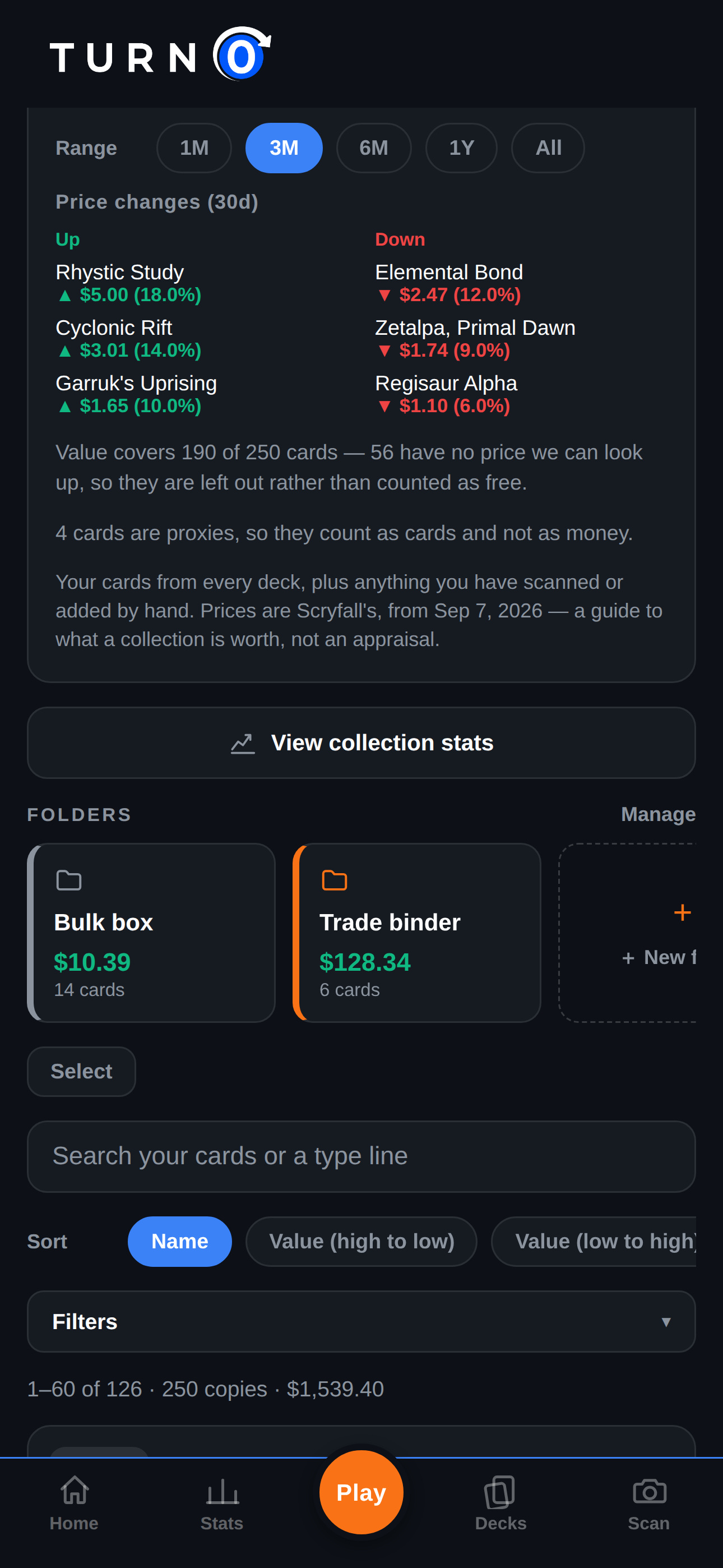
Folders group the pile however you file it, each with its own count and value
ManaBox
Best all-round free tracker with scanning built in
ManaBox is the default recommendation for most players, and deservedly so. It scans cards with the phone camera, sorts them into binders and lists, pulls live prices from TCGplayer and Cardmarket, and runs on iOS, Android and the web off one account. The free tier covers scanning and collection tracking; a paid subscription lifts limits on things like saved decks. Scanning works best against a plain light background, which is worth knowing before you sit down with a shoebox.
Delver Lens
Best for scanning a large collection quickly
If you have thousands of cards to enter and the entering is the whole problem, this is the one. Delver Lens started as an Android scanner and built its reputation on raw speed, batching scans and coping with cards held at an angle. It handles reprints well because you can lock it to a set, which matters more than it sounds when a card has fifteen printings at fifteen prices. It exports to Deckbox, Archidekt and CardSphere, so it works as the input stage for a collection you keep somewhere else.
Dragon Shield
Best for scanning cards you are not going to unsleeve
Free, made by the sleeve company, and built around a problem the others mostly ignore: reading cards through sleeves and binder pages. If your collection is already sleeved and filed, being able to scan a binder page without stripping it is the difference between a weekend project and never doing it. It also does AR translation of foreign-language cards, which is a genuinely useful trick if you buy from overseas sellers.
Moxfield
Best if your collection should live next to your decklists
Moxfield is a deckbuilder first, but its collection side has become good enough that plenty of players use nothing else. The advantage is not the tracking itself, it is that the collection and the decks are the same account: cards you own are flagged while you build, so the gap between a list and a buildable list is visible without exporting anything. No camera scanning, so entry is by search or bulk paste.
Archidekt
Best for answering "what can I build with what I own?"
Archidekt's collection tracking is the most tightly wired into its deckbuilder of any tool here. Owned cards are highlighted as you build, and you can filter a build down to only what is already in your boxes, which turns a collection from an inventory into a shortlist. Prices come from TCGplayer, Card Kingdom, Cardmarket and Cardhoarder, so the shopping list at the end is costed in whichever market you actually buy in.
Deckbox
Best for trading, want lists and inventory discipline
Deckbox has been running since 2008 and nothing has really displaced it for trading. Inventory, tradelist and wishlist are three separate things, it matches you against other users who have what you want, and it tracks sent and received cards with a feedback system on top. Filtering by edition, condition, language and foil is exact rather than approximate. The interface is its age, but if you trade by mail or at an LGS, the tooling is still the best available.
TCGplayer app
Best if you buy and sell in the same place you track
The TCGplayer app scans cards into a collection that is priced against the marketplace those prices come from, which removes a step if buying and selling is the point of tracking for you. It is the least neutral option on this list by design, since it is a storefront with a collection feature attached rather than the other way round. For a player whose collection is mostly a trading position, that alignment is the feature.
How to Actually Choose
Start with why you want the collection in a database at all, because the honest answers point at different apps. If it is to stop buying cards you already own, Archidekt or Moxfield solve it for free and you never leave the deckbuilder. If it is to know what the collection is worth, or to trade, you want a dedicated tracker: ManaBox for a phone-first collection, Deckbox if the point is trading. If it is simply that ten thousand cards need to become a list before any of the rest is possible, pick on scanning speed alone and export afterwards, which is what Delver Lens is for. If the honest answer is "both — I want to know what I own and whether the deck I built with it is actually working," that is the case TurnZero HQ's My Library is built for, since it is the one inventory here that shares an account with deck version history and results.
The other question worth asking first is whether your cards are sleeved. It sounds trivial and it is the single biggest predictor of whether a cataloguing project ever finishes. Unsleeving and resleeving a few thousand cards to scan them is the kind of task that gets abandoned halfway, which is why Dragon Shield's through-the-sleeve scanning matters more than its feature list suggests. Some players still end up using two tools: a dedicated tracker for trading or foil-by-foil pricing detail, and TurnZero HQ for the deck they actually build out of the pile. That is a reasonable outcome, not a failure to choose.
What Most Trackers Still Can't Tell You
Most of the apps on this list stop at the inventory. They know what you own, roughly what it is worth, and which of it is currently sitting in a deck. What they don't know is whether the deck is any good, because none of them were at the table. That is a real gap for Commander specifically, where a deck is rarely finished and most players are cutting and adding cards month after month on the strength of a feeling about how the last few games went.
TurnZero HQ closes that gap without leaving the inventory. Every deck edit snapshots a version, every game is tagged with the version that was actually on the table, and results split per version, so swapping eight cards produces an answer instead of an impression. Rate My Deck gives a bracket read on the list itself before a game is played, and deck MMR tracks results globally and inside your own playgroup. It's the same account that already knows what you own — nothing to export, nothing to keep in sync by hand.
Frequently Asked Questions
What is the best free MTG collection tracker app?
ManaBox is the usual answer as of 2026 and a strong start for the inventory itself: free camera scanning, binders and lists, live prices from TCGplayer and Cardmarket, and it runs on iOS, Android and the web off the same account. Our own pick is TurnZero HQ's My Library, also free — it scans or searches cards into a real inventory with folders and total value, and it is the only one here that also tracks what those cards did in a deck, game by game. Dragon Shield's app is free too and is the better pick if your cards are already sleeved, since it reads them through sleeves and binder pages. Delver Lens is free to download and is the fastest option for entering a large collection. Tiers and prices move, so check the current terms before subscribing to anything.
What is the fastest way to scan a whole MTG collection?
Use a dedicated scanner rather than a deckbuilder, work in set-locked batches, and scan against a plain, evenly lit background. Delver Lens and ManaBox are both built for volume; Dragon Shield's app is the one to use if you would otherwise have to unsleeve everything first. Most people find bulk commons are not worth the time at all, and scan only cards above roughly a dollar plus anything they might build with.
Can I track my collection and build decks in the same app?
Yes. Moxfield and Archidekt both do collection tracking inside the deckbuilder, which is the main reason to choose them over a dedicated tracker: cards you own are highlighted while you build, and Archidekt can filter a build down to only what you already have. The tradeoff is card entry, since neither has camera scanning, so you either type, paste, or scan elsewhere and import.
Does TurnZero HQ track my card collection?
Yes, through My Library. Cards get in by scanning a pile with the camera or by searching the catalog, and each one is tracked as a deck copy, a scanned copy, or a loose copy logged by hand, so the total reflects what you actually own rather than only what is in an active deck. Folders group cards however you like, each showing what is filed under it and what that is worth, and pricing syncs nightly so the total value stays current and is charted over time. It does not do trading or want lists the way Deckbox does, so a dedicated tracker is still worth running if that's your main use case — but for most players, the reason to also use TurnZero HQ is the other half nothing else here offers: per-version deck history, win rates and deck MMR from games you actually played.
Is a collection tracker worth it if I only play Commander?
It depends on whether you are solving for building or for value. If you want to know what you can build without buying anything, Archidekt or Moxfield answer that directly and cost nothing. If you mostly want to know what the pile in the closet is worth, or you trade, a dedicated tracker like ManaBox or Deckbox is the better fit. Singleton decks make the first question sharper than in other formats, since one copy of a card is all any deck needs.
Track the cards. Then track what they did.
Scan a pile into My Library in seconds, then see how each version of the deck you built from it actually performs at the table.
Create Free Account