Draft & Limited
What to Do at an MTG Prerelease
A prerelease is a sealed event held the week before a new set comes out: you open a kit of six packs, build a 40-card deck on the spot, and play a few rounds against people who are seeing the cards for the first time too. Here is what to bring, how the day runs, and what to do at each step, with a phone-sized checklist to take with you.
Download the prerelease handouts
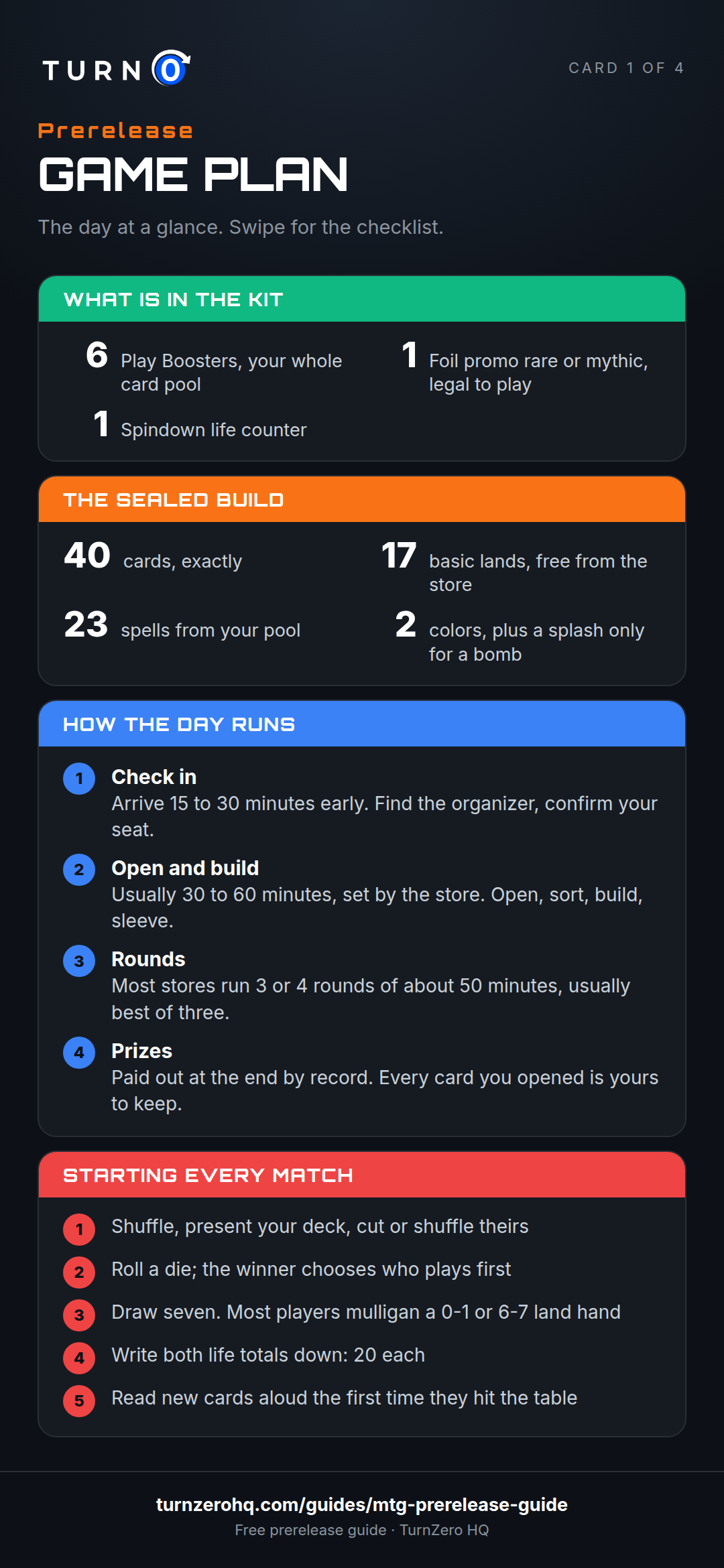
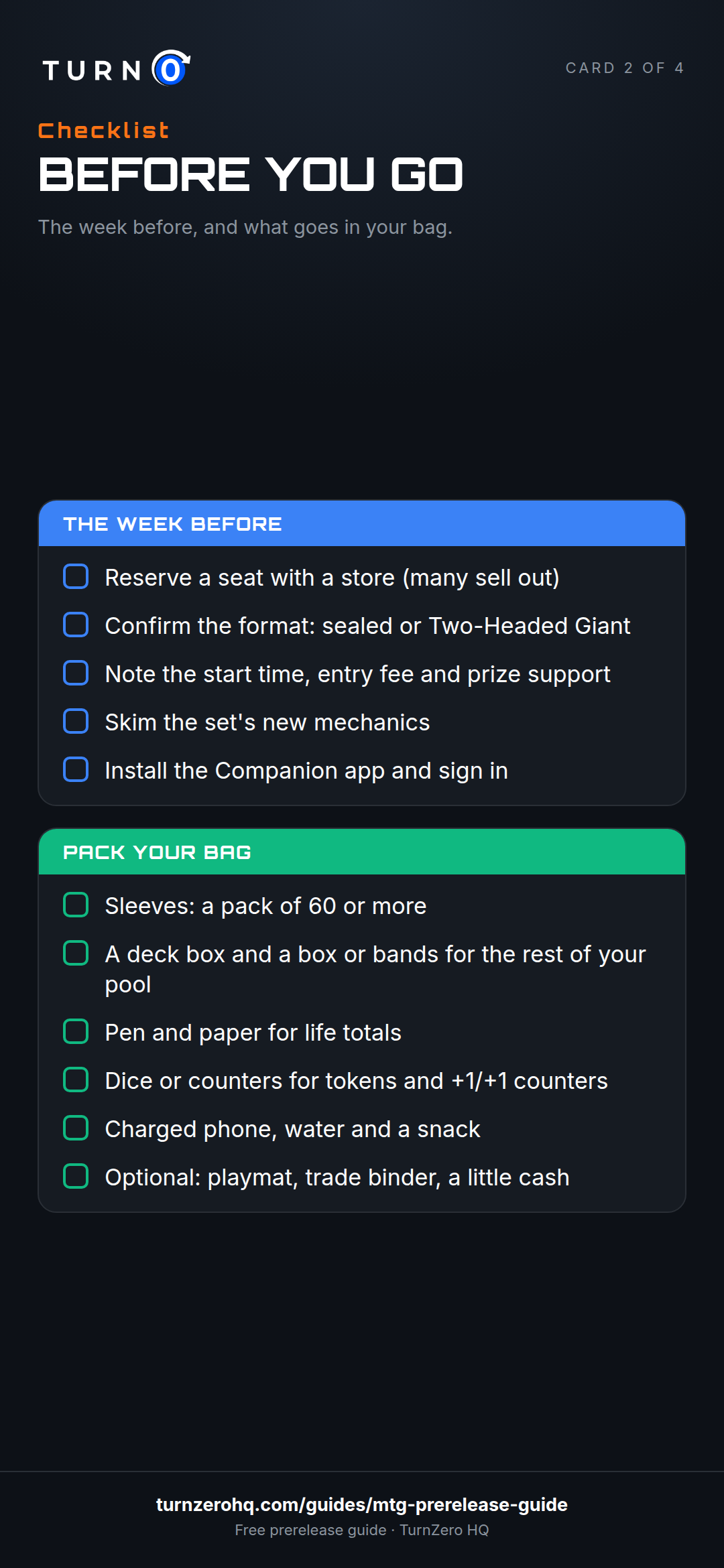
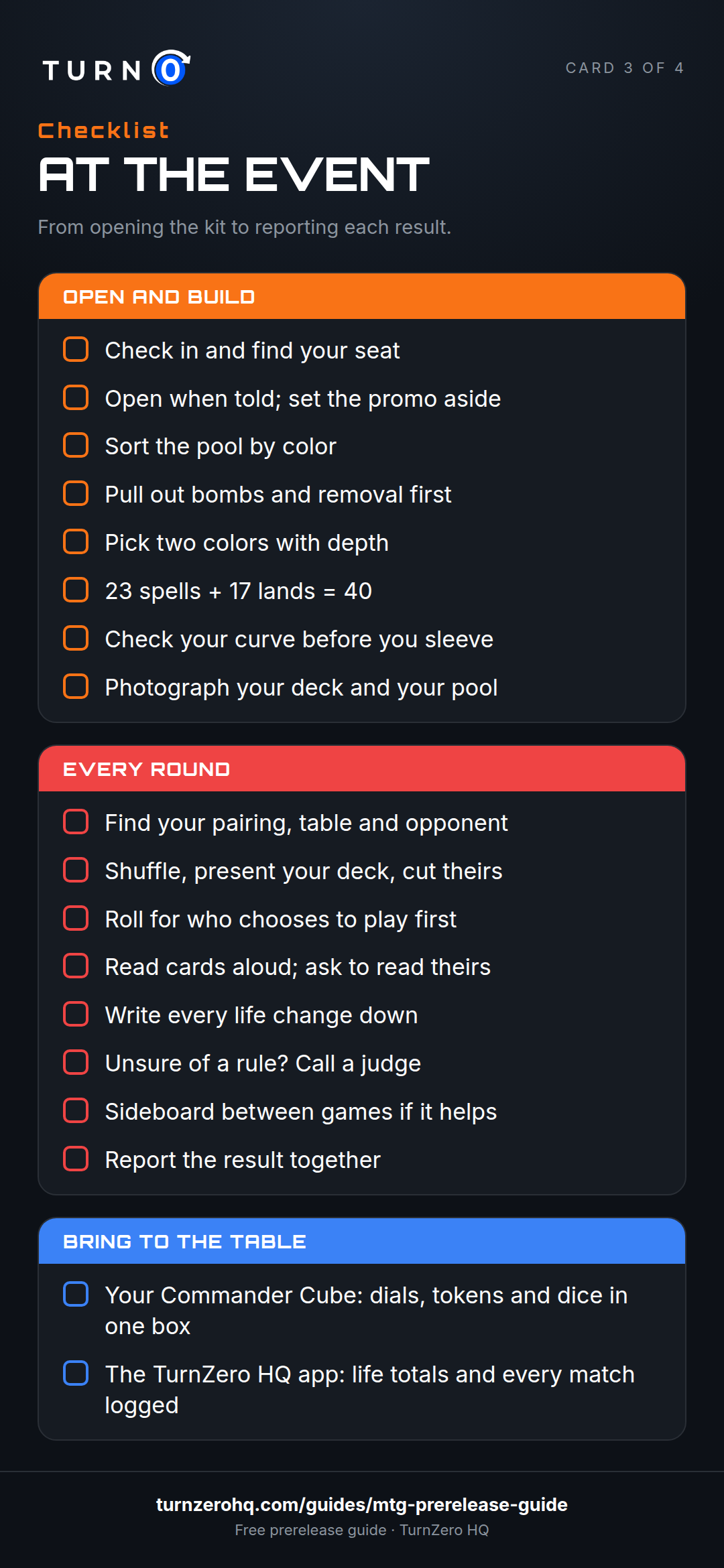
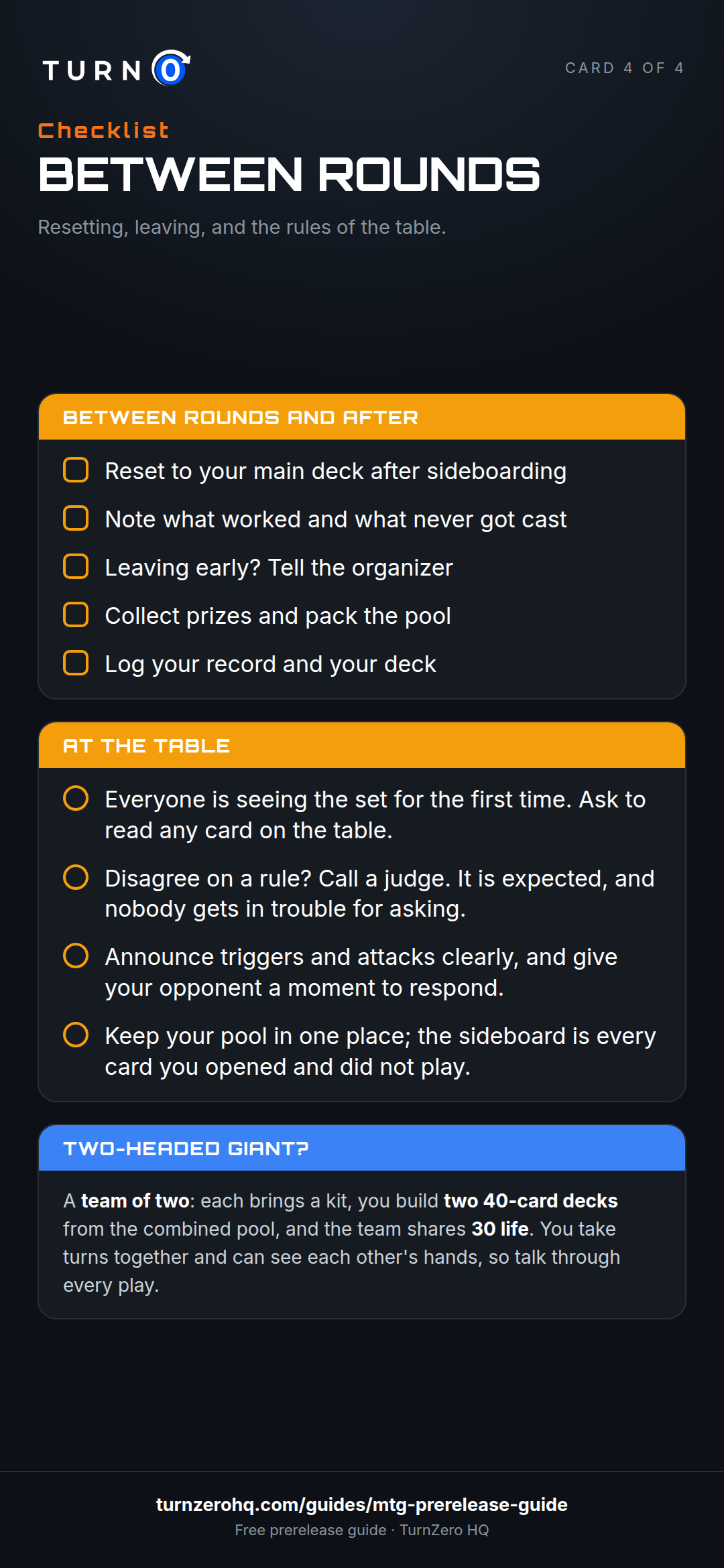
Four phone-sized cards, made to be read at the table: the game plan for the day, then the checklist from this article split into before you go, at the event, and between rounds. Save them to your camera roll one at a time, or grab all four as a single PDF. Free, no email required.
What a Prerelease Is
A prerelease is a store event held in the week before a Magic set goes on general sale. Everyone gets the same kit, opens it at the table, builds a sealed deck from what is inside, and plays a few rounds. It is the first chance anyone has to play with the new cards, which makes it the one event where nobody has an information advantage: the player across from you is reading their cards as carefully as you are.
Prereleases run at the most relaxed level of rules enforcement, and most stores treat them as a social event first and a tournament second. If you have played a game of Magic before, you know enough to go.
The Week Before
Most of the work of a good prerelease happens before you arrive, and none of it is studying. It is making sure you have a seat, know which event you are in, and know when to show up.
Reserve a seat. Most stores take registration in person, on their own site, or through the Magic: The Gathering Companion app, and popular time slots sell out, so do not assume you can walk in.
Check which event you signed up for. Most prereleases are one-player sealed, but many stores also run Two-Headed Giant flights where you build and play as a team of two.
Note the start time, the entry fee and what the prizes are. All three are set by the store, and the start time is usually when building begins, not when the doors open.
Skim the set's mechanics. You do not need to memorize a card list, but knowing what the new keywords do saves you the most time during the build.
Install the Magic: The Gathering Companion app and sign in, if your store uses it for pairings. It saves hunting for your name on a printed sheet every round.
What to Bring to a Prerelease
You do not bring cards. The kit is your entire card pool and the store supplies basic lands, so everything in your bag is there to protect, store and keep track of the cards you are about to open.
Sleeves, at least 60. The deck is 40 cards, and you want spares so a sideboard card can come in between games without an unsleeved card giving itself away.
A deck box for the deck, plus a spare box or a few rubber bands for the 40-odd cards you do not play. That pile is your sideboard, and it needs to stay together.
A pen and paper for life totals. The spindown in the kit works, but a written running total settles any disagreement about what the life total is and how it got there.
A handful of dice or counters for tokens and +1/+1 counters, which the kit's single spindown will not cover.
A charged phone, water and something to eat. A prerelease runs most of an afternoon, and the break between rounds may be too short to leave the store.
Optional: a playmat, a trade binder if you trade, and a little money for extra packs or a store snack.
Opening and Building
The standard prerelease kit is six Play Boosters, a foil promo rare or mythic, and a spindown life counter. Some sets add extras. The build period that follows is usually 30 to 60 minutes, and it goes faster than you expect, so work in order rather than admiring the rares.
Check in with the organizer as soon as you arrive, even if you prepaid, so you are in the event before pairings are made.
Open your kit when the organizer says to, and set the foil promo aside where you will not lose it. It is part of your pool and legal to play.
Sort everything by color, with multicolor, artifacts and lands in their own piles. You cannot see a deck in an unsorted stack of cards.
Pull out every bomb and every removal spell, whatever the color, and let those two piles tell you which colors to look at first.
Pick the two colors with the best mix of bombs, removal and enough playables to fill half a deck each. A third color is a splash for one or two cards, never a plan.
Count to exactly 23 spells and 17 basic lands, which the store supplies. Play 40, not 41: every card over the minimum makes your best card less likely to show up.
Lay the deck out by mana cost before you sleeve it. You want plays on turns two and three, not a pile of six-drops.
Take a photo of the deck laid out, and of the sideboard. Between rounds it tells you exactly what to put back after sideboarding, and afterward it is the record of what you built.
That is the short version. The full method, including when a third color is worth it and why sealed rewards a slower deck than draft does, is in the sealed deck guide.
Playing Your Rounds
Most stores run three or four rounds of about 50 minutes, usually best of three games. Pairings go up at the start of each round, often in the Companion app, and you play whoever you are paired against. The routine is the same every round.
Find your pairing, sit at the right table and introduce yourself. Most opponents at a prerelease are there for the same reason you are.
Shuffle thoroughly, present your deck to your opponent to shuffle or cut, and do the same for theirs.
Roll a die. The winner chooses who plays first, and in Limited that is usually the right call unless your deck is built to go long.
Read new cards aloud the first time you cast them, and ask to read theirs. Nobody has seen these cards before, so this is normal, not a sign of inexperience.
Write down every life change as it happens, both yours and your opponent's.
If the two of you disagree about how something works, raise your hand and call for a judge. Asking is expected, and it is always better than guessing.
Between games you may swap cards in from your pool. Use it when you saw something specific, such as flyers you cannot block, not just because you can.
Report the result the way the store asks, in the app or on a slip, and check that the score is right before you leave the table.
Calling a judge is the part new players are most nervous about, and it should not be. At a prerelease the judge is usually a store employee or a volunteer, the call is a question rather than an accusation, and the answer gets the game back on track faster than an argument does.
If You Are in a Two-Headed Giant Flight
Many stores run at least one Two-Headed Giant event during prerelease week. You play as a team of two: each of you brings a kit, you build two 40-card decks from the combined pool, and the team shares one life total of 30. Teammates take their turns at the same time and can see each other's hands, so talking through every play is part of the format rather than a breach of it.
Everything else on this page still applies. The difference in the build is that the two decks should not compete for the same colors, so split the pool by color first and decide who gets which pair before anyone starts counting playables.
How Two-Headed Giant works in Commander →Between Rounds and After
The breaks between rounds are short, and they are where a prerelease deck gets better. Use them to reset, eat something, and write down what you learned while it is still fresh.
Reset any sideboard swaps before the next round, using the photo from the build.
Jot down what won you games and which card you never wanted to draw. Those are your first swaps if you have a moment.
If you have to leave, tell the organizer you are dropping before the next round is paired, so nobody is left waiting for an opponent who went home.
Collect any prizes, and pack the whole pool together. Everything you opened is yours to keep.
Log the record and the deck while you still remember it. A prerelease deck exists for one day, so what you write down is the only part that survives.
Prizes are set by the store and usually paid in packs by record at the end of the event. Everything you opened is yours whether you go 4-0 or 0-4, so the entry fee is mostly the price of the kit and the afternoon is the bonus.
Common Prerelease Mistakes
Showing up at the start time. The listed time is usually when building starts, and a late check-in can mean missing the first round's pairings.
Building around the promo because it is the promo. It is one rare in a pool of about 84 cards; if its color is the shallowest in your pool, it goes in the sideboard.
Bringing exactly 40 sleeves. The first time you want to side a card in, you have nothing to put it in.
Letting the pool scatter. Your sideboard is every card you opened and did not play, and it only helps you if it is still in one pile when game two starts.
Guessing at a rule instead of calling a judge. Two players agreeing on a wrong ruling is how games get decided by accident, and nobody is penalized for asking.
Leaving without telling the organizer. You get paired anyway, and someone spends a round waiting at an empty seat.
Frequently Asked Questions
What should I bring to an MTG prerelease?
Sleeves (at least 60, so sideboard cards can be sleeved too), a deck box, something to hold the rest of your pool, a pen and paper for life totals, a few dice or counters for tokens, a charged phone, and water and a snack. You do not need to bring cards or lands: the kit is your card pool and the store supplies basic lands.
What comes in a prerelease kit?
The standard kit is six Play Boosters, one foil promo rare or mythic, and a spindown life counter. Some sets add extras, so check the set's product page if it matters to you. Everything in the kit is yours to keep, and the promo is legal to play in your deck.
How long does a prerelease take?
Plan for most of an afternoon, roughly four to five hours. Building usually takes 30 to 60 minutes, and most stores run three or four rounds of about 50 minutes each. The store sets all of this, so ask when you register if you have somewhere to be.
Do I need to know the cards before a prerelease?
No. Nobody in the room has played with the set before, which is the reason a prerelease is the friendliest event most stores run. Skimming the set's new mechanics beforehand saves you time during the build, and reading cards aloud at the table is normal for everyone.
Is a prerelease good for beginners?
It is the best first event there is. The format is sealed, so there is no pick order to learn, everyone is seeing the cards for the first time, and prereleases run at the most relaxed level of rules enforcement. If you know how to play a game of Magic, you know enough.
Can I leave a prerelease early?
Yes. Tell the organizer you are dropping before the next round is paired, so nobody is left waiting at an empty seat. You keep everything you opened, and any prizes you have already earned.
What is a Two-Headed Giant prerelease?
A team version of the event. You and a partner each bring a kit, build two 40-card decks from the combined pool, and play against another team with one shared life total of 30. Teammates take their turns together and can see each other's hands. Not every store runs one, so check when you register.
One kit, one deck, one afternoon. Keep the record.
Log your prerelease matches alongside your Commander, draft and Standard games, so the deck you built for a day is still there next week.
Create Free Account