Feature
Deck MMR: An Elo-Style Rating From Real Games
Every deck in TurnZero HQ earns its own Elo-style MMR, built entirely from its actual wins and losses at the table, not from what's in the decklist. It's tracked both globally and scoped to your own playgroup, and split by deck version, so a rebuilt list gets a clean slate to prove itself against rather than inheriting an old version's record.
The problem it solves
Every long-running playgroup has some version of the argument over which deck is actually the strongest at the table. Without data, it's just vibes and selective memory of one big win, and the deck somebody's been losing with for months still gets talked about like a menace because of the one game it broke open.
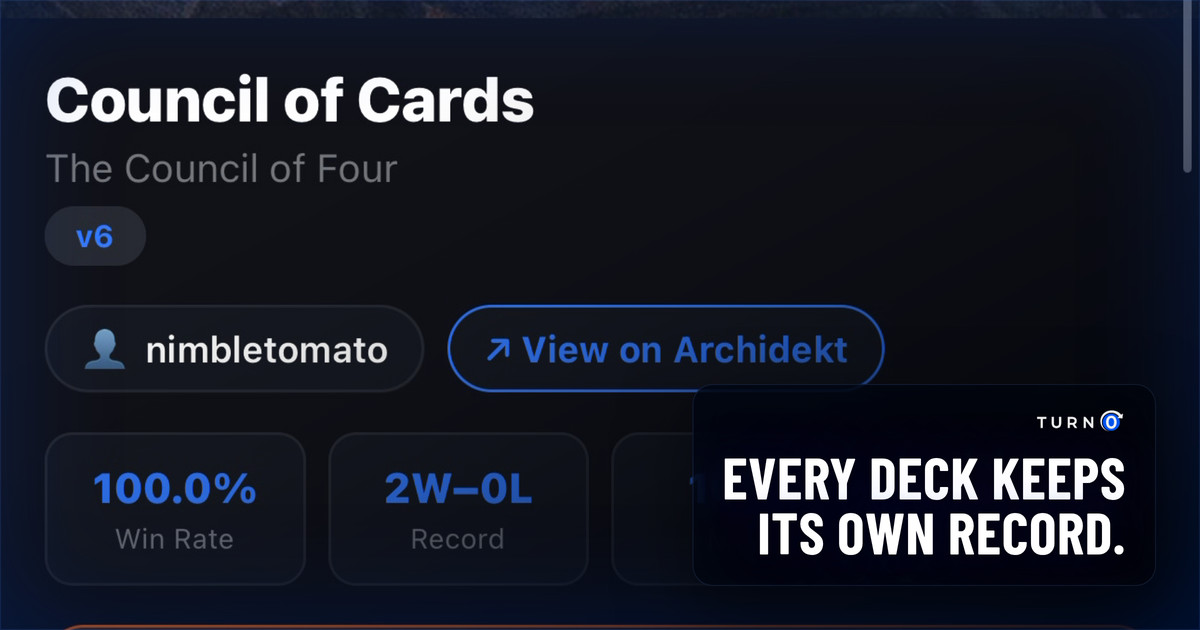
Deck MMR settles that with an actual record instead of an anecdote: a number built entirely from what a deck has actually done in real games, updated every time it plays one.
How it works
Under the hood it's an Elo-style rating extended for multiplayer games, so a four-player pod's result still moves every deck's number sensibly rather than treating the game as a single win/loss pair. A few things about how TurnZero HQ applies it are worth knowing:
Two scopes, reported separately: a global rating across the wider TurnZero HQ population, and a rating scoped to just your own playgroup. A deck can carry two different numbers at once, and the playgroup-scoped one is usually the more meaningful answer for "which of my decks is actually good."
Provisional ratings under 10 games: a deck that hasn't played enough yet shows a hedged rating (marked with a "≈" in the app) rather than presenting an early result as a settled one.
A real starting point, not a blank slate: a brand-new deck's rating starts from the power level you declare for it (bracket 1-5), so a deck you call bracket 4 doesn't launch rated the same as one you call bracket 2. The rating still moves from there based entirely on results.
Deck MMR also feeds pre-game win odds: the percent-to-win badges TurnZero HQ shows before a game starts, and the "called it," "upset," or "beat the odds" verdict once it ends. That's its own feature; the rating here is what makes it possible.
Why it's split by version
Editing a deck's list in TurnZero HQ cuts a new version, and MMR is tracked per version rather than as one lifetime number stapled to the deck's name. That matters the moment you actually rebuild something: cut a combo piece, swap the ramp package, retune the curve. A single running record would blend the new list's results into whatever the old one had already earned, which answers nothing about whether the change actually helped.
Split by version, a rebuilt deck starts that version with a clean record and has to prove itself over its own games, so "is this new version actually better" gets a real answer instead of a number smeared across several different decklists that happened to share one name.
Deck MMR vs. Rate My Deck
TurnZero HQ deliberately has two different numbers that can both get called a "deck rating," and they answer different questions. Deck MMR is the play-time number: it's earned strictly from that deck's actual win/loss record at the table over time, and it's what this page is about. Rate My Deck is the separate build-time estimate: it reads the decklist's cards, curve, and combo density and returns a bracket estimate before you've played a single game with it.
Deck MMR: reads the results. Answers "what has this deck actually done at the table?"
Rate My Deck: reads the list. Answers "what should this deck be capable of, on paper?"
A deck can look strong on paper and underperform in games, or the reverse, which is exactly why it's worth having both numbers instead of picking one.
Who this is for
Playgroups arguing about which deck is actually the strongest at the table
Players who own several decks and want an honest answer on which one to bring
Anyone curious whether a deck's reputation matches its actual record
Frequently Asked Questions
What is deck MMR?
An Elo-style rating TurnZero HQ tracks for every deck, built from that deck's actual wins and losses at the table rather than from anything in its decklist. It moves game by game, up after a win and down after a loss, so it converges toward an honest answer for which of your decks actually performs.
Is deck MMR the same as my deck's bracket rating?
No, and TurnZero HQ deliberately keeps the two separate. Deck MMR is a play-time number, earned strictly from real results over time. Rate My Deck's bracket estimate is a build-time read that reads the decklist itself and returns where it lands on the official 1-5 scale before a single game is played. See Deck MMR vs. Rate My Deck below for the full distinction.
Does deck MMR reset if I edit my deck?
Editing a deck's list cuts a new version in TurnZero HQ, and MMR is tracked per version rather than as one lifetime number for the deck's name. So a meaningful rebuild starts that version with a clean record instead of blending its results into whatever the old list had already earned, which is what lets you cleanly answer whether the new version is actually better.
What does a provisional rating mean?
A deck with fewer than roughly 10 games hasn't played enough for its rating to have settled, so TurnZero HQ marks it provisional (shown with a ≈ prefix in the app) rather than presenting an early number as if it were a finished read. Once the deck has enough games under this version, the hedge comes off.
Is deck MMR shared across playgroups or just mine?
Both, reported separately. Every deck carries a global rating, scoped to the wider TurnZero HQ population, and a rating scoped to just your own playgroup. The two can be different numbers for the same deck, and the playgroup-scoped one is usually the more useful answer to “which of my decks is actually good at my table.”
Let your decks' results speak for themselves.
TurnZero HQ tracks an Elo-style MMR for every deck you own, built from real wins and losses, not from what's in the list. Free to start.
Create Free Account