How to use TurnZero HQ
The live game board
A tile per seat, damage dealt by dragging from the source to the target, commander damage on chips carrying the commander's own art, and counters for whatever your table needs counting. Built to be read upside down, across a table, without anyone looking away for long.
Reading the board
Each seat gets a tile, and each tile gets a color and a motif from a fixed set of jewel tones. That sounds cosmetic and is not: four tiles have to be told apart at a glance, by four people, from four different sides of a table, and a name in small text does not survive that. A color does. The seats across the table are rotated a hundred and eighty degrees so they read the right way up to the people sitting there, rather than forcing anyone to read their own life total upside down.
Around the tiles sit the things that describe the game rather than a player: a round counter, the game timer, and a per-player turn clock that runs on whoever is active. Three display preferences live on the device rather than on the game, so "I always play with sound off" is set once and not re-set every week. More on the two clocks →
Dealing damage by dragging it
Damage in Magic always has a direction. Somebody's creature hits somebody else, and the interesting part is who, not the arithmetic. So the board makes that the gesture: drag from a seat to an opponent's tile and an arrow is drawn between them, colored by what is about to happen. Drag to the top or bottom half of your own tile for damage or healing. Drag into the amber circle in the center to hit every opponent at once.
The four-player board wipe is the case that makes the point. On a stepper-based tracker it is six taps spread over four tiles while everyone watches. Here it is one gesture, and the arrow shows the table what was targeted before anything is committed.
For the ordinary case of tapping a total down a few points at a time, a tally chip appears under the number once you have been at it: nine taps on minus one shows a "−9 life" chip until you stop. You can see what the run of taps actually did, rather than trying to remember where the total started.
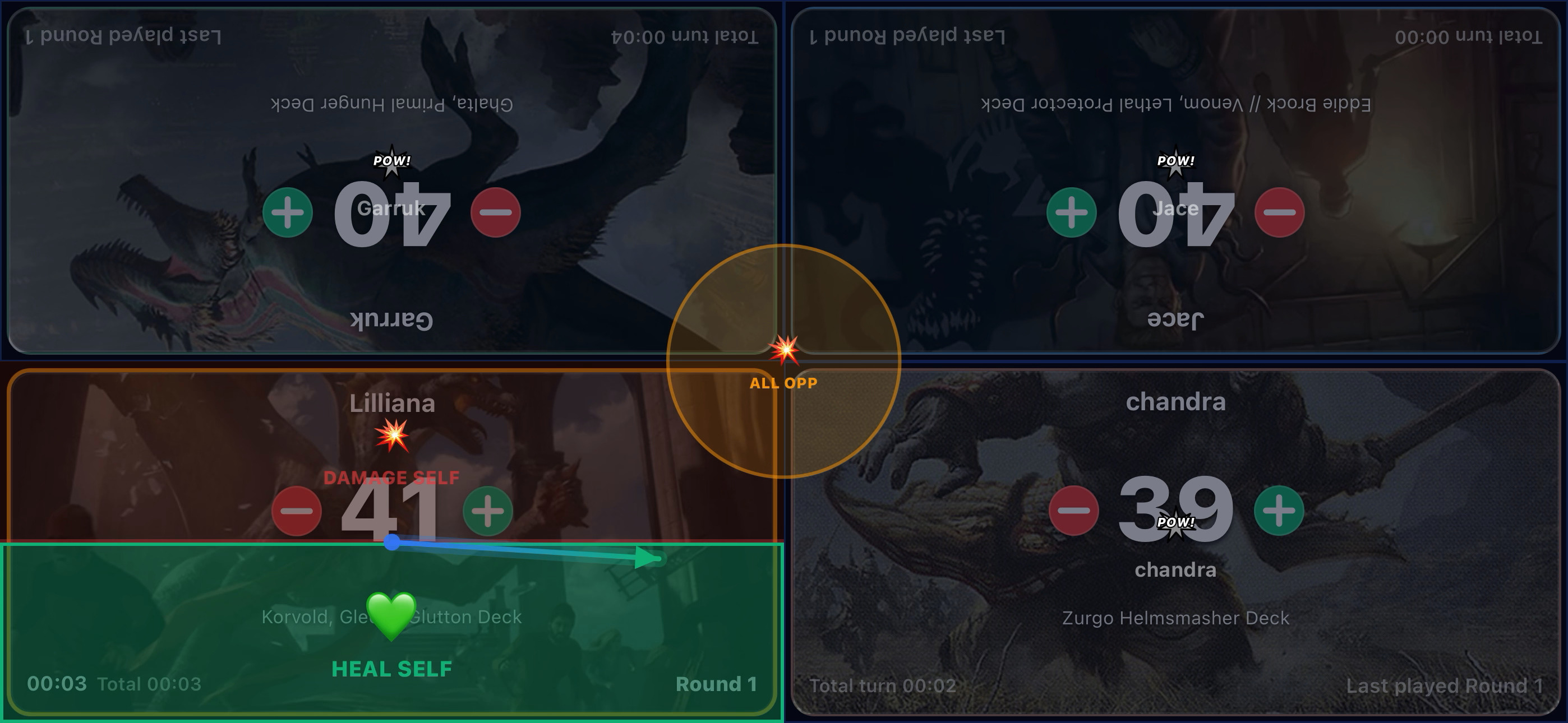
Drag to an opponent, to your own half for damage or healing, or into the center circle for the whole table. The far seats read upside down because at a real table they face the players sitting there
Commander damage, tracked per attacker
Twenty-one points of combat damage from a single commander kills a player, however much life they have. The rule is per commander, which is why keeping it on paper is tedious: in a four-player game each player tracks three opposing commanders, twelve running totals across the table (more with partner commanders), and no player can safely lose track of any of them.
Each seat carries a stack of commander damage counters, one per opposing commander, each chip showing that commander's art. Recognizing the art is faster than reading a name, and it removes the mistake that actually happens at tables, which is attributing damage to the wrong general. If you want the rule itself rather than the feature, the guide covers it. What is commander damage? →
Counters, and the mana nobody believes you have
Poison and energy are in the counter catalog every table gets, and a table can define its own on top of that. Experience, rad, ticket, or whatever a given deck decided to invent: it is tracked per seat and shown as a chip on the tile, so the table stops falling back on a pile of dice that somebody's sleeve will eventually knock over.
Each seat also has a floating mana pool with its own emptying rule. That one is more social than mechanical. Most of what a Rhystic Study argument is about is whether the person actually has the mana up, and a mana pool the whole table can see settles it without anyone having to be trusted.
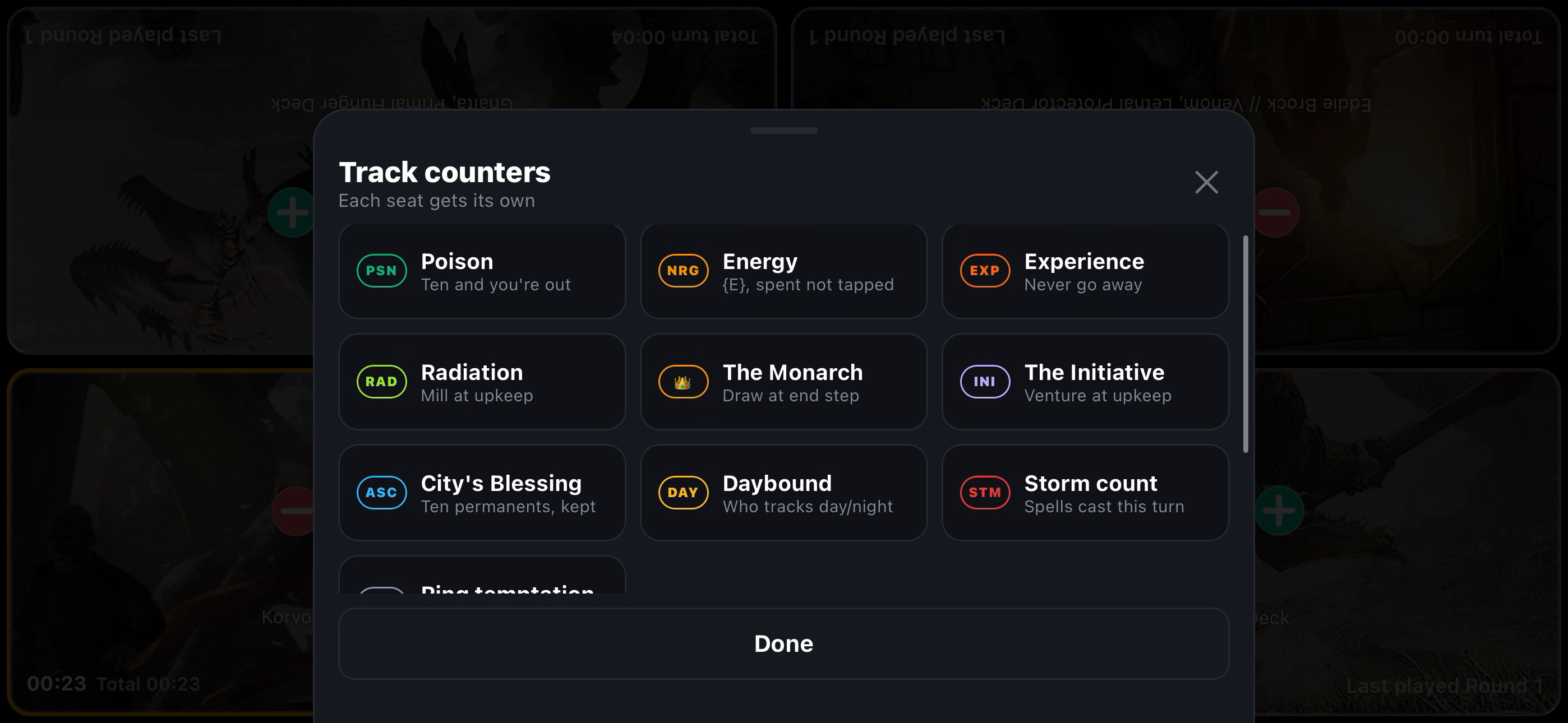
The counter catalog every table starts with, plus any this one defines itself
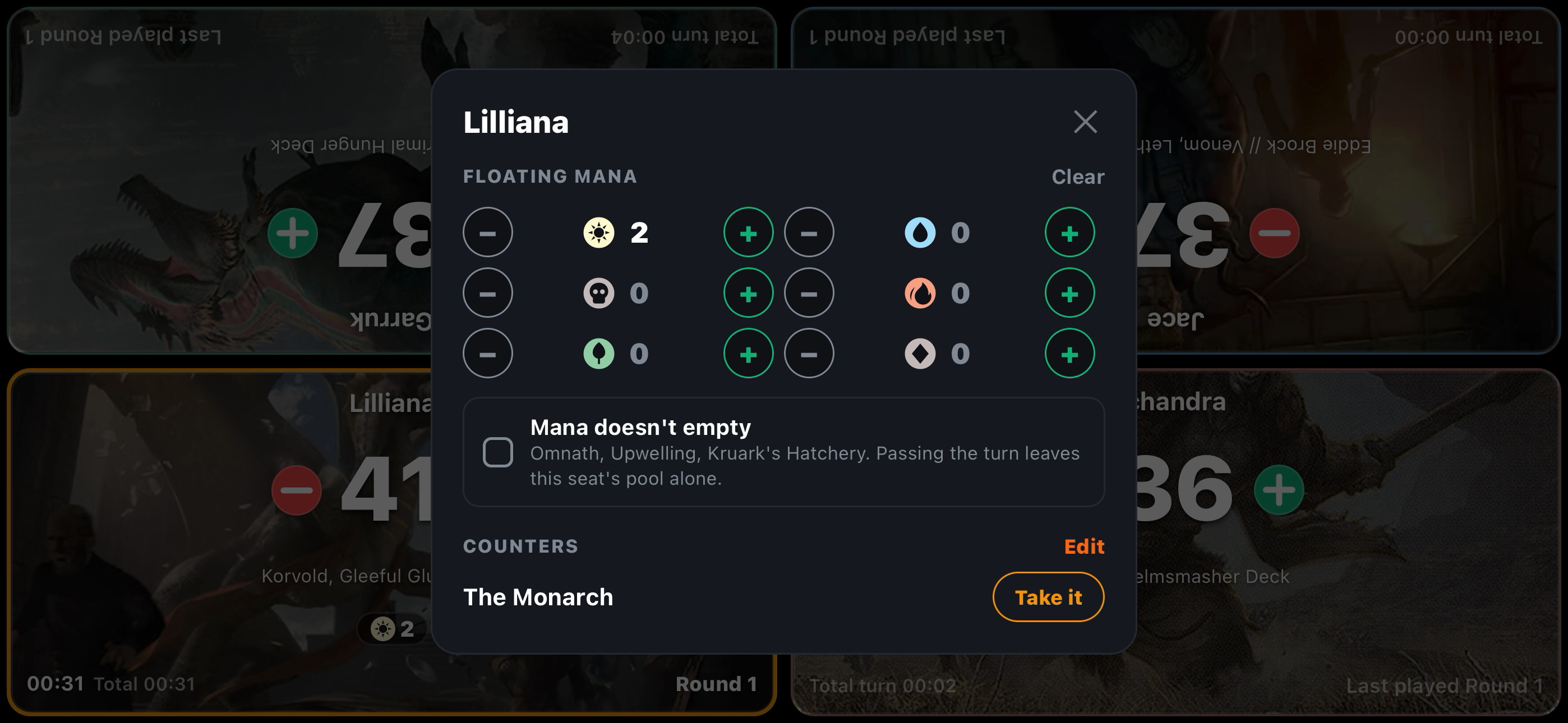
A mana pool the whole table can see, with its own emptying rule
When it goes wrong, which it will
Somebody will tap the wrong tile. The undo stack covers life changes, turn passes and poison counters and restores the exact prior value, so the fix is one press instead of a table-wide reconstruction of what the total was two minutes ago.
Elimination is handled the same way, by refusing to store a fact the app can work out. Who is out is recomputed continuously from life, poison and commander damage. Nobody stays eliminated after being healed back above zero, and nobody has to go find the control that un-eliminates a player, because there is not one.
The host can also pause a running game, so that a food break does not inflate every turn timer and throw off the night's pace statistics.
Everyone else at the table
One device drives the board, but the other three people are also holding phones. Personal Mode gives each of them a single-seat view of the same live game from the Game Menu, so the app is useful to everyone at the table rather than only to whoever volunteered to run it. How Personal Mode works →
Two other things open from that same menu mid-game. A board state photo captures the turn everyone is going to argue about later, on Premium. And Ask the Judge takes a rules question, optionally with the cards named and a photo attached, and returns a ruling, keeping what it decided for the rest of the night. Rulings at the table →
Two-Headed Giant is a supported format rather than four totals somebody mentally pairs up: shared team life, turn order over teams, and team-aware win reporting. Playing alone works too, with the same tracking and the same record, which is what makes goldfishing a new build worth doing in the app at all.
Who this is for
Pods that have been keeping commander damage on paper and losing track of it by turn six
Anyone whose table needs counters a generic life app has never heard of
Tables where whoever is running the board changes from week to week
Players who want their own phone doing something useful while somebody else drives
Frequently Asked Questions
How do I deal damage to everyone at once?
Drag into the amber circle at the center of the board. One gesture hits every opponent, which is what a board wipe or a Blasphemous Act actually does. The alternative in most trackers is six taps on six steppers while the table waits.
What happens if I tap the wrong seat?
Press undo. The action stack covers life changes, turn passes and poison counters, and it restores the exact value that was there before, so a mis-tap in the middle of combat is one press rather than a negotiation about what the total used to be.
Does the app track commander damage separately from life?
Yes. Each seat carries a stack of commander damage counters, one per opposing commander, each chip showing that commander's art. The twenty-one damage rule is tracked where it happens rather than resting on somebody's memory, and it is tracked per attacker, which is the only way the rule works.
Can it count poison, energy or experience?
All three, and anything else. Every table gets a catalog of counters and can define its own, tracked per seat and shown as chips on the tile. Rad counters, tickets, whatever the deck needs counting: the board counts it instead of the table reaching for dice.
Whose phone has to run the board?
Whoever opens it. One device is authoritative for writes, and anybody actually seated claims that role automatically when nobody else holds it, so the table's game just works when they open it. Taking over from a live host stays a deliberate tap, so two devices never fight over the same board.
Does a player get marked out automatically?
Elimination is recomputed continuously from life, poison and commander damage rather than being stored the moment it happens. A player brought back above zero is simply not eliminated any more, and nobody has to un-eliminate anyone by hand.
Put the board on the table.
Life, commander damage and any counter your deck needs, in one gesture per attack. Free to start.
Create Free Account