Commander Brainstorm
Commander Brainstorm: Niv-Mizzet, Ghost Counsel
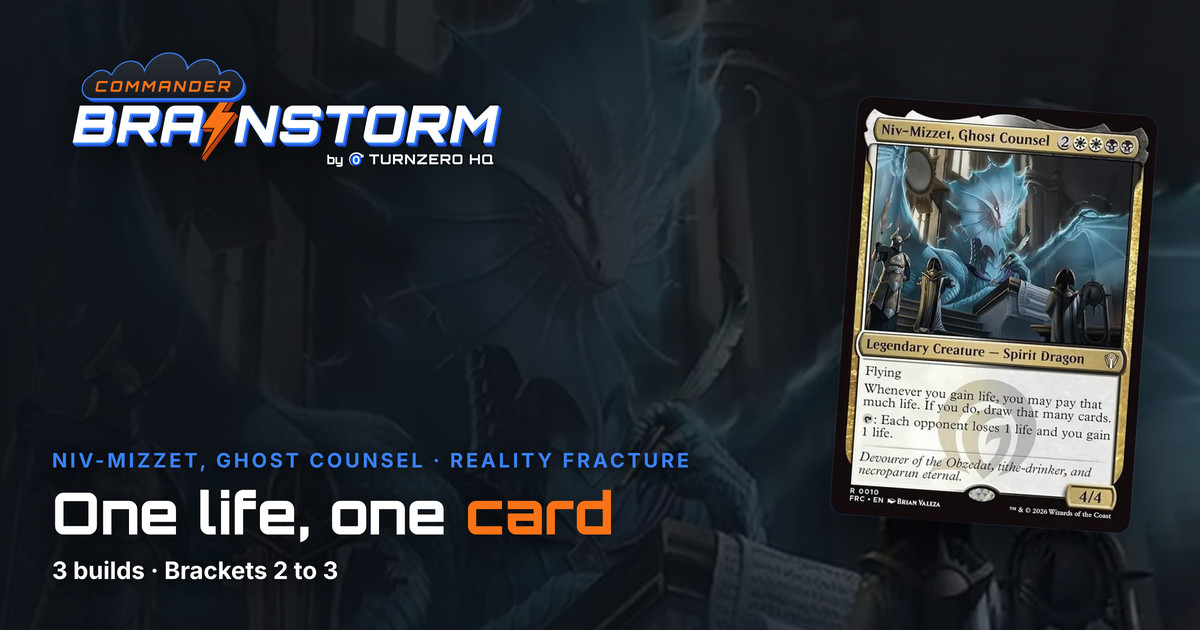
This Niv-Mizzet turns every life you gain into the same number of cards. Here are three different decks built on that one line, with the cards, the win condition and the bracket each one is aiming for.
Quick answer
Commander Spotlight
Niv-Mizzet, Ghost Counsel ↗
Six mana (two generic, two white, two black) for a legendary 4/4 Spirit Dragon with flying. Whenever you gain life, you may pay that much life. If you do, draw that many cards. Tap: each opponent loses 1 life and you gain 1 life. Rare, Reality Fracture Commander (FRC), released October 2, 2026.
Niv-Mizzet, Ghost Counsel is a six-mana Orzhov commander that changes what lifegain is for. Instead of a bigger life total, every gain can become cards, one for each life, and your total ends where it started. The three builds below use that in different ways: a stream of small gains from Spirit tokens at Bracket 2, gains that also drain the table at Bracket 3, and a few huge gains from X spells at Bracket 3.
Why Niv is worth a brainstorm
Most Orzhov lifegain commanders reward you for having a lot of life. Niv rewards you for gaining it and then giving it straight back, which is a different deck. Five rules decide how he plays, and each one changes which cards are good with him.
Paying life is losing life, and it is all or nothing. You pay exactly the amount you gained, and paying life subtracts it from your total (Comprehensive Rules 119.4). So the cards are free in life terms, your total stays flat, and anything that cares about you losing life sees it.
Every life gain event is its own trigger. "Whenever you gain life" means whenever a source causes you to gain life (Comprehensive Rules 119.9), and several lifelink creatures dealing damage at once are separate gains (702.15e). Three Spirits entering with Soul Warden out is three triggers of Soul Warden, so three gains of 1. You decide on each one, so you can draw exactly as many cards as you want.
Doublers double the cards. Rhox Faithmender and Boon Reflection are replacement effects that apply before you gain the life (Comprehensive Rules 119.10). Niv sees the doubled number.
His tap is a card every turn. Each opponent loses 1 and you gain 1, and that 1 life is a Niv trigger: a drain, and a card for no net life. He needs to have been under your control since the start of your turn to use it (Comprehensive Rules 302.6), so haste matters.
Too many cards can lose you the game. Drawing from an empty library loses at the next check (Comprehensive Rules 704.5b). Niv's payment is optional, so he never forces it, but a mandatory draw like Vilis, Broker of Blood's will.
Three builds at a glance
| Build | The plan | Win condition | Bracket |
|---|---|---|---|
| The Haunting | Spirit tokens and Soul Warden effects: a life, and a card, per creature | A wide flying Spirit army with an anthem | 2 (Core) |
| The Ledger | Permanents that make every life gain drain the table | Drain from Niv's tap and every small gain, with a two-card loop as the upgrade | 3 (Upgraded) |
| Blood Money | X drain spells and life doublers for a few huge gains | One big X drain after Niv has drawn you into it | 3 (Upgraded) |
Build 1: The Haunting (Bracket 2)
A Spirit Dragon leading a deck of Spirits. The plan is the oldest lifegain trick in white, Soul Warden and a pile of tokens, except that each token is now a card instead of a point of life. Niv's draw is a "may", so each 1-life trigger is a choice, and you can stop the moment your hand is full.
The count adds up quickly. Cast Spectral Procession with Soul Warden and Impassioned Orator out and three Spirits enter: six separate gains of 1, so up to six cards for three mana, and your life total ends the turn where it began.
Life per creature, and the creatures
Soul Warden ↗
One mana. Every other creature that enters, on either side of the table, gains you 1 life, and Niv turns that life into a card.
Soul's Attendant ↗
A second Soul Warden, so every creature that enters is two triggers and up to two cards.
Impassioned Orator ↗
A third Soul Warden at two mana. It counts only your own creatures, which in this deck is most of them.
Lunarch Veteran ↗
One more gain per creature, and when it dies you can cast it back from the graveyard as a flying Spirit that gains you life whenever another creature you control leaves.
Lingering Souls ↗
Two flying Spirits now and two more from the graveyard. With one Soul Warden out, that is four cards across two casts.
Spectral Procession ↗
Three Spirits at once is three separate life gains, so three separate Niv triggers. You choose each one.
Field of Souls ↗
Every nontoken creature of yours that dies makes a 1/1 flying Spirit, which enters and triggers your Soul Wardens again.
Turning the Spirits into a clock
Intangible Virtue ↗
Two mana for +1/+1 and vigilance on every token. A board of 1/1 Spirits becomes a flying clock.
Teysa Karlov ↗
Your creature tokens have lifelink. Each token that deals combat damage is its own life gain, so a swing with six Spirits is six Niv triggers. It also makes Field of Souls and Cruel Celebrant trigger twice per death.
Sorin, Lord of Innistrad ↗
A 1/1 lifelink Vampire every turn, and the emblem pumps the Spirits too.
Mentor of the Meek ↗
A second way to draw off small creatures entering: pay one mana instead of one life.
Spirit Bonds ↗
Each nontoken creature you cast can bring a flying Spirit with it for one white mana, which is one more life and one more card.
Win condition. A wide board of flying Spirits. With Intangible Virtue out, eight 1/1 Spirits are 16 flying damage a turn, and Niv adds 4 more in the air. Teysa Karlov gives the tokens lifelink, so each Spirit that connects is its own trigger, and the attack that deals the damage also refills your hand for the next one.
Why Bracket 2. No Game Changers, no tutors, no combos, and the threats are 1/1 tokens any sweeper answers. The card draw is strong, but it is paid for by setting up creatures that attack in plain sight, which is what a Core table expects from a deck.
Build 2: The Ledger (Bracket 3)
Orzhov is the guild of bankers, and this build keeps the books: every life you gain is written down twice, once as a card from Niv and once as life your opponents lose. The pieces are permanents that say "whenever you gain life, an opponent loses life", and because they trigger on the same gain as Niv, you never choose between drawing and draining.
Drain on every gain
Sanguine Bond ↗
Whenever you gain life, target opponent loses that much. It triggers on the same gain as Niv, so a gain of 3 is 3 life lost and 3 cards.
Marauding Blight-Priest ↗
Three mana: every life gain, however small, is 1 life from each opponent.
Cliffhaven Vampire ↗
The same trigger on a 2/4 flier, in both of Niv's colors.
Vito, Thorn of the Dusk Rose ↗
Sanguine Bond's text on a three-mana creature, and it can give your whole team lifelink for a turn.
Starscape Cleric ↗
Two mana, 1 from each opponent per gain. Pay offspring and you get a second copy.
Defiant Bloodlord ↗
Seven mana, but a flying Sanguine Bond that also attacks.
Cheap ways to gain
Vampire Nighthawk ↗
Flying, deathtouch and lifelink for three. It blocks anything and every hit is a trigger.
Pontiff of Blight ↗
Gives your other creatures extort. Each extort payment drains each opponent 1 and gains you the total, which is one gain of 3 in a four-player game.
Syndic of Tithes ↗
Extort on a two-drop. Every spell you cast can be a drain, a gain and a card.
Ghost Council of Orzhova ↗
Drains 1 as it enters, and it can sacrifice a creature to blink itself and drain again at the next end step.
Cruel Celebrant ↗
Every creature or planeswalker of yours that dies drains each opponent 1 and gains you 1.
Win condition. Drain, a little from everything. With Sanguine Bond, Marauding Blight-Priest and Cliffhaven Vampire out in a four-player game, one tap of Niv is 3 life from the tap, then 1 from Sanguine Bond, 3 from Blight-Priest and 3 from Cliffhaven off the 1 life it gains: 10 life lost across the table, and a card. Every extort payment and every lifelink hit does the same again.
The upgrade is a loop. Exquisite Blood gains you life whenever an opponent loses life, so with Sanguine Bond or Vito, Thorn of the Dusk Rose out, one point of life loss keeps going until every opponent is out of life. Bloodthirsty Conqueror does the same as Exquisite Blood on a creature. Niv triggers on every gain in the loop, and because his draw is optional, you just say no. Both cards cost about $35 to $40 at this writing, which is why they are not on the post.
Why Bracket 3. The engines drain the whole table every turn, which is faster than a Core deck. With the loop added, Vito and Exquisite Blood are a two-card infinite that costs eight mana between them, so it is not an early-game combo, which Bracket 3 allows. If you build to assemble the pair early, or run more than three Game Changers, call it Bracket 4.
Build 3: Blood Money (Bracket 3)
The first two builds gain life one point at a time. This one gains it in a few huge chunks, with X drain spells, and uses the doublers to make each chunk bigger. Then you decide whether the chunk is worth cashing in. That is the whole tension of the deck, because Niv's payment is all or nothing: a gain of 30 is 30 cards or none.
The big gains
Exsanguinate ↗
Each opponent loses X, and you gain all of it. Against three opponents, X = 5 is a gain of 15.
Debt to the Deathless ↗
The same idea at twice the rate: each opponent loses two times X.
Gray Merchant of Asphodel ↗
Drains for your devotion to black. Niv alone adds two.
Sovereign's Bite ↗
Two mana for a 3-life drain. With a doubler out it is a gain of 6.
Tainted Sigil ↗
Sacrifice it to gain life equal to all the life every player lost this turn, yours included. After an Exsanguinate, that is a second big gain.
Doubling it and drawing it
Rhox Faithmender ↗
Doubles every life gain, and the doubled number is what Niv sees. Niv's own tap becomes 2 cards.
Boon Reflection ↗
The second doubler. With both out, every gain is four times as big.
Vilis, Broker of Blood ↗
Whenever you lose life, draw that many cards, and paying life is losing life. Pay 6 to Niv and you draw 12.
Aetherflux Reservoir ↗
Each spell gains 1 life for every spell you have cast this turn, so the third spell is a gain of 3. A long turn draws itself. Forget the 50-life cannon; Niv spends that life as it comes.
Well of Lost Dreams ↗
Draws off the same gain for mana instead of life, and you choose how many.
The best small turn: Sovereign's Bite with Rhox Faithmender and Vilis out. You gain 6, pay 6 to draw 6, and Vilis sees you lose 6 and draws 6 more. Twelve cards for two mana. The worst big turn is the same thing with an Exsanguinate for 10: that is 30 life, 60 doubled, and 120 cards with Vilis. Say no.
Win condition. One large X drain. Debt to the Deathless for X = 5 costs nine mana and takes 10 life from each opponent, and you gain all 30. The plan is for Niv to have drawn you the mana and the spell over the turns before, off the smaller gains.
Why Bracket 3. An X drain to every opponent can end a game from hand once you have the mana, and the doublers make the card draw far stronger than a Core deck's. It needs no Game Changers, but it has room for up to three. Necropotence fits best, since paying life to it is losing life for Vilis too.
Cards that look right but are not
Orzhov lifegain has a set of cards that reward climbing past where you started, and Niv is built to keep your total flat. Commander starts you at 40 (Comprehensive Rules 903.7), so cards that only need 40 are fine: Felidar Sovereign wins on an upkeep when you have not dropped below your starting total, and Serra Ascendant is a 6/6 flier from the turn it lands. The ones that need more than 40 are the trap, because each asks you to stop using your commander.
Test of Endurance ↗
It wins at 50 life. Commander starts you at 40, and Niv wants you to spend every life you gain, so the total never climbs the last 10. You can decline the draws, but then the commander does nothing.
Chalice of Life ↗
It flips at 10 more than your starting life, 50 in Commander, so it won't while you are paying with Niv. As a card a turn off its 1 life it is still fine; just don't play it for the flip.
What every build shares
Under each plan, the deck is a normal Orzhov Commander deck that needs to reach six mana. It wants two-mana rocks like Arcane Signet, Orzhov Signet and Talisman of Hierarchy, cheap removal like Swords to Plowshares and Anguished Unmaking, and a way to keep Niv on the battlefield, because each build draws far fewer cards without him. Lightning Greaves does both of the jobs he needs: shroud against removal, and haste so he can tap the turn he lands. See the Commander deck template for the baseline counts.
Weaknesses
Niv is six mana and a 4/4, so he comes down late and dies to every common removal spell. Each build still gains life without him, but it stops drawing. Lifegain hate hits harder than usual: an opponent's Erebos, God of the Dead stops your life gain outright, and an opponent's Tainted Remedy turns every one of your gains into a loss. And because Niv keeps your total flat, you never build the cushion other lifegain decks have against an aggressive table.
Which build should you pick?
Pick The Haunting if your table plays at Bracket 2 or you like a wide board of fliers. Pick The Ledger if you want every small trigger to count and enjoy watching three life totals fall at once. Pick Blood Money if you like big turns and deciding, every time, how much a gain is worth. Build the list in the Deck Lab, and check its bracket with Rate My Deck before you sit down.
Frequently Asked Questions
Where does Niv-Mizzet, Ghost Counsel come from?
It is a rare in Reality Fracture Commander (FRC), the single Commander deck released with Reality Fracture on October 2, 2026, which is led by Jace, Multiverse Architect. It is a white and black Spirit Dragon, so it can lead its own Orzhov deck.
Can I pay only part of the life I gained?
No. Niv says pay that much life, so it is all or nothing: gain 12 and you either pay 12 and draw 12, or pay nothing and draw nothing. You can only pay if your life total is at least the amount (Comprehensive Rules 119.4), which it will be unless you lost life in between.
Do several lifelink creatures give me one trigger or several?
Several. Damage from different lifelink sources dealt at the same time is a separate life gain event for each source (Comprehensive Rules 702.15e and 119.9), so each one triggers Niv and you decide on each one.
Does a life doubler give me more cards?
Yes. Rhox Faithmender and Boon Reflection replace the gain before it happens (Comprehensive Rules 119.10), so Niv triggers on the doubled amount and you can draw twice as many cards.
Can Niv deck me?
Niv on its own cannot, because paying is optional. Vilis, Broker of Blood can: its draw is mandatory, and drawing from an empty library loses the game (Comprehensive Rules 704.5b). With Vilis out, paying X draws 2X (X from Niv, then X from Vilis), so say no to Niv on any gain bigger than half your library.
Can Niv use its tap ability the turn it comes out?
Not without haste. A creature's tap ability needs it to have been under your control since the start of your turn (Comprehensive Rules 302.6). Lightning Greaves gives it haste and shroud for free.

This is the second Commander Brainstorm, a series that works out the different decks a new commander could lead. See every brainstorm.
Build your Niv deck and see how many cards a game it really draws.
TurnZero HQ logs every game, so you can tell whether the Spirits, the drain or the X spells are closing it out.
Create Free Account