Beginner Series
The Commander Template
How many lands, how much ramp, draw and removal: the counts that make a 100-card deck play well, and how to tune each one for yours. Start with an idea you love, then give it the supporting cast it needs to work at the table.
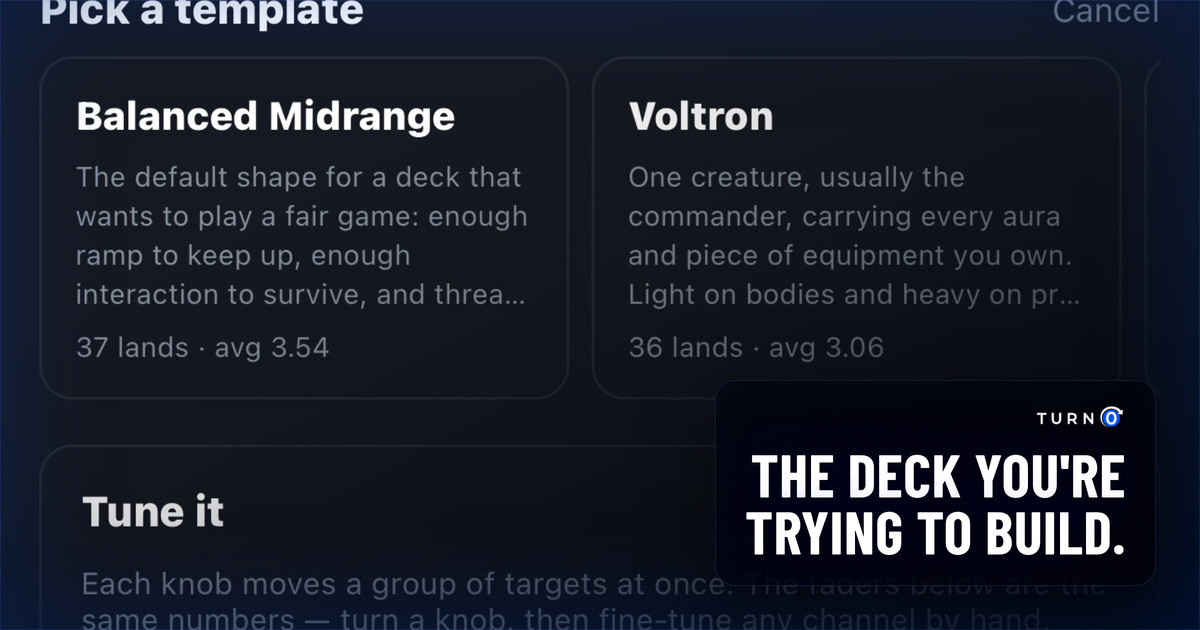
Download the template
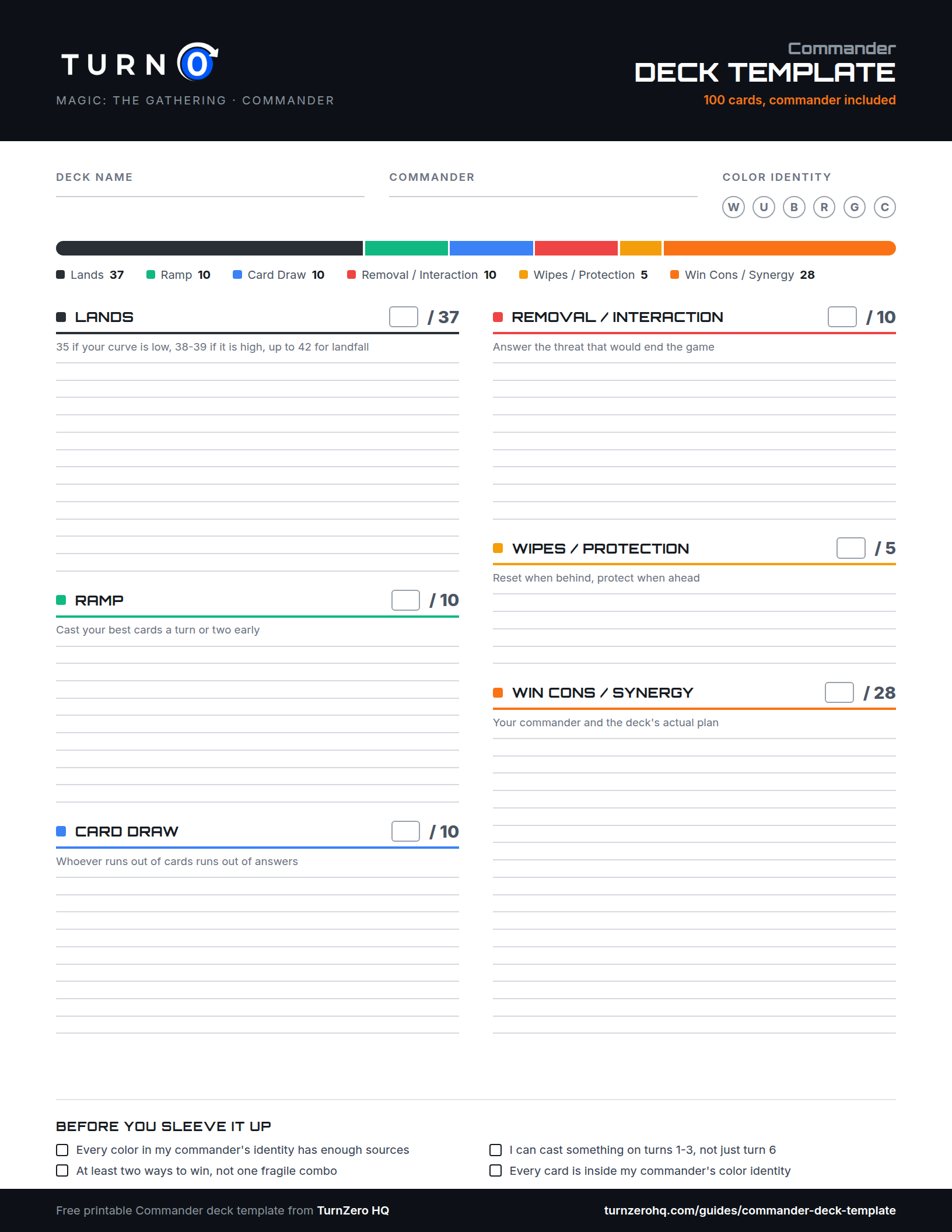
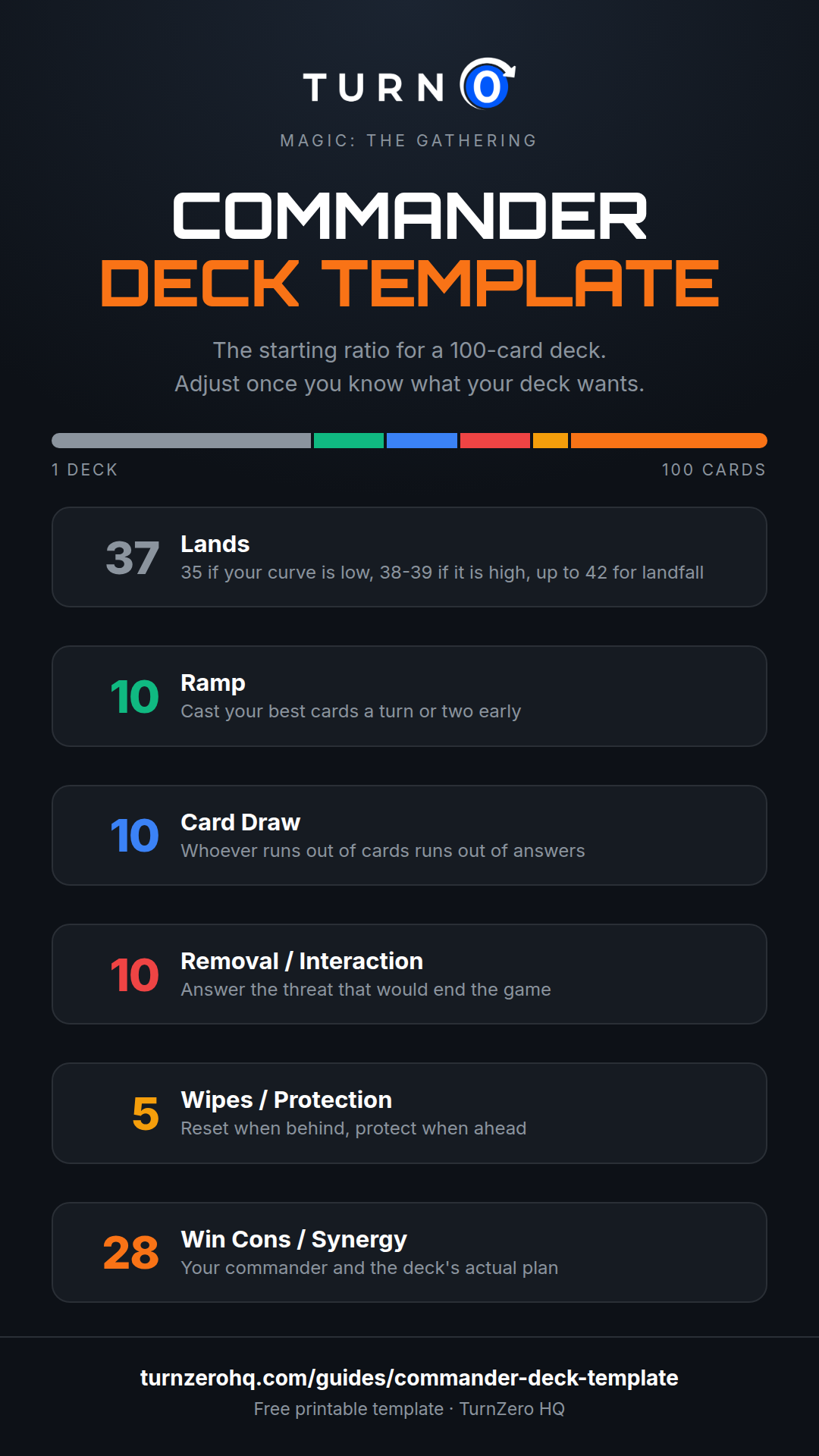
The same ratio in two shapes: a one-page sheet to print and fill in as you build, and a phone-sized card to keep open while you shop for cards. Free, no email required.
Start with an idea you like
Every good deck starts with an idea, not a spreadsheet, and the idea doesn't have to be a single card. Sometimes it is: one card is cool enough to build 99 more around it. Just as often it's a mechanic you want to lean into, or a whole style of play. Some players build every deck around combat in some new shape: go-wide, voltron, extra combats. Others chase spellslinger shells stuffed with cheap instants and sorceries, or group hugs where the win condition is almost beside the point. All of those are exactly the right place to start.
The idea just can't be the whole deck. You've played the game where nobody at the table can answer the one threat that matters, and you've played the one that's all removal and no payoff: four players staring at empty boards until someone decks out. Both are the same gap: a great idea with nothing built to support it. The other cards are what let that idea actually happen at the table, ramping you there, drawing you into it, and keeping it alive once it's in motion.
The template
Treat these as a starting ratio to build from, then adjust as your deck's plan comes into focus.
Higher curve decks want closer to 38-39 lands. Fast, low-curve decks can trim to 35 and lean on ramp spells instead. Landfall decks go the other way and run up to 42, where lands aren't just how you cast your spells, they're the payoff, and the extra hits are worth the flooding risk. The categories don't need hard walls either: a lot of good ramp rocks also draw cards, a lot of removal doubles as a win condition.
Tune each slot for your deck
The numbers above are where a deck starts. Where it ends up depends on what your deck costs, how it wins, and what your pod plays. These are the usual reasons to move each one.
Run more when: Your curve is high, or lands are the payoff (landfall decks run up to 42).
Run fewer when: Your curve is low and you run plenty of cheap ramp. 35 is about the floor.
How many lands to run →Run more when: Your commander or your key spells cost five or more.
Run fewer when: Your deck is fast and most of its spells cost three or less.
How much ramp to run →Run more when: Your hand is regularly empty by the midgame.
Run fewer when: Your commander draws cards on its own every turn.
How much card draw to run →Run more when: Your pod's games keep being decided by one engine nobody could answer.
Run fewer when: Rarely. Swap in removal that also helps your plan before you lower the count.
How much removal to run →Run more when: Wipes if your deck plays few creatures; protection if one card is the whole plan.
Run fewer when: Wipes in a go-wide creature deck, which a wipe hurts more than anyone.
How many board wipes to run →Change one slot at a time and play a few games before changing the next. Move three counts at once and you won't know which change helped.
Check your deck against the template
A deck that plays badly usually shows it in one of a few ways, and each one points at a slot in the template.
You miss land drops before turn four. Count your lands and ramp first.
Why your deck keeps missing land drops →Your hand is empty by the midgame. Your card draw is short, or it is one-shot cantrips instead of engines.
Why your deck keeps running out of cards →Someone else's engine takes over and you can only watch. You need more removal, and some of it instant speed.
How much removal to run →You get ahead on board but can't close the game. Your win conditions are thin, or buried under synergy pieces.
Why your deck can't finish games →To count the slots without going card by card, paste your list or a Moxfield or Archidekt link into Rate My Deck. It breaks down your lands, ramp, card draw, removal and curve for free, with no account needed, so you can see which number is off before you start cutting.
Example cards for each slot
A few staples worth knowing by name in each category, the kind of cards that show up across dozens of good decklists because they simply do their job well.
Ramp
Ramp gets you ahead of the game's natural mana curve, playing your bombs a turn or two early instead of waiting on lands alone. In a 4-player game, tempo compounds fast, so a few good ramp pieces early can decide who's casting a game-changer first. Most of these ten slots end up being artifacts, and which ones depends on your color count more than anything else. see the full mana rocks guide →
Card draw
Games go long, and the player who runs out of cards first usually runs out of answers first too. Draw engines keep your hand full so you're never just topdecking and hoping.
Removal / interaction
Not every threat can be raced. Removal and interaction are how you buy time, answer the thing that's about to end the game, and stay relevant against plans your deck can't out-value.
Wipes & protection
The smallest category on purpose: a couple of board wipes for when you're behind, and a couple of ways to protect your own board when you're ahead, so one removal spell doesn't undo your whole game plan.
Building to the template: a worked example
Let's put it into practice with Atraxa, Praetors' Voice, a four-color commander built around counters and card advantage.
Commander Spotlight
Atraxa, Praetors' Voice ↗
37 lands leaning on fixing lands since the deck is four colors. Ramp slots favor mana rocks like Arcane Signet over land-fetch, since Atraxa wants counters and card draw more than raw land count. Draw is stacked toward proliferate synergy: cards that grow counters while replacing themselves. Removal stays flexible (Swords, Beast Within) since the deck isn't fast enough to need a hyper-aggressive answer suite. Win cons lean on proliferate payoffs: a handful of planeswalkers and counter-doublers that turn every proliferate trigger into a snowball.
Common mistakes
Too many "win-more" cards. Cards that only matter when you're already winning don't help you get there.
Cutting lands to fit more spells. It is the most common cut and the one that costs the most games, because a spell you can't cast does nothing.
Not enough interaction. A deck with zero removal is a deck that loses to the first real threat it sees.
Curve too top-heavy. A deck full of 6-drops with no early plays just dies before it gets to do anything.
Track how your deck performs once it's built.
TurnZero HQ rates every deck automatically, game after game, so you know if the ratio is actually working.
Create Free Account