Precon Upgrade Guide
Devour for Power Upgrade Guide
What to cut, what to add, and how to play the Sultai graveyard precon from Commander 2011, commanded by The Mimeoplasm.
Commander 2011
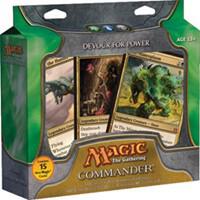
Devour for Power
Sizing it right off two graveyard creatures takes some math before it resolves. Out of the box, before any upgrades. How we rate precons
Buy Devour for Power on TCGplayer →Quick verdict
Devour for Power is a graveyard deck with a commander that rewards you for having the right two creatures in any graveyard. The Mimeoplasm becomes a copy of one creature card and grows by the power of another, so with a little setup it is a huge copy of your best threat. The precon splits its attention between filling your own graveyard and milling opponents, and the second half does much less for the commander. Tighter self-mill, cheaper reanimation and a mana base that enters untapped are the main fixes.
TurnZero HQ rates Devour for Power a 3 out of 5 on difficulty and a 3 out of 5 on power, as it comes in the box. That is our editorial read, not an official Wizards rating. The full hundred cards are on the Devour for Power decklist page, and every other precon we cover is on the precon directory.
How the precon plays
As The Mimeoplasm enters, you may exile two creature cards from graveyards. It enters as a copy of one of them, with extra +1/+1 counters equal to the power of the other. Copy Avatar of Woe and exile Artisan of Kozilek alongside it, and you have a creature that taps to destroy a creature and carries ten extra counters. The cards can come from any graveyard, so an opponent's best creature is fair game too.
The deck sets that up with Buried Alive , which puts three creature cards from your library into your graveyard, plus Shared Trauma , Dreamborn Muse and Memory Erosion , which mill other players. The same full graveyards grow Lhurgoyf and Mortivore , power Svogthos, the Restless Tomb , and turn on Stitch Together 's threshold.
When The Mimeoplasm isn't on the battlefield, the deck plays a grindy recursion game. Gravedigger , Eternal Witness and Desecrator Hag return creatures to hand, Rise from the Grave and Living Death put them straight onto the battlefield, and Grave Pact with Fleshbag Marauder or Butcher of Malakir makes every creature you lose cost an opponent one too.
What works out of the box
The Mimeoplasm ↗
Enters as a copy of any creature card in any graveyard, grown by the power of a second one. The more creatures in graveyards, the better the copy.
Buried Alive ↗
Puts the three creature cards you choose from your library into your graveyard. It sets up The Mimeoplasm and every reanimation spell in one card.
Living Death ↗
Every player swaps their board for the creatures in their graveyard. After a few turns of self-mill, your side of that trade is far better.
Grave Pact ↗
Whenever a creature you control dies, each other player sacrifices a creature. Your creatures come back from the graveyard; theirs usually don't.
Damia, Sage of Stone ↗
Refills your hand to seven every upkeep. In a long graveyard game, seven fresh cards each turn keep the deck from running out of things to do.
Eternal Witness ↗
Returns any card from your graveyard to your hand, so a key removal spell or Buried Alive can be used twice.
What needs improvement
Half the mill in this deck points at opponents. Memory Erosion , Riddlekeeper and Sewer Nemesis do mill other players, and their creatures can feed The Mimeoplasm, but you don't choose what they hit. Milling yourself puts your own big creatures and reanimation targets where you want them, and the precon has very few cards that do it.
The mana base has eight lands that enter tapped and three more that tap only for colorless, including Temple of the False God and Rupture Spire . A three-color deck with a five-mana commander needs to hit its colors on time. Interaction is also expensive: Relic Crush costs five and Spell Crumple is the only counterspell.
Upgrade ideas
Each upgrade below starts from something the deck does poorly and says what a replacement card has to do. The cards named are examples, not the only answer: if you own something else that does the same job, or a newer printing does it better, it goes in the same slot. Make one change at a time and play a few games between them, so you can tell which change helped. The general method is in how to upgrade a Commander precon →
1. Mill yourself on purpose
The Mimeoplasm and the reanimation spells all want specific creature cards in your graveyard. Self-mill early in the game gets them there faster and more reliably than milling opponents.
What to look for One- and two-mana creatures or spells that put several cards from the top of your library into your graveyard, ideally ones that also give you a land or creature to keep.
Cut, for example
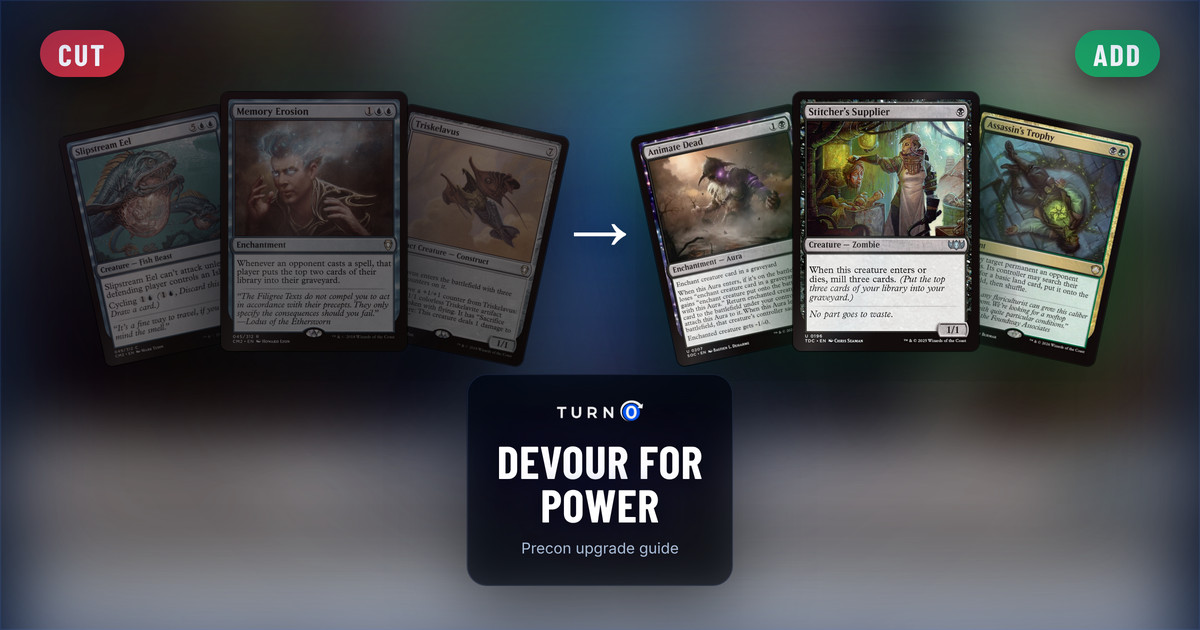
Memory Erosion Mills an opponent two cards whenever they cast a spell. It fills their graveyard at random and does nothing for your own reanimation spells.
Riddlekeeper Only mills a player when they attack you, and the 1/4 body rarely stops that attack anyway.
Sewer Nemesis Its size and mill depend on one chosen player's graveyard. In a self-mill deck it is a mid-sized creature that does little else.
Add, for example
Stitcher's Supplier ↗
One mana: mills three cards when it enters and three more when it dies. A great turn-one play and a fine creature to sacrifice to Grave Pact.
Satyr Wayfinder ↗
Two mana: reveals four cards, keeps a land if there is one, and puts the rest in your graveyard.
Grisly Salvage ↗
Two mana at instant speed: reveals five, keeps a creature or land, and bins the rest. You can cast it at the end of an opponent's turn.
2. Cheaper ways to reanimate
Rise from the Grave costs five and Stitch Together needs threshold to put a creature onto the battlefield. A couple of two- and three-mana reanimation spells get a milled threat into play turns earlier.
What to look for Spells costing three mana or less that put a creature card from a graveyard onto the battlefield. Ones that can take from any graveyard are a bonus.
Cut, for example
Slipstream Eel A 6/6 that can't attack unless the defending player controls an Island. Its cycling is the only reliable use for it.
Triskelavus Seven mana for a flier that splits into small tokens. Most of the deck's top-end creatures do more for the same cost.
Add, for example
Animate Dead ↗
Two mana to return a creature card from any graveyard to the battlefield under your control, at -1/-0.
Necromancy ↗
Three mana to reanimate a creature from any graveyard. You can cast it at instant speed, though the creature is sacrificed at the next cleanup step if you do.
Victimize ↗
Three mana: sacrifice a creature to return two creature cards from your graveyard to the battlefield tapped. With Grave Pact out, the sacrifice also hits each opponent.
3. Cheaper, broader removal
The deck's answers are mostly creatures and five-mana spells. A few cheap instants handle the threat that matters before your graveyard plan comes together.
What to look for Instants at three mana or less that destroy a creature or any nonland permanent. See how much removal a Commander deck needs for a target count.
Cut, for example
Unnerve Four mana to make each opponent discard two cards. It feeds their graveyards a little but doesn't answer anything on the battlefield.
Vow of Flight An Aura that pumps a creature, grants flying and stops it attacking you. It is a weak political tool next to real removal.
Add, for example
Assassin's Trophy ↗
Two mana at instant speed to destroy any permanent an opponent controls. Its controller gets a basic land, which is a small price for the flexibility.
Beast Within ↗
Three mana to destroy any permanent, leaving its controller a 3/3 Beast. It also answers lands and planeswalkers.
Go for the Throat ↗
Two mana to destroy any nonartifact creature, black ones included.
4. Lands that enter untapped
Eight tapped lands plus three colorless ones slow down a deck that needs blue, black and green by turn five. Untapped dual lands fix that without costing a turn.
What to look for Two-color lands in any pair of blue, black and green that usually enter untapped.
Cut, for example
Temple of the False God Makes no mana until you control five lands, so it is a blank in the early turns.
Rupture Spire Enters tapped and costs a mana to keep. It fixes your colors at the price of a whole turn.
Add, for example
Win conditions
The upgraded deck wins with one huge creature. Self-mill puts your biggest threats in the graveyard early, and The Mimeoplasm or a cheap reanimation spell puts the best one onto the battlefield, often with ten or more counters from a second creature. Grave Pact and Living Death keep opponents from rebuilding, and Damia, Sage of Stone keeps your hand full for the long game.
Who should buy this precon
A good pick for a player who likes graveyard decks and is comfortable reading every graveyard at the table. Choosing the right two cards for The Mimeoplasm and timing Living Death take some thought, but none of it is fiddly, so it is a moderate challenge. It suits players who enjoy a slower, value-heavy game rather than a fast attacking one.
Checked against the printed decklist on October 10, 2026.
Track how the upgrades actually perform.
TurnZero HQ keeps a win rate per deck version, so you can change a few cards, play some games, and see the difference instead of guessing.
Create Free Account