How to use TurnZero HQ
Practice draft: a whole set, solo, graded at the end
Drafting is the format you get the least practice at, because every rep costs a pod, an evening and three packs. Practice draft in the TurnZero HQ app gives you the reps: open three packs against seven bots, take forty-five cards, and get a graded summary that names the picks that cost you the most and what you should have taken instead.
Why drafting is the hardest format to practice
Everything else in Magic can be practiced cheaply. A Commander deck can be goldfished on the kitchen table as many times as you like, a list can be rebuilt a dozen times in an afternoon, and a rules question can be looked up the moment it comes up. Drafting has none of that. A rep costs three packs, seven other people and most of an evening, and a set is only in shops for a few months before the next one arrives and the whole picture resets.
That is a bad shape for learning anything. The pick that actually teaches you something is the one where you took the splashy rare over the common removal spell and your deck ended up short a playable, and you only find that out at the end, once, in a room where nobody is going to walk you back through pick nine of pack one. So most drafters get better slowly, from a handful of events a season, and most of them never get a straight answer about which of their picks were wrong.
A practice draft solves the cost problem and the feedback problem at the same time. How to Draft MTG: The Complete Guide → covers the theory: pack passing, pick priority, reading signals and turning about 42 cards into a 40-card deck. This is the place to go and do it, as many times as you want, on any set.
How a practice draft runs
It is a normal eight-person draft with you in one seat and bots in the other seven. Pick a set, and the app opens the first pack.
Three packs, forty-five picks. Fifteen cards a pack, three packs each, eight seats. You take one card and the seven bots take one each, at the same moment, out of their own packs.
The packs pass left, then right, then left. The same rotation a real pod uses, so what comes back to you is exactly what the players on that side chose to let go.
Cards wheel. A pack you have already seen comes back around with eight cards gone, and the app marks it, so you can learn what survives a lap and what never does.
Tap to select, then confirm. A single tap never commits a pick, because a mis-pick cannot be undone: the pack has moved on and the bots have already taken theirs.
No timer. Take as long as you want over a pick. The clock is the part of a real draft that makes it stressful, not the part that makes it instructive.
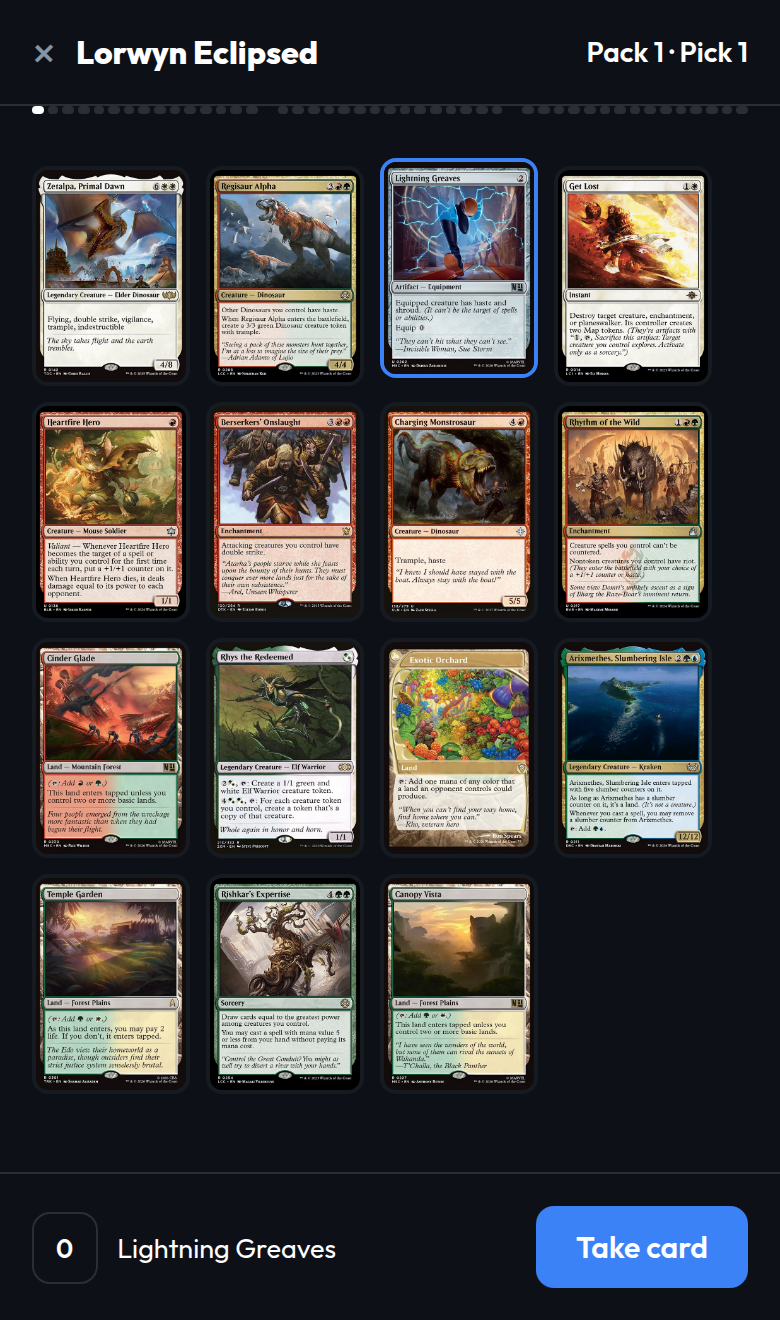
Pack 1, pick 1. Tap to select, then confirm.
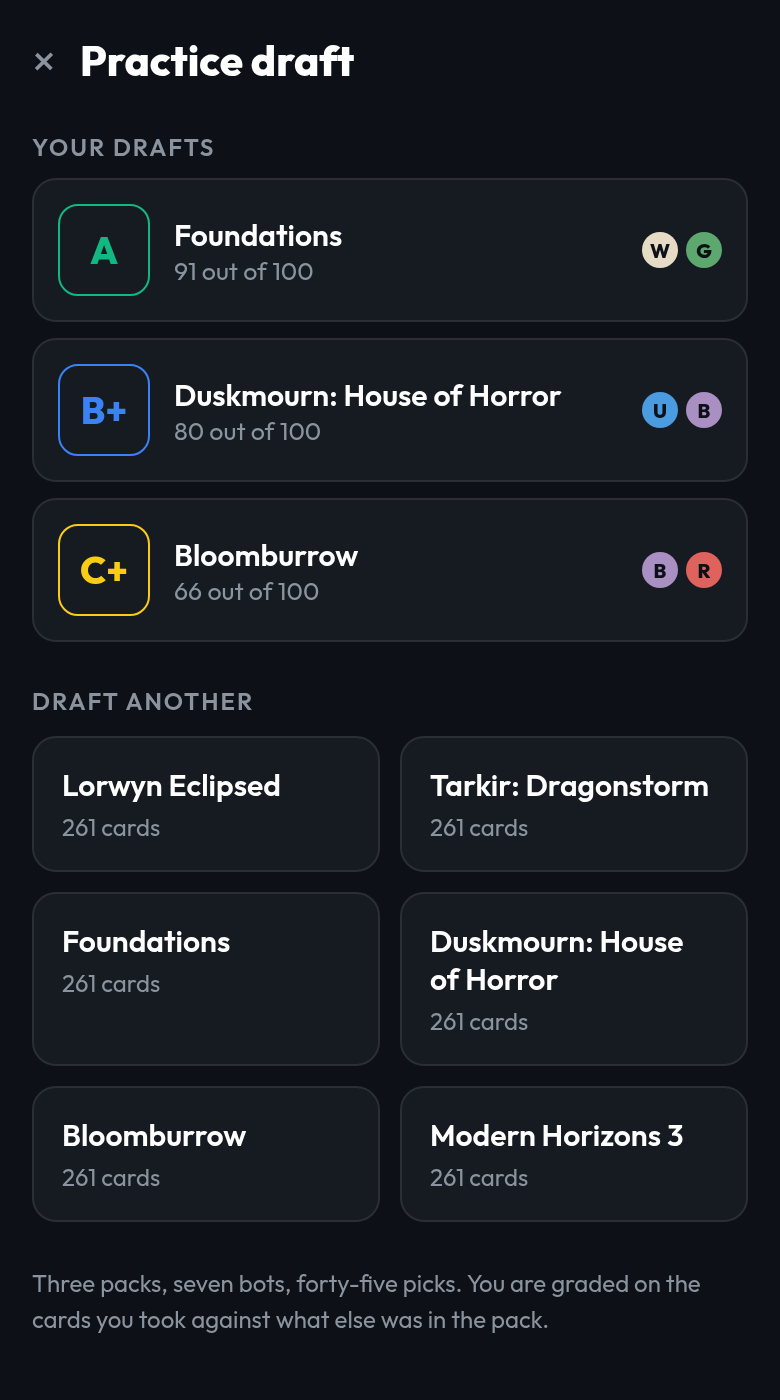
Your drafts, then the sets that are ready to draft
A running summary sits above the pack: what you have taken so far, and which colors your pool is drifting into. Nothing is hidden and nothing is scored while you play, so the draft itself reads the way a draft does, with the judgement saved for the end.
Every draft is saved after every pick, so you can put your phone down mid-pack and pick it up later on another device. Three drafts can be open at once, which is enough to run the same set twice and compare, or to try a second set without abandoning the first.
The bots, and how sharp they are
The seven other seats pick instantly, because they are arithmetic rather than a language model. Each bot scores every card in the pack it is holding, adds a small bonus for the colors it has already committed to, and takes the best one. That is worth knowing for two reasons: a draft never pauses waiting for a server, and the bots behave the same way on every set rather than being better at the ones somebody tuned by hand.
Relaxed: reaches past the best card in the pack fairly often, so packs wheel generously and there is more left when they come back.
Normal: usually right, occasionally reaching. The default, and the closest to a table of people who all know the format.
Sharp: takes the best card it sees almost every time. Packs come back thin and the good cards do not wheel.
The setting only changes how often a bot reaches, never what the bots think a card is worth. That is deliberate: if a weaker bot also valued cards differently, your picks would be graded against a standard nothing in your draft ever used, and the grade would stop meaning anything.
Two things the bots will not do. They cannot see your pool, so nobody is taking a card purely to keep it away from you. And they do not take the rare out of every pack: a removal common out-rates a vanilla rare in the ratings the bots pick by, on purpose, because rare-drafting is the most common mistake a new drafter makes and a practice tool whose opponents do it is teaching it instead of teaching you out of it.
The grade, and what is actually in it
Finish the third pack and the draft scores itself out of 100, from three components, and cuts a letter from A+ down to F. The weights are fixed and the page shows you the figure behind each one, because a B with nothing under it is a number you either accept or ignore, and neither of those is learning.
Color discipline only starts counting after pick twelve, roughly where a real draft stops being open and starts being a deck, and lands and colorless cards never count against you because neither is a commitment to anything. Pool depth is measured against the 23 non-land playables a 40-card Limited deck needs, which is where the 17-land build → comes from.
Under the score is the part worth reading twice: up to five specific picks, worst first, each one written as "took this over that," with the pack and pick number so you can place it. That is the answer no real draft ever gives you. A pick you took from the last card of a pack is never counted, because it was not a choice, and a pick made from a full pack counts for more than one made from the dregs.
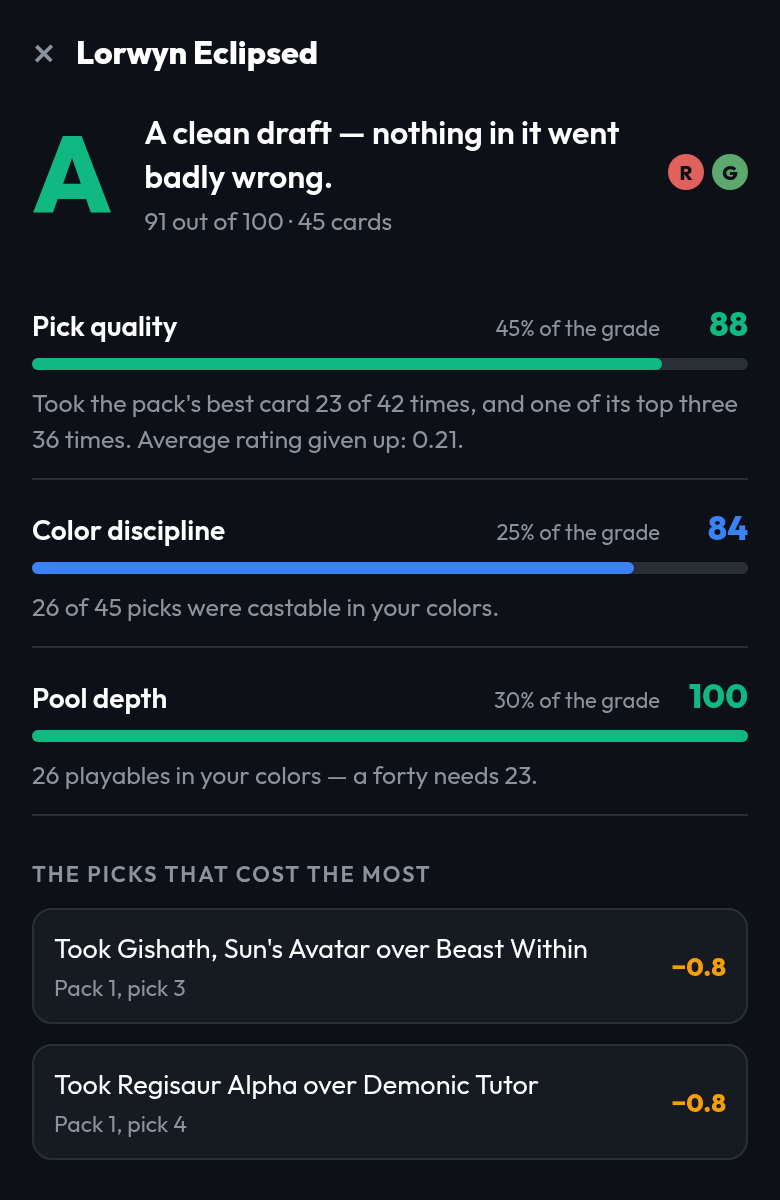
The letter, what each component was worth, and the picks that cost the most
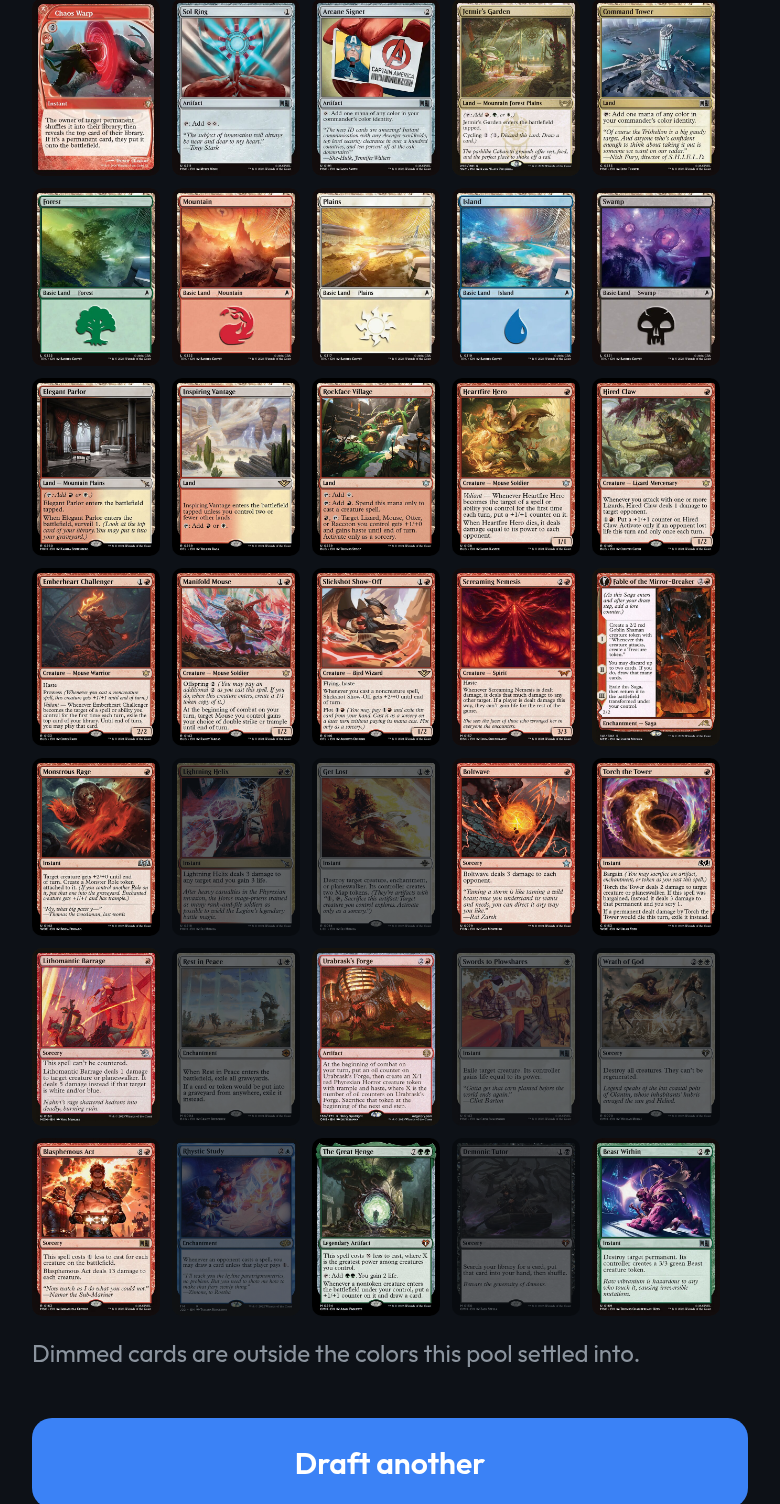
The pool you finished with, cards outside your colors dimmed
A clean draft gets no call-outs at all, rather than five invented criticisms. A summary that always finds something is one you stop reading after the second draft.
A component that cannot be measured is left out of the average rather than scored zero. Those are not the same thing: zero says you did badly at something, and a grade dragged down by something nobody could measure is a mark you cannot act on.
The grade is written once and kept. Card ratings change as sets get rated more carefully, and a B that quietly became a C+ next month, on a draft you cannot go back and replay, would be worse than useless.
Your pool is laid out under it, with the cards outside your final colors dimmed, so the shape of what you actually built is visible at a glance.
Below the pool, the app suggests a 40 to build out of what you took. That part is AI-written, and it is the one section of the summary with a condition attached: a player who has AI features switched off gets the pool and the whole grade as normal, with that section marked unavailable. Everything above it is counted from your own picks rather than generated, which is why the letter still arrives either way.
Finished drafts are kept, with the letter, the score and the colors you ended up in, filterable by set. Ten drafts of one set is a record of whether you are actually getting better at it.
Drafting a set before it is out
Preview cards reach the card catalog days before anybody can buy a pack, and a set becomes draftable as soon as enough of it exists to fill packs from. So the week between a set being fully spoiled and release day is the week where practice is worth the most, and the app flags those sets accordingly.
That is the one window where nobody has a format read. Turning up to a prerelease or a release-weekend draft having already taken forty-five picks out of that set is the difference between forming an opinion at the table and arriving with one, and it is the cheapest edge available in Limited. Prereleases and sealed, explained →
What it does not pretend to be
A practice tool is only useful if you know what it is approximating, so three things are worth stating plainly rather than leaving you to discover them.
The packs are one convention, not a per-set slot table. Fifteen cards, one rare or mythic, three uncommons and eleven commons, applied to every set. Modern Play Boosters are fourteen cards with a wildcard slot, a land slot, a foil and per-set special slots, so a practice pack is the right shape for making picks and the wrong shape for predicting what falls out of a real one.
Pick quality is measured against the same card ratings the bots pick by. A drafter who only ever takes the highest-rated card in the pack scores full marks on that component by definition, which is exactly why colors and pool depth carry 55 of the 100 between them.
It does not model a real table. There is no timer, no signals you can send by passing something deliberately, and no opponent who remembers that you took their bomb. Those are real parts of drafting, and the store event is still where you learn them.
It is also not a queue. There is no entry cost and nothing is at stake, which makes it a different thing from MTG Arena's draft events → where you pay to enter, play against people, and keep the cards. Practice here, then spend the entry fee knowing the format.
Where to find it
Practice draft lives in the TurnZero HQ app on iOS, Android and the web, free with an account. It is on the home screen, naming the newest draftable set, and again on the setup screen for a draft night, since somebody organizing one has already said the word draft.
When the real night comes around, the app runs that too: pods, Swiss rounds, standings and the games themselves. How to run a draft night → A draft deck exists for one evening and then gets pulled apart, so the record of what it did is the only part of it that survives.
Who this is for
Anyone who drafts a few times a year and wants more reps than their local shop's schedule allows
Players learning a new set before a prerelease or a release-weekend draft
Commander players who have never drafted and would rather make their first forty-five picks somewhere nobody is waiting on them
Drafters who suspect they rare-draft too much and want it measured instead of argued about
Frequently Asked Questions
What is a practice draft?
A draft you do on your own, against software, to get reps at making picks without needing seven other people and three booster packs. In TurnZero HQ it runs the full shape of a real booster draft: eight seats, three packs each, forty-five picks, packs passing left then right then left, and cards wheeling back to you. At the end you get a graded summary of what you took and what you passed.
Is practice draft free?
Yes. It needs a TurnZero HQ account and nothing else, and there is no per-draft cost of any kind. The one part with a condition on it is the suggested 40-card build at the bottom of the summary, which is AI-written: a player who has AI features switched off gets the pool and the full grade with that section marked unavailable instead.
Which sets can I practice draft?
Every set the card catalog holds completely enough to fill packs from, which in practice means expansions, core sets, masters sets and draft-innovation sets. Commander precons and Secret Lairs are excluded on purpose, because nobody drafts them. Eligibility is measured against the catalog rather than kept as a hand-written list, so a set appears on its own the moment enough of it is imported.
Can I draft a set before it comes out?
Once it is fully spoiled, yes. Preview cards reach the catalog days before anybody can buy a pack, and a set becomes draftable as soon as it holds enough commons, uncommons and rares to fill packs from. The app flags those sets as fully spoiled, which is the window where practice is worth the most: nobody has played the set yet, including the people you are about to play it against.
Do the bots cheat, or hate-draft me?
No. A bot cannot see your pool at all, which is a deliberate design decision rather than an oversight: a bot that could see your pool would take cards specifically to deny you them, and a practice tool that hate-drafts is one people report as unfair rather than as a challenge. Each bot scores the pack in front of it, leans toward the colors it has already committed to, and takes the best card it sees.
Is there a timer?
No. A real draft puts you on a clock and this deliberately does not, because a practice tool with a timer is a stress test rather than a place to think a pick through. The picks that cost you the most are still recorded whether you took two seconds or two minutes over them.
Can I stop halfway through a draft?
Yes. A draft is saved after every pick and can be picked back up later from any device signed into the same account, and you can have up to three going at once, which is enough to compare two sets without collecting a pile of half-finished drafts.
Does a practice draft deck get tracked like a real deck?
The pool and the grade are kept, and so is the summary's suggested 40, but a practice draft is not a game and does not touch your decks, your MMR or your win rate. If you go on to draft that set for real at a store, that is the night to track: TurnZero HQ records a draft night's games and standings, which is the part of a draft deck that outlives the evening you built it in.
Draft the set tonight, without the pod.
Three packs, seven bots, forty-five picks and a graded summary at the end. Free with a TurnZero HQ account, on any set the catalog holds.
Create Free Account