Feature
Achievements & Play Streaks
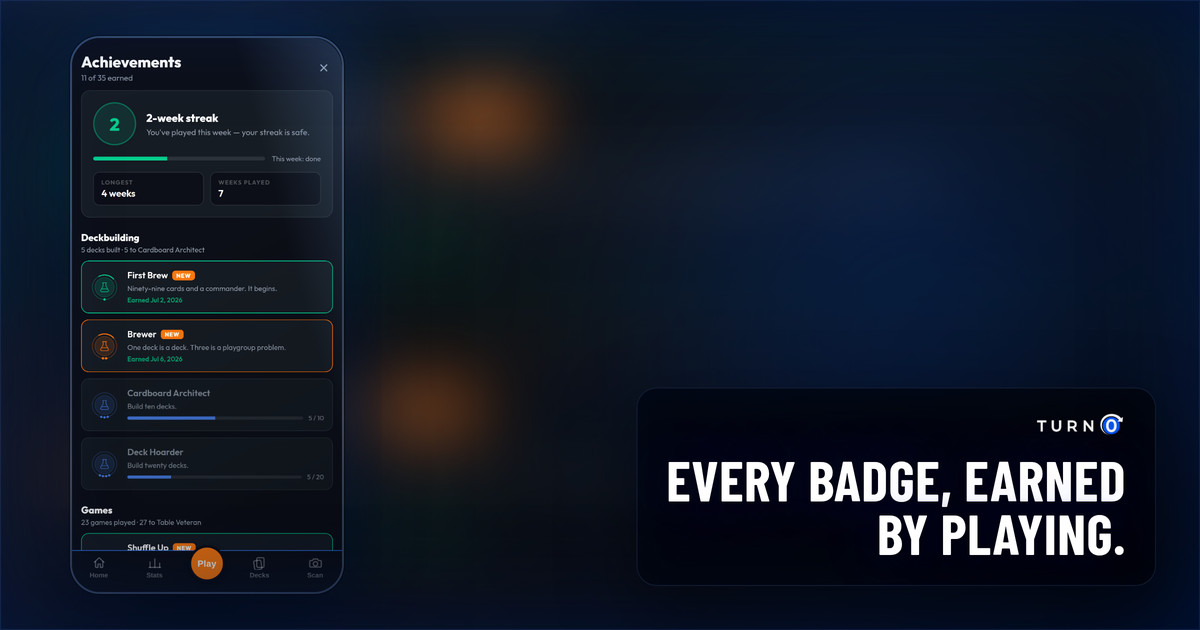
Commander is a hobby you do a few evenings a month, which makes it very easy to play for a year and have nothing to show for it but a vague sense that it went well. TurnZero HQ keeps a weekly play streak and thirty-five badges earned from the games you have already played.
The problem it solves
Most hobbies with a record attached are daily. Commander is not: it is a Friday, or the odd Tuesday, or whenever four people can get a table. That cadence is exactly the one that leaves nothing behind. You can play forty games across a year, meet thirty people, build a dozen decks, and end up with no sense of any of it, because nothing was counting and the only record was whoever remembered it.
A streak and a set of badges are the two cheapest ways to fix that. One gives the current week a reason to matter. The other turns a year of evenings into something you can look at.
The week streak
The play streak counts consecutive weeks with a game in them. Not days, and not wins. A week runs Monday to Sunday, and one finished game anywhere inside it keeps the streak going.
The week is the unit on purpose. A daily streak would break for anyone with a job; a weekly one matches how often Commander is played. It is also generous: you have seven days, and missing Friday does not mean missing the week. It also means the streak does not collapse the moment a new week starts: it only breaks once a full week has gone by empty, so a Tuesday with nothing played yet is a week in progress rather than a failure.
Your current streak sits on the home screen, with a single line saying whether anything is being asked of you: nothing at all if you have already played this week, and a count of days left if you have not. It is deliberately quiet. A streak that shouts at you every time you open an app is one people delete the app to switch off.
This is not the win streak on your stats screen, which counts consecutive games won. The two are named apart everywhere in the app for that reason: one is about how you are doing, the other is about showing up.
The badges
Thirty-five badges across eleven families. Each family is a ladder counting one thing, so "the next one up" always means something. Every badge shows what it needs and how far along you are, including the ones you have not earned.
Deckbuilding
1 · 3 · 10 · 20decks built
A deck counts once it holds cards, so naming a commander and walking away is not a badge.
Games
1 · 10 · 50 · 100games played
Finished games, won or lost. Turning up is the thing being counted.
Wins
1 · 10 · 50games won
In a four-player format most games are losses, which is exactly what makes the first one worth marking.
Week streak
4 · 12 · 52weeks in a row
Earned against the longest run you have ever put together, so a quiet fortnight never takes one back.
Collection
500 · 1,000 · 5,000cards owned
The same total My Library reports, counted the same way: deck cards, scanned cards and spares.
People
5 · 10 · 25different people played with
Counted once each, however often you play them. A shop night moves this one faster than a year of the same pod.
Scanning
1 · 100 · 500cards scanned in
Photographing a pile of cards into your collection, rather than typing it. The first one is a step on the learn-the-app list.
Friends
1 · 5 · 15friends in the app
An accepted friendship, which is not the same as the People family. You can play with twenty strangers at a shop and have no friends.
Nights
1 · 10 · 50nights played out
Two or more finished games in one evening. Two is where the leaderboard, the recap and the night's stats start saying something a single game cannot.
Rulings
1 · 10 · 50rules questions asked
Asking the judge at the table, whatever the answer was. The achievement is having reached for it.
Board states
1 · 25 · 100boards captured
Photographing the battlefield mid-game, which is what the deck suggestions later read to say a card has never been cast.
A badge you have not earned is blue, and each rung you have earned has a color of its own: green, orange, gold, then pink for the last few. The blue ones are ahead of you and the colored ones are behind you, and nothing is hidden in either direction. Earn one while you are using the app and a card opens with the badge spinning. A badge earned from your history instead appears with a NEW mark on it the next time you look.
How they're earned
Every badge is a threshold on something TurnZero HQ already knows: games finished, decks built, cards owned, people played with, weeks in a row. Nothing has to be switched on, and nothing is awarded by being present at the right moment.
That has one consequence worth stating, because it is the opposite of how most achievement systems behave: your history counts. Open the achievements screen for the first time with two hundred games behind you and you will find them already earned, each dated to the game or the deck that actually crossed the line rather than to the day you looked. Nothing is ever taken back either: a badge you hold stays held.
Your earned badges show on your profile. The whole set, earned and locked, with progress on each, is one tap further in.
Learning the app is the first rung of seven of them
The first badge in seven families is also a step on a learn-the-app checklist that sits at the top of the home screen until it is finished: build a deck, scan a card into your collection, finish a game, make a friend, and play out a whole night. The last two are the ones most people never find on their own: ask the judge a rules question, and photograph a board state mid-game. Each step says in one line how to do it and takes you to the screen that does it.
Nothing separate records your progress through it: a step is done when its badge is earned. So somebody who has been using TurnZero HQ for a year opens the checklist with most of it already ticked, off the games they have already played. The two advanced steps stay on it, which is why the list is still useful after the first evening.
Who this is for
Playgroups with a regular night who want the run of weeks to be worth something
Players who have been at it for years and have never seen the total written down
Anyone whose collection or deck count has grown past what they can keep track of
People who play at a shop and meet a new table most weeks
Frequently Asked Questions
What is a play streak in TurnZero HQ?
The number of consecutive weeks you have finished at least one tracked game in. Winning has nothing to do with it. A week runs Monday to Sunday, and the streak only breaks when a whole week goes by with no games in it, so it does not reset every Monday morning just because you have not played yet.
Does my streak break if I miss a night?
No. Missing a night is not missing a week. As long as one game lands somewhere in the week, the streak carries. It breaks when an entire Monday-to-Sunday week passes with nothing finished in it.
Is the play streak the same as the win streak on my stats?
No, and they are deliberately named apart. The win streak on your stats screen is a run of consecutive games won. The play streak is a run of consecutive weeks you played in at all. One is about how you are doing; the other is about turning up.
Do I get badges for games I played before this existed?
Yes. Badges are worked out from the games, decks and cards already on your account rather than being handed out as things happen, so the first time you open the achievements screen you get everything your history has already earned, each dated to the game or the deck that crossed the line rather than to today.
Can a badge be taken away?
No. Nothing un-earns an achievement. If a game is later deleted or a deck archived, the badges you already hold stay exactly where they are.
What are the badge tiers?
A badge you have not earned yet is blue, and earning it is what gives it a color: green for the first rung, then orange, then gold, then pink for the rarest few. Locked badges are drawn in full rather than hidden, with how far along you are underneath, so a family reads as a ladder you are partway up rather than a list of things you have not done.
Do achievements cost anything?
No. Streaks and badges are part of the free app on every platform. Nothing here is behind the subscription.
Start the streak this week.
One tracked game keeps it going, and everything you have already played counts the moment you sign in.
Create Free Account