Precon Upgrade Guide
Turtle Power! Upgrade Guide
What to cut, what to add, and how to play the five-color precon from Teenage Mutant Ninja Turtles, led by Leonardo, the Balance and whichever partner joins him.
Teenage Mutant Ninja Turtles
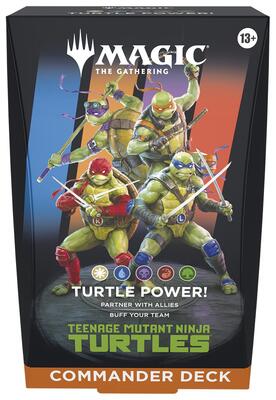
Turtle Power!
Counters and Mutagen tokens: straightforward. Out of the box, before any upgrades. How we rate precons
Buy Turtle Power! on TCGplayer →Quick verdict
Turtle Power! is for a player who wants a five-color, go-wide counters deck without having to build the mana base for one from scratch. It's good out of the box for a casual table, since Leonardo's ability turns every token the deck makes into a counter on the whole board, and the Character Select partner mechanic means the same box plays differently depending on which turtle joins him. Its biggest weakness is the five-color mana base itself: even with generous fixing, five colors is five colors, and an awkward opening hand can cost a turn or two before the deck does anything.
TurnZero rates Turtle Power! a 3 out of 5 on strength and a 2 out of 5 on difficulty, one of the more approachable precons to pick up and play. See it alongside every other precon we cover on the precon directory.
How the precon plays
Leonardo, the Balance puts a +1/+1 counter on every creature you control once per turn, any time a token enters, so the deck's real job is making tokens as cheaply and often as possible. Whichever partner joins him supplies a different kind of token: Donatello, the Brains and Raphael, the Muscle both add a Mutagen token to whatever else enters, Michelangelo, the Heart makes Food, and Splinter, the Mentor makes a Mutagen every time a nontoken creature you control leaves the battlefield.
Corpsejack Menace and High Score double up on whatever counters land, and payoffs like Biogenic Ooze and Voracious Hydra turn a wide, countered board into real damage fast. Heroes in a Half Shell is the deck's five-color payoff proper: it grows the whole team and draws a card every time a Mutant, Ninja, or Turtle connects.
Which partner should join Leonardo?
Leonardo, the Balance has Partner—Character select, meaning he can pair with any of the deck's four other Character Select legends. Each pairing changes what kind of tokens the deck is actually making.
Donatello is the simplest and most consistent pairing for a first game, since it multiplies whatever the rest of the deck is already doing. Raphael rewards a build that leans harder into the deck's counters payoffs for a faster clock, and Michelangelo or Splinter fit a slower, grindier table better than an aggressive one.
What works out of the box
Corpsejack Menace ↗
Doubles every +1/+1 counter the deck produces, stacking directly with Leonardo's own trigger.
Biogenic Ooze ↗
Makes a token on entry and grows every Ooze you control each turn, a real go-wide engine on its own.
Big Mother Mouser ↗
Doubles its own counters on attack and leaves behind value when it dies. A strong, self-sufficient threat.
Leatherhead, Iron Gator ↗
Puts two counters on the whole team on every attack, turning a wide board into a much bigger one fast.
Heroes in a Half Shell ↗
The deck's five-color payoff: grows the team and draws cards off Mutant, Ninja, or Turtle damage.
Coin of Mastery ↗
Rewards spending artifact mana on creatures with extra counters, and makes Treasures on top.
What needs improvement
Five colors is always going to be the hardest mana base to build, and this precon's fixing (thriving lands, the tri-lands, Chromatic Lantern) is a fine starting point but worth reinforcing early. See the Land & Mana Base Guide → before anything else, since more fixing is the single highest-leverage upgrade this exact 99 can get.
The deck also runs three separate full board wipes, which is redundant for a go-wide plan that wants its own board to survive. See What Makes a Curve and Why It Matters → for how to weigh trimming that redundancy, and the +1/+1 Counters archetype guide → for how go-wide counters decks typically protect the board instead of wiping it.
10 cards to cut
Each of these has a real function, but this specific 99 has better options for the slot.
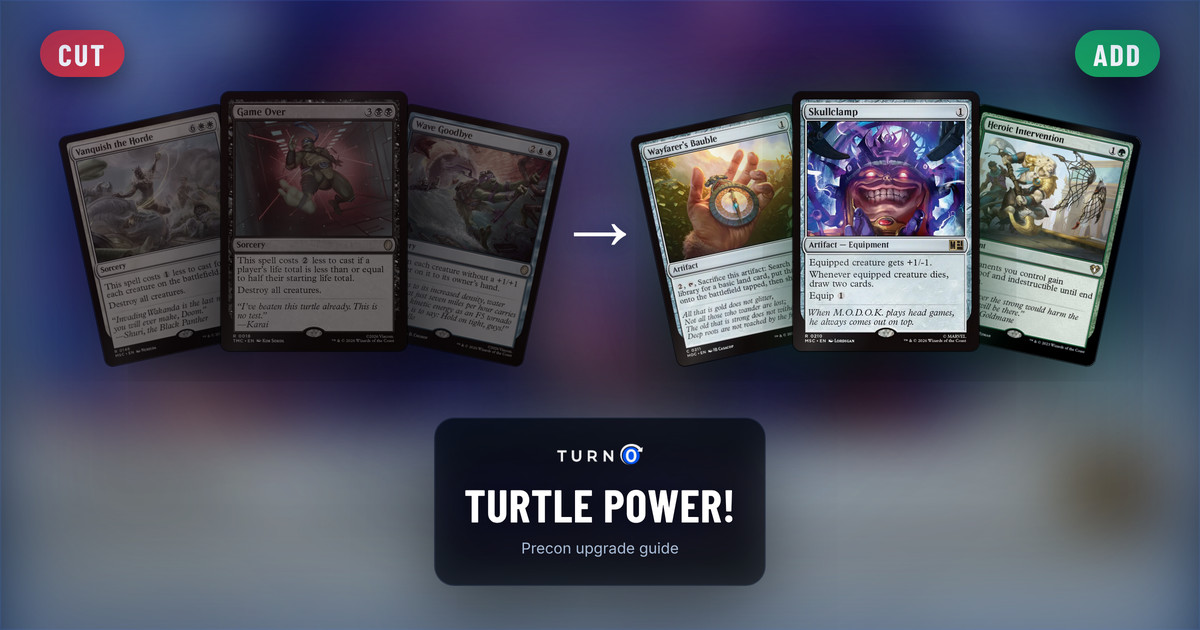
Vanquish the Horde is the deck's third full board wipe, redundant once Blasphemous Act is doing the same job more efficiently.
Game Over is another full board wipe that only gets cheap once a player is already at half life, unreliable timing on top of the redundancy.
Wave Goodbye only bounces creatures without a counter on them, a soft effect next to the deck's real removal.
Exploding Barrel needs eight mana and a tap to deal its damage, far too slow to matter most games.
Mole Module needs Crew 2 and combat damage to connect before its mill ever pays off, a lot of setup for a marginal reward.
Mona Lisa, Science Geek only taps for mana equal to her own power, which is small before the deck's counters show up.
Roadkill Rodney needs real Squad investment to be worth the slot, awkward next to the deck's cheaper token sources.
Tempestra, Dame of Games needs a spare artifact to sacrifice every activation, a narrow resource this precon doesn't generate reliably.
Electric Seaweed is a defensive Wall whose one-turn damage trigger does very little once that turn passes.
Double Jump // Flying Kick is a pair of minor combat tricks that don't advance the counters plan the way the deck's other spells do.
First upgrades
Budget, first
Wayfarer's Bauble ↗
More of the fixing this exact five-color manabase needs most, for one mana.
Skullclamp ↗
Turns any small Ninja or Rat token the deck makes into two cards the moment it's done its job.
Next
Heroic Intervention ↗
Protects the whole go-wide board from exactly the kind of wipe this deck's own three sweepers were trying to avoid needing.
Beast Whisperer ↗
Draws a card off every creature cast, refilling the hand as the wide board empties it.
Higher-investment
Doubling Season ↗
Doubles both the +1/+1 counters Leonardo hands out and every Mutagen, Food, or Treasure token the deck makes. The single best fit for this exact plan.
Anointed Procession ↗
A second token doubler, stacking with Doubling Season to build a wide board quickly.
Smothering Tithe ↗
Punishes the table for drawing extra cards in a deck that's already five colors deep into good stuff.
Win conditions
The upgraded deck still wins the way the precon wants to: make tokens, let Leonardo, the Balance and Corpsejack Menace turn them into counters across the whole board, doubled further by Doubling Season and Anointed Procession, then close with a wide alpha strike backed by Heroes in a Half Shell's card draw. Heroic Intervention is what turns that board from a one-time threat into a repeatable clock once the table starts looking for an answer.
The upgraded 99, in shape
The finished list keeps the precon's core engine untouched (Leonardo and whichever partner leads, the Mutagen and Food support, Corpsejack Menace) and doubles down on it with Doubling Season and Anointed Procession layered on top. The redundant board wipes and narrow filler are gone, replaced by real protection and more fixing for a demanding five-color manabase. The deck still plays the same wide, counters-first game it always did; it just gets there faster and survives the sweeper that used to be its own backup plan.
Who should buy this precon
A good fit for a player who wants an easy entry point into five-color Commander without building the mana base from scratch, and for anyone who likes a deck that plays differently depending on which partner is in the command zone. It's a weaker fit for a player who dislikes color-screw variance, since even solid fixing can't fully remove the risk that comes with five colors.
Track how the upgrades actually perform.
TurnZero HQ keeps a win rate per deck version, so you can change ten cards, play ten games, and see the difference instead of guessing.
Create Free Account