Precon Upgrade Guide
Witherbloom Pestilence Upgrade Guide
What to cut, what to add, and how to play the Golgari precon from Secrets of Strixhaven, commanded by Dina, Essence Brewer.
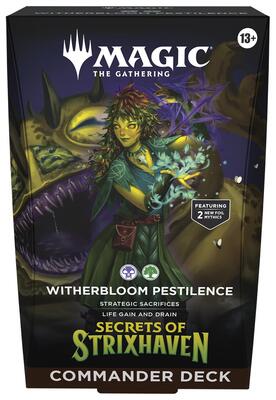
Secrets of Strixhaven
Witherbloom Pestilence
Sacrifice timing paired with life-total swings. Out of the box, before any upgrades. How we rate precons
Buy Witherbloom Pestilence on TCGplayer →Quick verdict
Witherbloom Pestilence is for a player who wants to sacrifice small creatures for real value: cards, life, and +1/+1 counters on a threat that keeps growing. It's good out of the box for a grindy multiplayer table, since the deck's Pest tokens and sacrifice payoffs generate a steady trickle of advantage that adds up over a long game. Its biggest weakness is speed: this precon has very little reach to close a game quickly, so a table that ends games fast can beat it to the punch before the sacrifice engine gets fully online.
TurnZero rates Witherbloom Pestilence a 3 out of 5 on strength and a 3 out of 5 on difficulty, with real payoff in exchange for correctly timing when to sacrifice. See it alongside every other precon we cover on the precon directory.
How the precon plays
Dina, Essence Brewer draws a card the first time each turn you sacrifice a creature, and can turn a sacrifice into life and +1/+1 counters on demand, so the deck wants a steady stream of small creatures to feed her. Priest of Forgotten Gods, Viscera Seer, and Woe Strider are the deck's free or near-free sacrifice outlets, while Blood Artist and Zulaport Cutthroat turn every death, yours or an opponent's, into life loss and life gain across the table.
Mazirek, Kraul Death Priest puts a +1/+1 counter on every creature you control whenever anyone sacrifices a permanent, which snowballs fast once Mycoloth or Gyome, Master Chef are producing tokens for free every turn. Beledros Witherbloom is the top end: a flier that hands out a Pest token every upkeep for the whole table to keep the sacrifice engine fed.
Dina, Essence Brewer vs. Gorma, the Gullet
Both commanders reward sacrificing creatures, but they turn that habit into different shapes of advantage.
Dina is the better fit for a slow, grindy build that wants consistent card draw off a small sacrifice each turn. Gorma rewards a build that clusters its sacrifices into bigger turns, feeding off board wipes or a sacrifice-outlet chain rather than one creature at a time.
What works out of the box
Priest of Forgotten Gods ↗
Turns two creatures into two mana, a card, and real damage to the table. The deck's best single engine piece.
Mazirek, Kraul Death Priest ↗
Grows the whole board every time anyone sacrifices a permanent, table-wide sacrifice included.
Blood Artist ↗
Drains and gains off every creature death, its own or anyone else's. A cheap, constant source of pressure.
Mycoloth ↗
Devours creatures on entry for size and keeps making Saproling tokens for free every upkeep after.
Woe Strider ↗
A free sacrifice outlet that comes with its own body and returns from the graveyard later.
Ophiomancer ↗
Refills a 1/1 deathtouch Snake every upkeep as long as none survives, endless sacrifice fodder.
What needs improvement
The manabase is a solid two-color base already; see the Land & Mana Base Guide → if the basics ratio needs adjusting as upgrades come in. The bigger issue is the curve's lack of a real finisher: see What Makes a Curve and Why It Matters → for how to weigh adding a genuine closer against the deck's existing density of small value creatures.
This precon also has very little reach once the board is stable, since draining a point or two of life per death is slow against a table starting at 40. See the Aristocrats archetype guide → for how decks built around sacrifice payoffs typically add a faster, more direct clock on top.
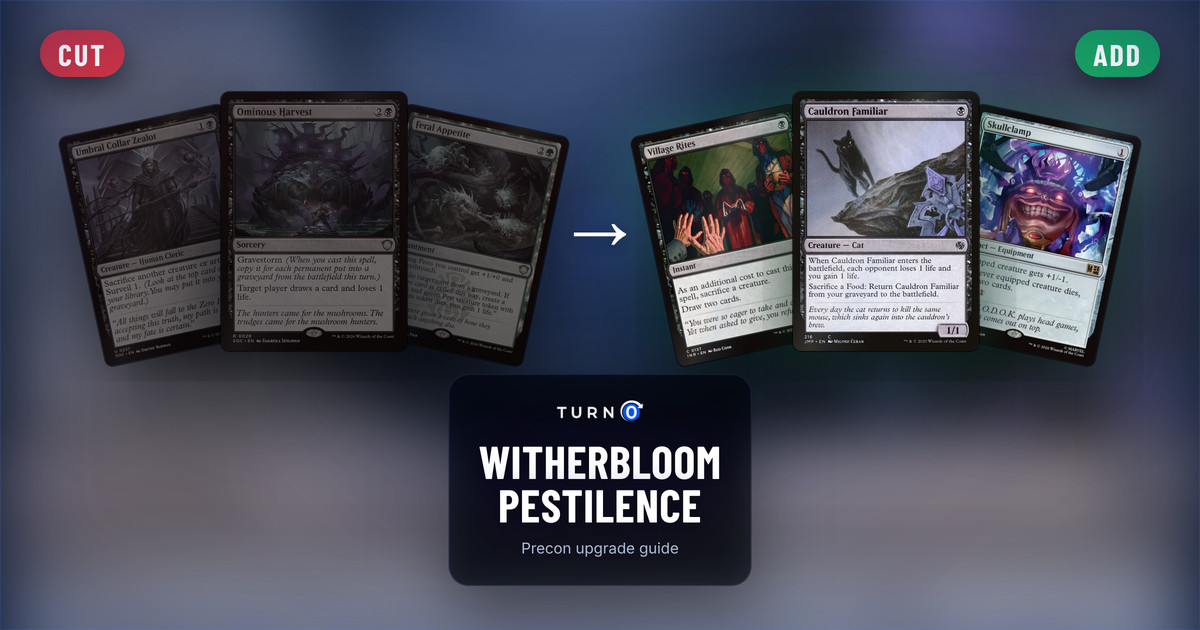
10 cards to cut
Each of these has a real function, but each does less for this deck's plan than the upgrades below.
Umbral Collar Zealot only offers a single scry off a sacrifice, a weak return next to the deck's other, far more rewarding sacrifice outlets.
Ominous Harvest is a middling draw spell whose copy mode needs several permanents to have already died that turn to matter.
Feral Appetite duplicates Blight Mound's Pest buff in a redundant slot without meaningfully improving on it.
Bloodghast's haste only turns on once an opponent is already at 10 life or less, a condition this precon rarely creates on its own.
Veinwitch Coven needs black mana held up on your own life-gain trigger, an awkward ask next to the deck's other, unconditional recursion.
Trudge Garden needs repeated life gain plus two extra mana for a single 4/4, too slow a payoff for the enchantment slot.
Smothering Abomination forces a sacrifice every upkeep whether or not there's real fodder to spare, a real cost as often as a benefit.
Nether Traitor's shadow evasion doesn't fit a midrange sacrifice shell that isn't otherwise trying to attack for damage.
Haywire Mite only answers noncreature artifacts and enchantments, a narrow tool next to the deck's broader removal.
Awakening Zone is a slow, replaceable token generator competing with the deck's stronger ramp and sacrifice-fodder sources.
First upgrades
Budget, first
Village Rites ↗
A free cantrip off a sacrifice at instant speed, the cheapest possible way to add more of the deck's own trigger.
Cauldron Familiar ↗
A recurring drain that loops with any sacrifice outlet already in the 99.
Next
Skullclamp ↗
The deck's own 1/1 Pest tokens turn into two cards each the moment they've done their job.
Poison-Tip Archer ↗
Drains a point of life every time one of the deck's many tokens dies, on top of what Blood Artist already does.
Bastion of Remembrance ↗
A cheap, passive drain that stacks with the deck's existing sacrifice-death payoffs.
Higher-investment
Win conditions
The upgraded deck still wins the way the precon wants to: feed small creatures and Pest tokens into Priest of Forgotten Gods and Ashnod's Altar, growing Mazirek, Kraul Death Priest and the board with every death while Blood Artist and Poison-Tip Archer drain the table down in the background. Toxic Deluge clears anything that threatens to outrace that plan, and the accumulated drain from a full game of sacrifices is usually enough to finish the job on its own.
The upgraded 99, in shape
The finished list keeps the precon's core engine untouched (whichever commander leads, Priest of Forgotten Gods, the Pest and Food token suite, Mazirek, Kraul Death Priest) and adds the faster sacrifice outlets and real drain payoffs it was missing to turn a slow value engine into an actual clock. The narrow and conditional filler is gone, replaced by cheap interaction and a board wipe the precon never had. The deck still plays the same patient, attrition-based game it always did; it just closes it out instead of grinding forever.
Who should buy this precon
A good fit for a player who enjoys a sacrifice-and-value deck that rewards careful sequencing over raw speed, and for anyone who likes turning a table's own removal against it through drain triggers. It's a weaker fit for a fast pod, since this precon's plan takes real time to snowball and has little natural reach until it does.
Track how the upgrades actually perform.
TurnZero HQ keeps a win rate per deck version, so you can change ten cards, play ten games, and see the difference instead of guessing.
Create Free Account