Precon Upgrade Guide
Quandrix Unlimited Upgrade Guide
What to cut, what to add, and how to play the Simic precon from Secrets of Strixhaven, commanded by Zimone, Infinite Analyst.
Secrets of Strixhaven
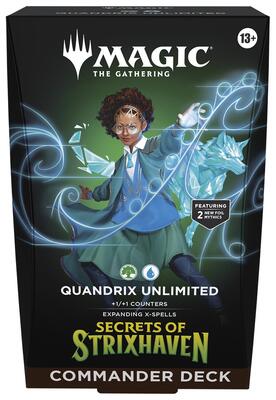
Quandrix Unlimited
X-spells and counter math, the most demanding of the five. Out of the box, before any upgrades. How we rate precons
Buy Quandrix Unlimited on TCGplayer →Quick verdict
Quandrix Unlimited is for a player who wants to grow one or two enormous threats out of X spells and +1/+1 counters rather than go wide with a full board. It's good out of the box for a table that plays a normal pace of Commander, since the counter-doubling package here is strong and the Hydra suite scales naturally into a long game. Its biggest weakness is the math: a lot of this deck's power depends on correctly sequencing X spells and counter-doubling triggers, which is exactly the kind of bookkeeping that punishes a rushed turn.
TurnZero rates Quandrix Unlimited a 4 out of 5 on strength and a 4 out of 5 on difficulty, the most demanding of the five Secrets of Strixhaven precons to pilot well. See it alongside every other precon we cover on the precon directory.
How the precon plays
Zimone, Infinite Analyst discounts the first X spell cast each turn by one mana per +1/+1 counter on her, and grows by two counters the first time that happens each turn, so the early turns are about landing cheap X spells to get her rolling before the bigger ones come down for less. Counter-doubling pieces like Ozolith, the Shattered Spire, Kami of Whispered Hopes, and Tanazir Quandrix then turn every X spell into far more counters than it looks like it should produce.
The Hydra suite (Hydroid Krasis, Primordial Hydra, Goldvein Hydra, Benevolent Hydra) does most of the actual damage, while colorless X-cost bodies like Hangarback Walker and Stonecoil Serpent give the deck a way to size a threat to exactly the mana available on any given turn. Magecraft creatures (Deekah, Fractal Theorist, Quandrix Apprentice) reward the deck's handful of instants and sorceries with Fractal tokens or extra card selection on top.
Zimone, Infinite Analyst vs. Primo, the Unbounded
Both commanders push the same X-spell shell in different directions, and the choice changes what the deck's mana is actually for on a given turn.
Zimone is the better fit for a build leaning on the deck's existing spread of small-to-medium X spells across a whole game. Primo rewards ramping hard into one big turn and building around 0-power Fractal tokens rather than a wide, incremental board.
What works out of the box
Ozolith, the Shattered Spire ↗
Turns every +1/+1 counter the deck makes into one extra, and survives its creature dying to keep growing the next one.
Tanazir Quandrix ↗
Doubles the counters on a creature on entry and can double them again on attack. The deck's cleanest payoff for its own plan.
Hydroid Krasis ↗
Draws cards and gains life scaled to X on cast, then leaves behind a body sized the same way. Efficient at any point in the game.
Primordial Hydra ↗
Doubles its own counters every upkeep if left unanswered, an exponential threat from a colorless-friendly cost.
Stonecoil Serpent ↗
Protection from multicolored dodges a huge amount of removal, and scales to whatever mana is open.
Kami of Whispered Hopes ↗
A second counter doubler and a mana sink in one body, stacking with Ozolith for even faster growth.
What needs improvement
The manabase is a reasonable Simic base already, but a deck this reliant on X spells wants mana to come in fast and untapped more than most. See the Land & Mana Base Guide → for how to weigh that tradeoff as upgrades come in. The curve also has a real gap between the cheap enablers and the Hydras that actually want a lot of mana behind them; see What Makes a Curve and Why It Matters → for how to smooth it.
The bigger gap is protecting the one or two threats this deck actually grows, since losing a heavily countered creature to a single removal spell erases several turns of investment at once. See the +1/+1 Counters archetype guide → for how decks built this way typically shore up that exact problem.
10 cards to cut
Each of these has a real function, but this specific 99 has better options for the slot.
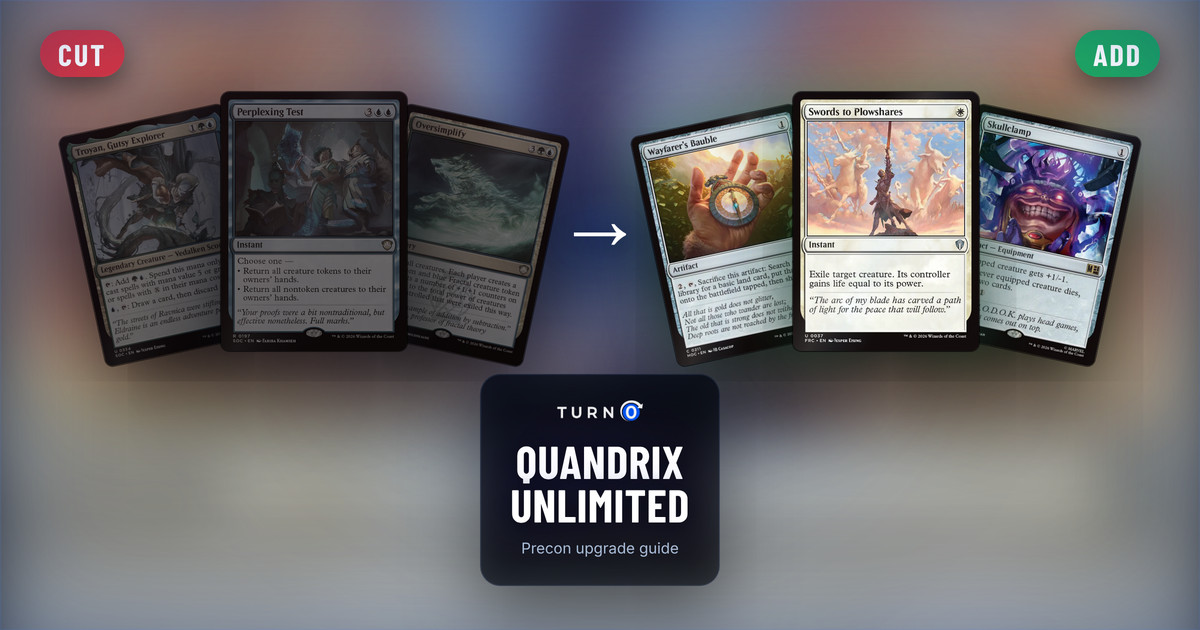
Troyan, Gutsy Explorer only makes mana for spells that cost five or more or have X in them, a narrow filter that leaves the mana dead against half the deck's own hand.
Perplexing Test bounces creatures on both sides of the table, undoing the deck's own counter investment as often as an opponent's board.
Oversimplify hands every opponent a Fractal sized off their own board's total power, propping up whoever was already ahead.
Zimone's Hypothesis needs the right odd-or-even parity across the whole board to hit correctly, too conditional to plan a turn around.
Guardian Augmenter only buffs commanders specifically, doing nothing for the Hydra suite the deck actually wants to protect.
Deekah, Fractal Theorist wants a heavy instant-and-sorcery count this precon doesn't actually run, leaving it a Wizard that rarely triggers.
Kinetic Ooze is X-cost removal on a body that competes with the deck's own X-cost threats for the exact same mana.
Nexus Mentality only doubles up when you control a commander, a conditional mode stapled onto an otherwise unremarkable counter-shuffling spell.
Quandrix Charm's soft counter mode asks an opponent to pay two mana, which any ramp-heavy table simply pays around.
Astral Cornucopia ramps slower than a fixed two-mana rock for most of the game, a poor rate for the same artifact slot.
First upgrades
Budget, first
Wayfarer's Bauble ↗
Cheap ramp and fixing to get X spells online a turn sooner.
Swords to Plowshares ↗
Premium one-mana removal, a real upgrade over the deck's softer answers.
Next
Skullclamp ↗
Turns any small Fractal or Eldrazi Spawn-style token that would otherwise just sit there into two cards.
Beast Whisperer ↗
Draws a card off every creature cast, and this deck casts a lot of them.
Heroic Intervention ↗
Protects the one or two heavily countered threats this deck actually depends on from a single board wipe.
Higher-investment
Doubling Season ↗
Doubles both the +1/+1 counters this deck already stacks and any Fractal or Hydra tokens it makes. The single best fit for this exact plan.
Rhystic Study ↗
The format's best pure card-advantage engine, funding more X spells across a longer game.
Cyclonic Rift ↗
A one-sided reset that clears the way for whichever huge threat the deck has already grown.
Win conditions
The upgraded deck still wins the way the precon wants to: grow one or two Hydras or a countered Fractal well past what the table can profitably block, doubled further by Doubling Season and Tanazir Quandrix, then swing for a total that closes the game outright. Heroic Intervention or Fierce Guardianship-style protection is what turns that plan from a one-time bet into a repeatable clock, since this deck loses far more to a single answer than most.
The upgraded 99, in shape
The finished list keeps the precon's core engine untouched (whichever commander leads, the Hydra suite, Ozolith, the Shattered Spire, Tanazir Quandrix) and adds the two things it was missing: real protection for its one big threat and a doubling effect that makes every counter the deck already produces worth twice as much. The narrow, situational filler is gone, replaced by cheap interaction and a genuine card-advantage engine. The deck still plays the same patient, math-heavy game it always did; it just survives long enough to cash in on it.
Who should buy this precon
A good fit for a player who enjoys tracking counters and sequencing X spells for maximum value, and who doesn't mind a deck that spends several turns setting up before it threatens to win. It's a weaker fit for anyone who wants a straightforward, low-maintenance precon, since correctly playing around counter-doubling order is one of the fiddlier things Commander asks a player to track.
Track how the upgrades actually perform.
TurnZero HQ keeps a win rate per deck version, so you can change ten cards, play ten games, and see the difference instead of guessing.
Create Free Account