Disney Lorcana Rules Explained
How Shift Works in Lorcana
Shift lets you play a character on top of one you already have with the same name, usually for less ink. The new card is still played, and it takes over the old one's damage, its exerted or ready state, and whether it was dry. This page covers all of it, as of the Comprehensive Rules version 2.3.0 (October 16, 2026).
The short version
Comprehensive Rules · Rule 8.10.1
"If you have a card in play with the same name as this card, you may play this character by paying their Shift cost instead of their ink cost. If you do, put this card on top of another character you have in play with the same name. This is called shifting."
The usual misreading is that the new card is a fresh character. It isn't treated that way. It sits on top of the old card and continues where that character left off: if the old one was exerted, damaged or had been in play since the start of your turn, so is the new one. The Lorcana keywords guide has the short entry for Shift; this page goes through the rules behind it.
What you can shift onto
Plain Shift needs one of your characters in play with the same name. Name means the large name line only, not the version under it (rule 5.2.6), so Omnidroid - V.9 can go onto any character of yours named Omnidroid. You can only shift onto your own characters, and the card underneath has to be in play, so not a card already under another stack.
Some characters have two names joined by an ampersand, and they count as each name as well as the full one (rule 5.2.6.1). Woody & Buzz Lightyear - Best Buddies has Shift 5 onto a character named Woody or one named Buzz Lightyear, as its reminder text says. The variants further down widen or change what you can shift onto.
What the shifted character keeps, and what it doesn't
As the new card goes on top, the card underneath loses its states and the new card takes them (rule 5.1.3, Example B). Section 8.10 spells out each one:
Damage carrying over is the part that costs games. A shifted character with a higher Willpower can survive damage that would have banished the one underneath, but it doesn't start clean. Shift onto a character with 3 damage and the new card has 3 damage too.
Shifting still counts as playing the character
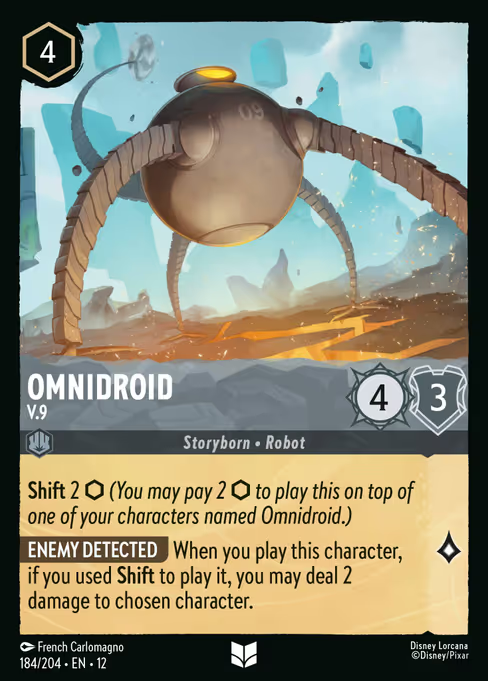
Shift is listed as an alternate cost (rule 1.5.5.2), so shifting is playing the card from your hand. The card enters play on top of the named character (rule 4.3.3.1), and its "When you play this character" abilities trigger and go into the bag (rule 4.3.4.1). Some cards add an extra condition: Omnidroid - V.9 reads "When you play this character, if you used Shift to play it, you may deal 2 damage to chosen character."
Because Shift is an alternate cost, you pick it or another way to pay, not both (rule 4.3.2.2). And if an effect lets you play a character "for free", you can't choose to shift it; the rules' example is a Donald Duck played from the discard by Pride Lands - Jungle Oasis, which can't use his Shift (rule 6.1.7).
The stack underneath
The shifted character and the cards under it form a stack (rule 5.1.1.7). Only the top card is in play. The cards under it aren't, they can't be chosen, and any player may look at them since they are faceup (rule 5.1.1.5).
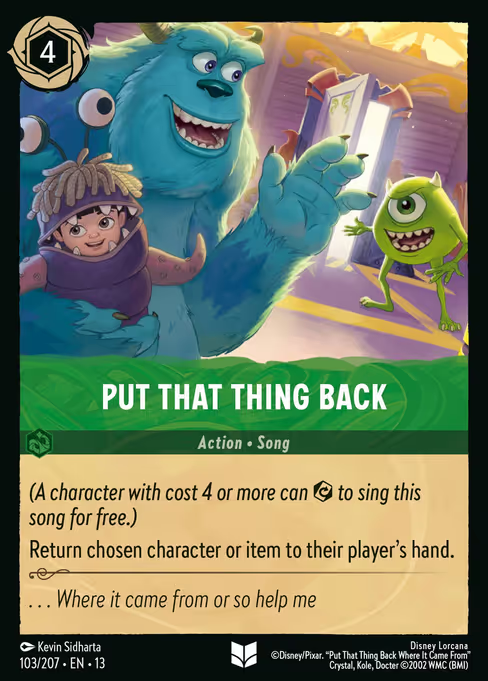
When the top card leaves play, every card in the stack goes with it to the same zone (rule 8.10.7). If the shifted character is banished, the whole stack goes to the discard pile. If an effect such as Put That Thing Back returns it to your hand, the whole stack returns to your hand. If the stack goes to the bottom of a deck "in any order", the cards can be ordered freely, and because they were faceup every player sees the order (rule 7.2.3).
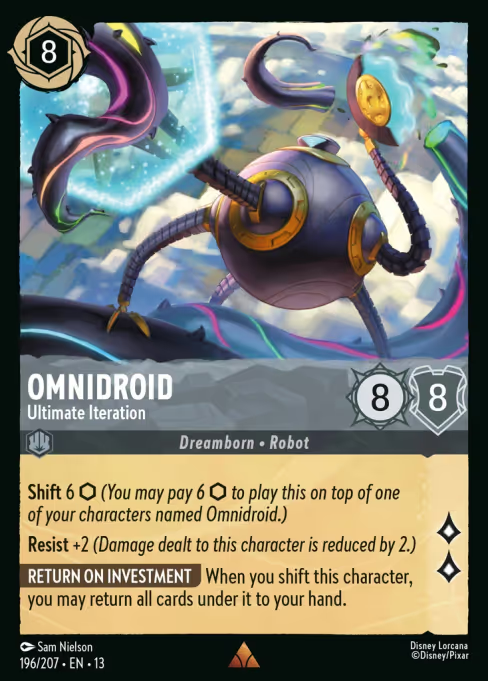
Some cards use the stack on purpose. Omnidroid - Ultimate Iteration may return all the cards under it to your hand when you shift it, so you can play the smaller Omnidroids again.
Shift variants
There are six variants of Shift as of October 2026 (rule 8.10.8). Each follows every Shift rule above except where its definition says otherwise.
Two characters underneath raise a question about states, and rule 8.10.4.2 answers it: on a dry and a drying character the result is drying, and on a ready and an exerted character it is exerted. A card with two variants combined, such as Temporary Red Panda Shift, must meet both (rule 8.10.9). Mickey Mouse & Minnie Mouse - Adventuring Duo has Duo Shift 0 onto a Mickey Mouse and a Minnie Mouse.
A worked example
Omnidroid - V.8 into Omnidroid - V.9
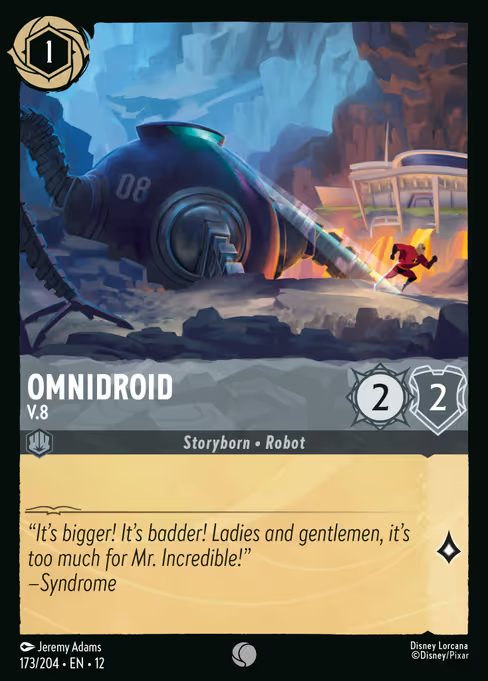
Turn one: you play Omnidroid - V.8 (cost 1, Strength 2, Willpower 2).
On your opponent's turn, one of their effects deals 1 damage to it. V.8 survives with 1 damage.
Your next turn: V.8 is dry and ready. You pay 2 ink to shift Omnidroid - V.9 (normally cost 4, Shift 2) onto it.
V.9 enters ready and dry, because V.8 was. It has the 1 damage from V.8 against its own Willpower of 3.
V.9 was played, so its ability triggers: you used Shift, so you may deal 2 damage to a chosen character.
V.9 can quest or challenge this turn. If it is banished later, V.8 goes to the discard pile with it.
Common Shift mistakes
Removing damage when you shift. The shifted character keeps it.
Waiting a turn to quest with a shifted character. If the card underneath was dry, the new one can act now.
Shifting onto a character you played this turn and expecting to quest. The shifted character is drying too.
Skipping "When you play this character" abilities on a shifted card. Shifting is playing it.
Leaving the cards underneath in play when the top card is banished. The whole stack moves together.
Looking for a matching version. Shift checks the name only.
Frequently Asked Questions
How does Shift work in Lorcana?
Shift is an alternate cost. If you have a character in play with the same name, you can pay the Shift cost instead of the card's ink cost and put the new card on top of that character. The new card takes over its ready or exerted state, whether it was dry, and its damage.
Can a shifted character quest the turn it is played?
Yes, if the character underneath was dry. A shifted character enters play dry when it is put on a dry character, and drying when it is put on one that is drying. It also enters exerted if the card underneath was exerted.
Does shifting count as playing the character?
Yes. Shift is a way of paying for the card, so the character is played, and its "When you play this character" abilities trigger. Some cards check "if you used Shift to play" them for an extra effect.
Does the shifted character keep damage?
Yes. A shifted character keeps all the damage that was on the character or characters it was put on top of.
Does the shifted character get the abilities of the card underneath?
No. The top card has only its own text. Effects that were already applying to the character underneath when you shifted, such as a Strength bonus for the turn, do carry over.
What happens to the cards under a shifted character?
They stay under it and aren't in play, so they can't be chosen. When the top card leaves play, every card in the stack goes with it to the same zone: banished together to the discard pile, or returned together to your hand.
Do you need the same version to shift?
No. Shift checks the name only, not the version. Any character named Omnidroid can be shifted onto by an Omnidroid with Shift, whatever their versions.
Build your Lorcana deck.
The Deck Lab checks a Lorcana deck against Core Constructed or Infinity as you build it. Free on iPhone, Android and the web.
Create Free AccountDisney Lorcana card names and images are the property of Disney and Ravensburger and their respective owners. ©Disney. TurnZero HQ is not affiliated with, sponsored, or endorsed by Disney or Ravensburger. Card data and prices come from Lorcast, which republishes TCGplayer market prices.