Disney Lorcana Rules Explained
Lorcana Inkwell Rules
Your inkwell is your ink: each card in it pays 1 for anything, whatever its color, and once a card goes in you can't look at it again. This page covers inking, extra ink, cards that go into the inkwell by an effect, and ink drops, as of the Comprehensive Rules version 2.3.0 (October 16, 2026).
The short version
Two inkwell rules surprise most new players. Ink has no color: every card in your inkwell is 1 ink, whatever ink type is printed on it. And the inkwell is hidden from you as well as your opponent: once a card goes in facedown, you can't check what it was.
Comprehensive Rules · Rule 7.5.1
"These cards are ink cards and each represents 1 [ink] the player can use to pay ink costs. Nothing on the front of an ink card affects the ink it generates."
The basic action, inking one card per turn, is covered on the Lorcana turn structure page. This page goes through the rest of the inkwell's rules.
Inking a card, step by step
Inking is a turn action, so you can only do it during your own Main Phase (rule 4.1.2). Rule 4.2.1 gives the steps:
The card must come from your hand and must have the symbol (rule 5.2.3). Inking is optional, and there is no limit to how many cards your inkwell can hold (rule 7.5.3). The decision is which card in your hand you need least, since a card in the inkwell can't be played.
Inking more than one card a turn
The once-per-turn limit applies to the inking turn action (rule 4.2.3). An effect that lets you put an "additional" card into your inkwell raises that limit for as long as the effect applies (rule 4.2.3.1), and you ink the extra card with the same reveal-and-check steps (rule 7.5.5).
The rules' example is Belle - Strange but Special, whose ability reads "During your turn, you may put an additional card from your hand into your inkwell facedown." With one Belle you can ink two cards a turn, and with two Belles, three. If you ink your extra card, then Belle leaves play and you play her again, you don't get another one: the additional card has already been inked that turn. Belle is from The First Chapter, so she is legal in Infinity but not Core Constructed as of October 2026.
Cards put into the inkwell by an effect
Many cards put a card into an inkwell directly, from the top of a deck, the discard pile, the hand or even play. Those follow different rules from inking (rules 4.2.3.2 and 7.5.6):
Most of these effects say "facedown and exerted". An exerted ink card can't be used to pay a cost, since paying ink means exerting ready cards (rule 4.3.2.4), so that ink is available from your next turn. Mickey Mouse - Detective is an example: he has no inkwell symbol himself, and when you play him you may put the top card of your deck into your inkwell facedown and exerted.
The card doesn't have to be yours to start with or to come from your deck. Let It Go puts a chosen character into its player's inkwell, so an opposing character becomes ink for your opponent. That removes it from play without banishing it, which the banish guide explains.

Mickey Mouse - Detective
Whispers in the Well #160
Not inkable, but inks the top card of your deck, exerted.

Laugh Canister
Attack of the Vine! #172
An item that inks the top card of your deck each time it is used.

Randall Boggs - Scary Smart
Attack of the Vine! #153
Puts one of your own characters from play into your inkwell.

Let It Go
Winterspell #163
A song that puts any chosen character into its player's inkwell.
What you can and can't see
The inkwell is a private zone, alongside the hand and the deck (rule 7.1.3.1), and it is stricter than your hand: you can look at your own hand but not your own inkwell.
Comprehensive Rules · Rule 7.5.4
"Players can't look at a card in an inkwell at any time, even their own. Players can count the number of cards in any inkwell at any time."
Ink type still matters elsewhere. A Constructed deck can't have more than two ink types (rule 1.10.1.1), and cards can mention an ink type (rule 5.2.5), but neither has anything to do with which ink pays for what. The Lorcana ink colors guide covers the six inks.
Paying with ink
To pay an ink cost you exert that many ready cards in your inkwell, remove ink drops, or a combination of the two (rule 4.3.2.4). A cost has to be paid in full (rule 1.5.3); if you start playing a card and find you are short, the play is undone and your ink readies again (rules 1.7.6 and 1.7.7, Example A). All your ink readies in the Ready step at the start of your turn (rule 3.2.1.1).
A few cards ready ink mid-turn. Belle & Beast - Certain as the Sun reads "Whenever this character quests, ready all cards in your inkwell," which gives you a second full inkwell to spend that turn.

Ink drops
Hyperia City (set 14) added ink drops, the game's second kind of counter after damage counters. Effects create them in your inkwell, and you can remove any number of them to pay that much ink toward any ink cost (rule 1.13.1.2). A removed ink drop is gone (rule 1.13.2).
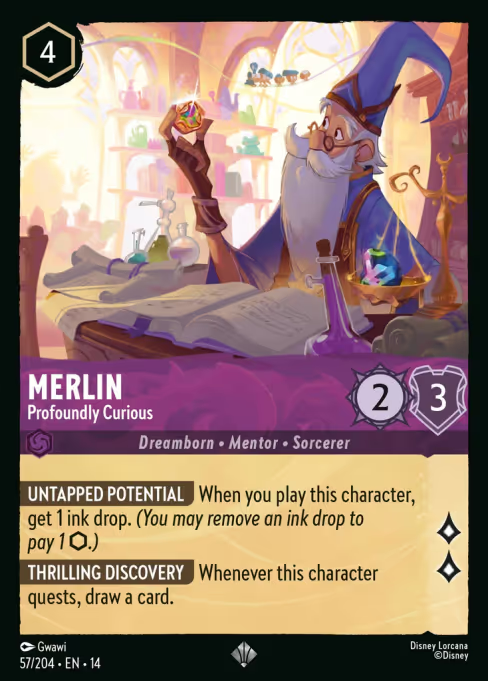
Ink drops aren't cards, and the rule is explicit that "Ink drop counters don't count as [ink]." So they don't add to a count of cards in your inkwell. Merlin - Profoundly Curious, for example, gives you 1 ink drop when you play him.
Common inkwell mistakes
Checking your inkwell to remember what you inked. Nobody can look at inkwell cards, including their owner.
Saving Amber ink for Amber cards. Ink has no color; any ink card pays for any card.
Counting a card put in "facedown and exerted" as ink you can spend this turn. It readies next turn.
Skipping your hand ink because an effect already inked a card. Effects that ink directly don't use up your once-per-turn action.
Inking on your opponent's turn. Inking is a Main Phase turn action, and only the active player takes turn actions.
Frequently Asked Questions
Can you look at the cards in your own inkwell in Lorcana?
No. The inkwell is a private zone, and the rules say no player can look at a card in an inkwell at any time, even their own. Anyone can count the cards in any inkwell and see which are exerted.
Does ink color matter in the inkwell?
No. Every card in your inkwell is 1 ink, and nothing on its front changes the ink it makes. An Amber card in your inkwell pays for a Steel card. Ink color matters for building a deck (no more than two inks in Constructed) and for cards that mention an ink type, not for paying costs.
Can you ink more than one card per turn in Lorcana?
Only with an effect. Inking from your hand is once per turn. A card that lets you put an "additional" card into your inkwell raises that limit, and effects that put a card straight into your inkwell don't count toward it at all.
Can you ink a card without the inkwell symbol?
Not with your once-per-turn inking. A card effect that puts a card into your inkwell can, because cards put there by an effect don't need the symbol and aren't revealed.
Can you use ink the turn you put it in your inkwell?
A card you ink from your hand enters the inkwell ready, so you can spend it that turn. Many effects that ink a card say it goes in "facedown and exerted"; that card can't be spent until it readies, normally in the Ready step of your next turn.
Is there a maximum inkwell size in Lorcana?
No. There is no limit to the number of cards in an inkwell, and you never have to ink a card on a turn if you don't want to.
What are ink drops in Lorcana?
Ink drops are counters that Hyperia City (set 14) cards create in your inkwell. You can remove any number of them to pay that much ink toward a cost. They aren't cards and don't count as ink, so they don't count as cards in your inkwell.
Build your Lorcana deck.
The Deck Lab checks a Lorcana deck against Core Constructed or Infinity as you build it. Free on iPhone, Android and the web.
Create Free AccountDisney Lorcana card names and images are the property of Disney and Ravensburger and their respective owners. ©Disney. TurnZero HQ is not affiliated with, sponsored, or endorsed by Disney or Ravensburger. Card data and prices come from Lorcast, which republishes TCGplayer market prices.