Riftbound
Riftbound 2v2 Rules
In Riftbound 2v2, two teams of two race to 11 shared points, turns alternate between the teams, and you can play cards on your teammate's turn. This guide covers setup, turn order, scoring with an ally and the 2v2 ban list, as of Riot's October 2026 rules.
Riftbound 2v2 at a glance
2v2 is one of Riftbound's five sanctioned modes of play. Riot's Core Rules call it Magma Chamber; players and stores mostly just say 2v2. Everything not listed here works as it does in a 1v1 game.
Setup and turn order
Every player brings a full deck with 3 battlefields. Once the first player is known, that player removes all of their battlefields from the game, and each of the other three picks one of theirs at random. That puts three battlefields on the table, the same count as a four-player War.
Turns alternate between the teams, so you never take two turns in a row on the same side. The Core Rules handle seating both ways: if teammates sit across from each other, turns go clockwise as normal, and if they sit side by side, the turn passes across the table. At an event, teammates sit next to each other in the order they registered, A then B, and the order is the first team's A player, the other team's A player, the first team's B player, then the other team's B player.
The first turn has the free-for-all adjustments rather than the 1v1 one. The first player doesn't draw a card in their first Draw Phase, and the player going last, the fourth seat, channels an extra rune in their first Channel Phase.
Playing with a teammate
You can act on your teammate's turn, but only when they let you. When your teammate has priority, they can invite you to play a spell or activate an ability using your own priority. When nothing else is happening on their turn, that includes spells and abilities without Action or Reaction, which you couldn't normally play on someone else's turn.
Control is not shared. Your units, runes and permanents are yours, and your teammate's are theirs. You can't give your teammate's units a standard move, you can't Hide a card at a battlefield they control, and a battlefield where your teammate has units is an invalid destination for yours, so the two of you can't stack units at one battlefield. Card text that says "friendly" does reach across the team: an effect like "ready a friendly unit" can target your teammate's units. XP isn't shared either: each player keeps their own.
Talking is allowed. Your hand is still private information, but you may show it to anyone at any time, including your teammate, and the Tournament Rules say teammates' strategic advice isn't outside assistance. Keep it quick: Riot asks teams to communicate "in a reasonably timely manner," and slow play is still a penalty.
Scoring with a teammate, and the final point
The team has one score. Both teammates always show the same number, a point either of you gains goes to the team, and a card that checks whether "you" gained or lost points checks your team. The team needs at least 11 in a cleanup and more points than the other team to win.
A battlefield scores for the team once per turn, not once per player. On top of that, a battlefield your teammate controls during the scoring step of your Beginning Phase can't be scored by your team that turn, by holding or by conquering. Riot's example: you can't get your partner to retreat from a battlefield and then conquer it yourself.
The final point rule has a matching adjustment. Once your team is on 10, a conquer only gives you the 11th point if you've scored every battlefield that turn, except the ones your teammate occupied during that turn's Beginning Phase scoring step. Holding a battlefield and points from card effects still aren't restricted. Riot's Radiance rules update (effective October 16, 2026) tidied this up so it applies to battlefields a team controls on its own or a teammate's turn, not on an opponent's. How scoring works in every mode →
Teammates win and lose together. If one of you concedes or loses, the whole team does, and at an event a game loss penalty for one teammate concedes the game for both.
2v2 decks and the 2v2 ban list
Each player brings their own deck, built under the normal constructed rules: 1 Legend, a main deck of 40 at events including your Chosen Champion, 12 runes, 3 battlefields, and up to 3 copies of a card by name. The 2v2 rules add two limits across the team: you and your teammate can't play the same Champion Legend, and you can't use the same battlefields. Riftbound deck construction rules →
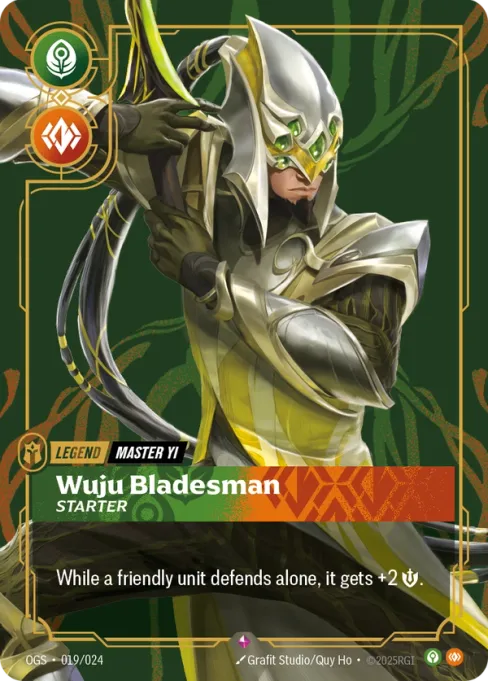
Since July 24, 2026, 2v2 Constructed has its own ban list. Riot defined it as "the entirety Standard ban list" plus its own additions, and said future updates will say whether they apply to both formats. So far the only 2v2-only ban is Master Yi's Proving Grounds Legend, Wuju Bladesman, whose defensive bonus, in Riot's words, "extends to both you and your ally." It is still legal in 1v1 Standard. The full Standard and 2v2 ban list →
2v2 Sealed
A 2v2 event can be Constructed or Sealed. In 2v2 Sealed the team shares a single pool of 8 boosters, against the 6 a single Sealed player opens. The Sealed deck rules otherwise apply: a main deck of at least 25, any three domains or one plus your Legend's, no copy limit, and runes in your domains from any source. Riot's rules don't spell out how a team splits the pool, so check the event's announcement for anything it adds. Sealed, Draft and every other format →
2v2 at events
Most 2v2 you'll find is at Nexus Nights, Riot's weekly casual events, where the store chooses between 1v1, 2v2 and free-for-all. The event listing on playriftbound.com says which. Finding a Riftbound event →
For a 2v2 tournament, you and your teammate register together as a team, each with your own registration details, and say which of you is the A player and which is B. Some events let teams pick a team name. If one of you drops or is disqualified, the whole team is.
Keeping score in 2v2
TurnZero HQ's free score tracker has a 2v2 mode. With four players seated, choose 2v2 in setup and each team gets one shared score that either teammate can add to, with the first team to 11 that is ahead of the other declared the winner. When a conquer would be your final point and not every battlefield has scored, it reminds you of the rule; it can't see which battlefields your teammate held at the start of the turn, so the prompt states that exception for you to apply. The Riftbound score tracker →
The Deck Lab's 2v2 option checks a deck against the constructed rules and the 2v2 ban list. It checks one deck at a time, so compare Legends and battlefields with your teammate yourself.
Frequently Asked Questions
How many points do you need to win Riftbound 2v2?
11, and the team shares them. Both teammates always have the same score, and a point either one gains goes to the team. The team wins when it has at least 11 in a cleanup and more points than the other team.
Can teammates play the same Legend in Riftbound 2v2?
No. Riot's Core Rules say teammates may not use the same Champion Legend, and they may not use the same battlefields either. Each player builds and plays their own deck under the normal deck rules.
Can you help your teammate on their turn in Riftbound 2v2?
Yes. You can play spells and activate abilities during your teammate's turn when they invite you to, using your own priority, and that includes cards without Action or Reaction when nothing else is happening. You can't move their units, Hide cards at their battlefields or move your units onto a battlefield they occupy.
Is Master Yi banned in Riftbound 2v2?
His Proving Grounds Legend, Master Yi, Wuju Bladesman, is banned in 2v2 Constructed from July 24, 2026. Riot said its defensive bonus extends to both you and your ally. It is still legal in 1v1 Standard. Every card banned in Standard is banned in 2v2 as well.
Who goes first in Riftbound 2v2?
At an event, a random method picks which team decides, and that team chooses where in the turn order play begins. Play then alternates teams: the first team's A player, the other team's A player, the first team's B player, the other team's B player. After the first game, the team that lost the previous game chooses.
Can you show your hand to your teammate in Riftbound 2v2?
Yes. Your hand is still private information, but the rules let you show it to anyone at any time, including your teammate, and the Tournament Rules allow teammates to talk strategy during the game as long as they don't slow it down.
Keep one score for the team.
TurnZero HQ's score tracker plays 2v2 with a shared score per team, a reminder on the final point, and every game saved. Free on iPhone, Android and the web.
Create Free AccountTurnZero was created under Riot Games' "Legal Jibber Jabber" policy using assets owned by Riot Games. Riot Games does not endorse or sponsor this project. Card data comes from Riot Games' official Riftbound card gallery, and prices from TCGplayer via TCGCSV.