Every Riftbound turn runs through six phases in a fixed order: Awaken, Beginning, Channel, Draw, Main and Ending. The first four set you up, the Main Phase is where you play cards, move and fight, and the Ending Phase cleans up. This guide goes through each one under Riot's Core Rules of October 9, 2026.
The order never changes. What you do inside the Main Phase is up to you, but the phases themselves are fixed, and
a phase ends only when nothing is left to resolve in it.
PhaseWhat happensYour choices
1. AwakenYou ready everything you control: units, gear, runes and your Legend.None
2. BeginningStart-of-turn effects happen, then you score 1 point for each battlefield you control (a hold).Only what a card asks
3. ChannelYou put the top 2 runes of your rune deck into play, ready.None
4. DrawYou draw 1 card. An empty main deck makes you burn out first.None
5. MainYou play cards, move units and fight, in any order, as often as you can pay.Almost all of them
6. EndingEnd-of-turn effects happen, units heal, "this turn" effects end, and unspent Energy and Power are lost.Only what a card asks
Players remember the first four as ABCD. They are quick: in most turns you ready your cards, score what you hold,
put out two runes and draw, and you are in your Main Phase within a few seconds.
Awaken, Beginning, Channel and Draw
Awaken
Ready everything you control that is exhausted. That includes the runes you spent last turn, units that moved or
attacked, and a Legend whose ability you used. Your opponent's cards stay as they are until their own Awaken.
Beginning
The Beginning Phase has two steps. First, anything that says "at the start of your turn" or "at the start of your
Beginning Phase" happens. A Temporary unit dies here, which is why its reminder text says it dies before scoring.
Then comes the scoring step: you hold each battlefield you control and gain 1 point for each. Holding is the
reason to keep units on a battlefield at the end of your opponent's turn.
Channel
Put the top 2 runes of your rune deck into play. They enter ready, so you can use them this turn. If your rune
deck has fewer than 2 runes in it, you channel what is there.
Draw
Draw 1 card. If your main deck is empty, you burn out: shuffle your trash into a new main deck, choose an opponent
to gain 1 point, then draw. Running out of cards costs you a point rather than the game, but that point can be
the one that ends it. How to win at Riftbound covers
burning out in more detail.
The first turn
Going first is an advantage, so each mode gives the later players something back on their first turn. The
adjustment depends on the mode:
ModePlayer going firstPlayer going last
1v1 (Duel and Match)Draws normallyChannels 3 runes on their first turn
Free-for-all, 3 players (Skirmish)Skips their first drawChannels 3 runes on their first turn
Free-for-all, 4 players (War)Skips their first drawChannels 3 runes on their first turn
2v2Skips their first drawChannels 3 runes on their first turn
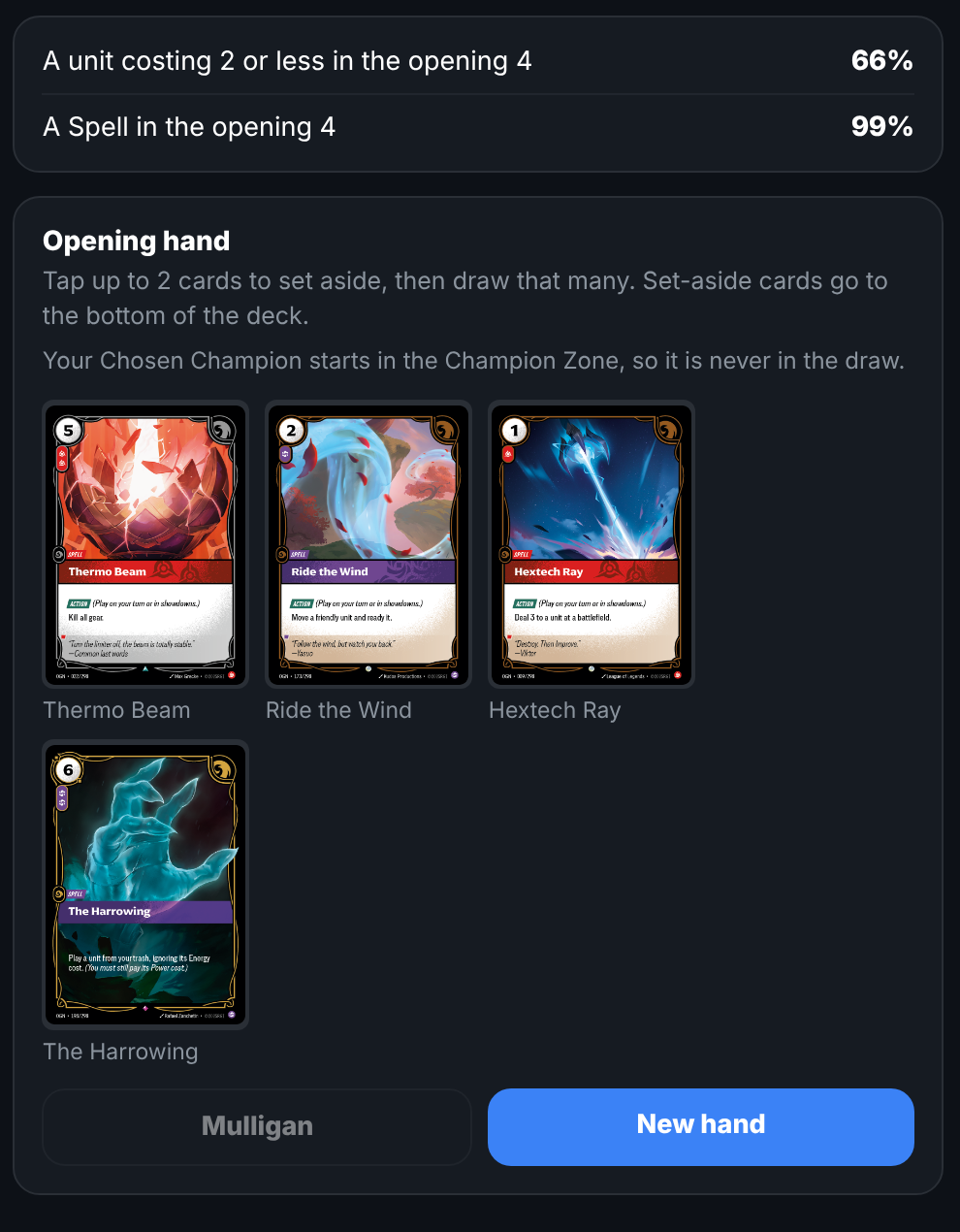
Before the first turn, each player draws 4 and may mulligan once: set aside up to 2 cards, draw that many, and put
the set-aside cards on the bottom of your deck. The player going first mulligans first.
Practicing the mulligan in TurnZero HQ's Deck Lab: tap up to 2 of your opening 4 to set aside, draw that many, and the set-aside cards go to the bottom. View full size
Runes, Energy and Power
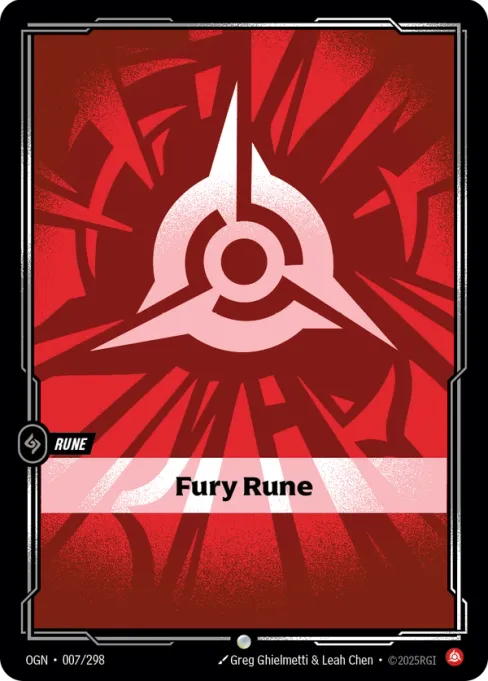
Runes pay for everything. Every basic rune has two abilities, and you can use them at any time you could play a
Reaction, including on your opponent's turn:
Rune abilityWhat it addsWhat it pays for
Exhaust the rune1 Energy, which has no domainThe number in the circle at the top left of a card
Recycle the rune to the bottom of your rune deck1 Power of the rune's domainThe domain symbols under that number
The two abilities have separate costs, so one rune can give you both: exhaust it for 1 Energy, then recycle it for
1 Power. The catch is that it leaves the board, so you have one fewer rune next turn until you channel it again.
Recycling is how you pay domain costs, and how much of it you do each turn is one of the main decisions in a
game. Some cards add Power of any domain instead, which the rules call universal Power.
What you add goes into your rune pool, and the pool empties at the start of your Main Phase and at the end of
every turn. Add Energy and Power when you are about to spend it, not before.
Riftbound runes explained covers the rune deck, how to split
it between your domains and the rune printings.
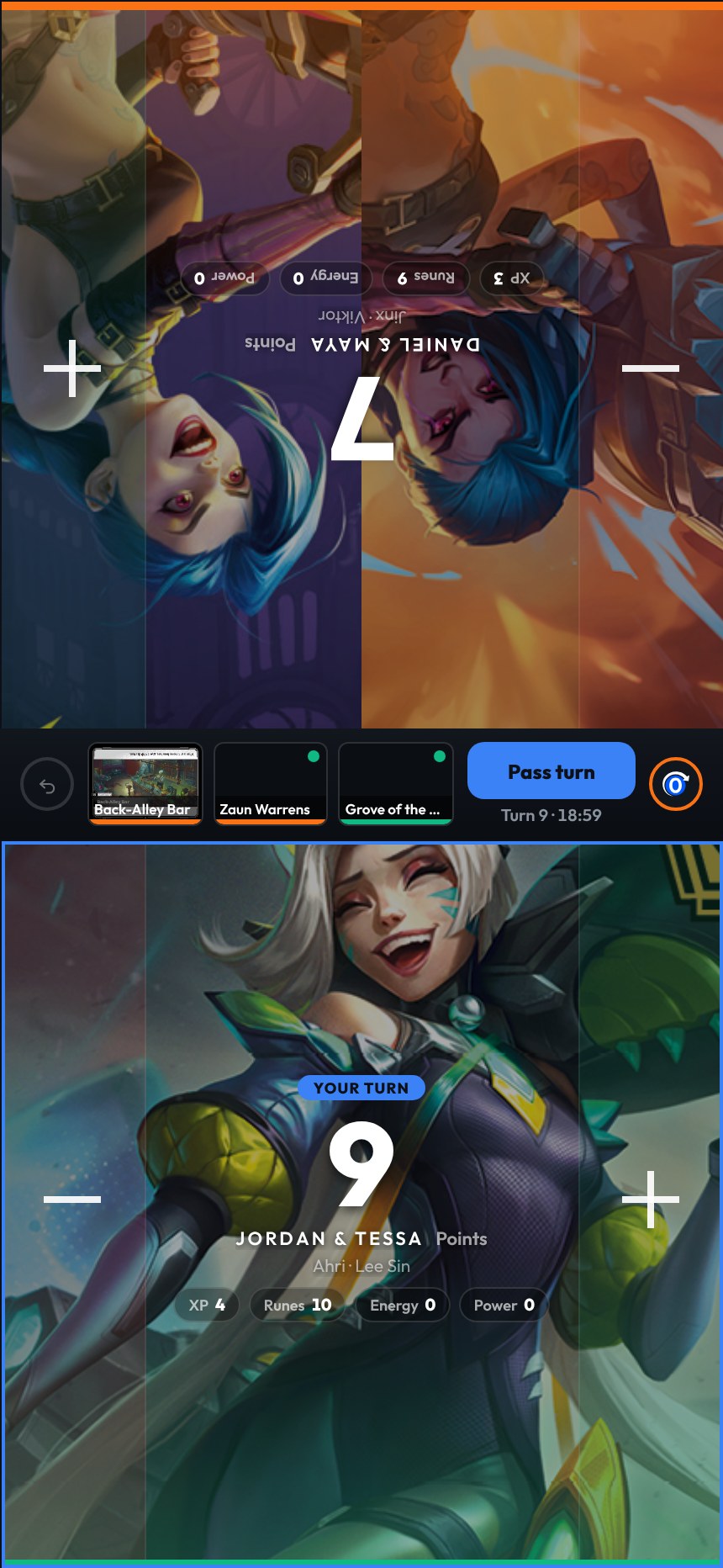
Keeping count at the table: TurnZero HQ's Rift mode can track each side's runes, Energy, Power and XP next to their points, and the turn number. View full size
The Main Phase
The Main Phase has no fixed order. You can do any of these, as many times as you can pay for them:
ActionHow it works
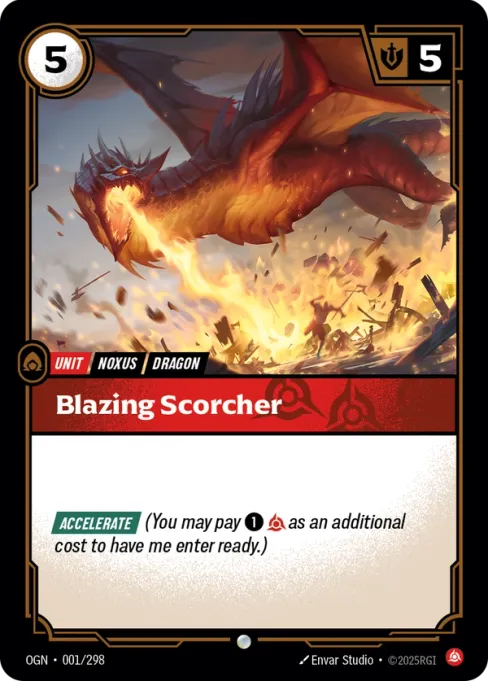
Play a unitPay its cost and put it in your base or at a battlefield you control. It enters exhausted unless you pay its Accelerate cost.
Play gearPay its cost and put it in your base. Equipment can then be attached to a unit with its Equip ability.
Play a spellPay its cost, do what it says, and put it in your trash.
Move unitsExhaust a ready unit to move it from your base to a battlefield, or from a battlefield back to your base. Units with Ganking can also move from one battlefield to another. Several units can move together if they go to the same place.
Use an abilityPay the cost before the colon on a unit, gear or your Legend.
Hide a cardPay 1 Power of any domain to put a card with Hidden facedown at a battlefield you control. You can play it from there on a later turn as a Reaction, ignoring its cost.
Moving onto a battlefield is how you fight and how you score. If an opponent's units are there, a combat starts;
if it is empty, a showdown starts, and you take control if you still have units there when it ends. Either one
interrupts your Main Phase until it is over, and then you carry on with whatever you have left.
How combat works covers that part of the turn.
A unit you play this turn usually can't move this turn, because it entered exhausted and moving costs exhausting
it. This is the rule new players miss most often. Playing a unit straight to a battlefield you already control is
the usual way around it, and Accelerate is the other.
When you have nothing else to do, say that you are ending your turn, and the Ending Phase begins.
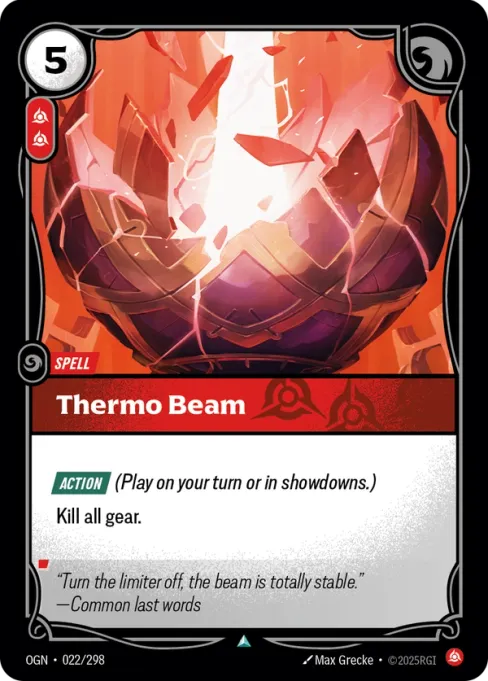
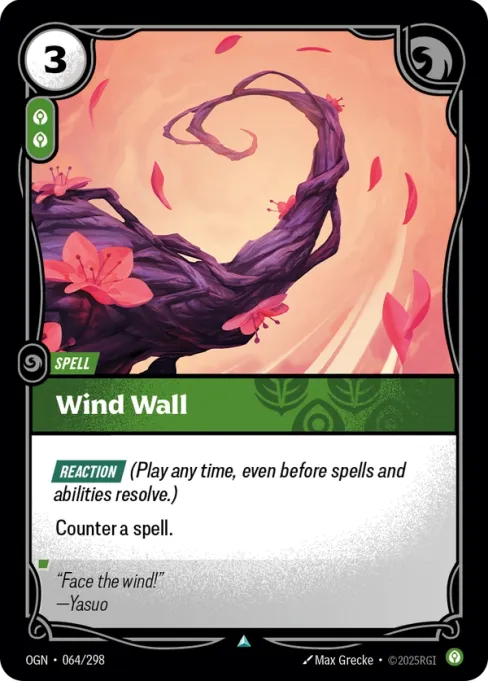
Playing cards on any turn: Action and Reaction
By default you can only play cards and use abilities during your own Main Phase, when nothing else is happening.
Two keywords change that, and they are the most common keywords in the game:
Card hasWhen you can play it
No timing keywordYour own Main Phase, outside showdowns, when nothing is waiting to resolve
ActionAll of the above, plus during any showdown or combat, on any player's turn
ReactionAll of the above, plus while a spell or ability is waiting to resolve, so you can answer it
When a spell is played, it goes on the chain, and each player in turn order gets a chance to add a Reaction to it.
Once everyone passes, the newest item resolves first. Units, gear and abilities that add Energy or Power are the
exception: they resolve as soon as they are paid for, so you can't answer a unit being played, only what it does
when it arrives.
The Ending Phase
First, anything that happens "at the end of turn" does. Then the turn cleans up, all at once: damage is removed
from every unit, effects that last "this turn" end, stunned units stop being stunned, and every player's rune pool
empties. Then the next player's turn begins with their Awaken.
Damage healing at the end of the turn matters. A 5 Might unit that took 4 damage in combat is back to full when
the turn ends, so if you want it dead, you have to finish it this turn.
Common beginner mistakes
MistakeThe rule
Forgetting to score a holdHolds are scored in your Beginning Phase, before you channel and draw. Count your battlefields before you touch your rune deck.
Moving a unit you just playedUnits enter exhausted. Only Accelerate or an effect that readies it lets it move the same turn.
Adding Energy earlyYour rune pool empties at the start of your Main Phase and at the end of each turn.
Recycling every rune for PowerEach recycled rune leaves the board until you channel it again. Recycle only what your domain costs need.
Playing a spell in a showdown without Action or ReactionWithout one of those keywords, a card can only be played in your own Main Phase outside showdowns.
Frequently Asked Questions
What are the phases of a turn in Riftbound?
Six, always in this order: Awaken (ready everything), Beginning (start-of-turn effects, then score each battlefield you hold), Channel (put 2 runes into play), Draw (draw 1), Main (play cards, move and fight) and Ending (end-of-turn effects, units heal, unspent Energy and Power are lost).
What does ABCD mean in Riftbound?
It is a memory aid for the four phases that open every turn: Awaken, Beginning, Channel, Draw. They happen in that order before your Main Phase, and none of them asks you to make a choice unless a card does.
Does the first player draw a card on turn 1 in Riftbound?
In a 1v1 game, yes, and the player going second channels 3 runes instead of 2 on their first turn. In three-player, four-player and 2v2 games, the first player skips their first draw and the last player channels the extra rune.
What is the difference between Energy and Power in Riftbound?
Energy pays the number in a card's cost and has no domain. Power pays the domain symbols and belongs to a domain. A rune adds 1 Energy when you exhaust it and 1 Power of its own domain when you recycle it to the bottom of your rune deck.
Can a rune give both Energy and Power?
Yes. Its two abilities have separate costs: exhaust it to add 1 Energy, then recycle it to add 1 Power. It goes to the bottom of your rune deck afterward, so you have one fewer rune on the board until you channel it again.
Does unspent Energy carry over in Riftbound?
No. Your rune pool empties at the start of your Main Phase and at the end of every turn. Energy you add during a showdown on an opponent's turn has to be spent before that turn ends.
Can I play cards on my opponent's turn in Riftbound?
Only cards and abilities with Action or Reaction. Action cards can be played during showdowns on any player's turn. Reaction cards can be played at those times and also while spells and abilities are waiting to resolve.
Can a unit move the turn it is played?
Usually not. Units enter play exhausted, and moving costs exhausting the unit. A unit played with its Accelerate cost paid enters ready and can move right away.
TurnZero HQ's Riftbound score tracker keeps each player's points by battlefield, reminds you of the final point rule and saves the game. Free to start.
TurnZero was created under Riot Games' "Legal Jibber Jabber" policy using assets owned by Riot Games. Riot Games does not endorse or sponsor this project. Card data comes from Riot Games' official Riftbound card gallery, and prices from TCGplayer via TCGCSV.