Riftbound
How the Chain Works in Riftbound
The chain is where Riftbound spells and abilities wait to resolve, and it is the only time Reaction cards matter. It looks like Magic's stack, but two rules work differently: you can't answer a unit being played, and a spell whose target is gone still resolves. This guide follows Riot's Core Rules as of October 2026.
What the chain is
The chain is a temporary zone that appears the moment a card or ability is played and disappears when the last item on it resolves. There is only ever one chain. Anything played while it exists joins the same chain.
While a chain exists, the turn is in what the rules call a Closed State, and only cards and abilities with Reaction can be played. That is the whole difference between Action and Reaction: Action lets a card into showdowns, and Reaction also lets it onto a chain that already exists. Riftbound's focus and priority guide covers the four turn states and who may act in each.
Pending and finalized items
A card goes onto the chain the moment you start playing it, as a pending item. It stays pending while you make choices, work out the total cost and pay it. Once the game checks that the choices and payment are legal, the item is finalized. Only finalized items can resolve.
If a check fails, for example because the card isn't allowed at this timing, everything you did while playing it is undone and the card goes back where it came from. Riot's Radiance patch notes also settle a rare case: a pending item is not a legal target for spells and abilities.
What skips the chain: units, gear and Add abilities
Three kinds of item resolve as soon as they are finalized, with no chance for anyone to answer them: units, gear, and abilities that add Energy or Power. A unit you play enters the board right after you pay for it. No Reaction can counter it, because no player gets priority while it is on the chain.
What players can answer is what the unit does when it arrives. A "When you play me" ability is a triggered ability that goes on the chain after the unit enters, and that trigger waits for responses like any spell. Solari Shieldbearer is a good example: the unit is on the board before anyone can react, but its stun is on the chain and can be answered.

Solari Shieldbearer
OGN-051/298
Solari Shieldbearer enters at once. Its stun goes on the chain and can be answered.

Dragonsoul Sage
UNL-093/219
Dragonsoul Sage's ability adds 1 Energy. Add abilities can't be reacted to.
Rune abilities are Add abilities with Reaction, which is why you can exhaust or recycle a rune to pay for a card at any time you need to pay, even in the middle of someone else's chain.
Passing and resolution order
Once an item is finalized, the player who controls the newest item on the chain gets priority, the right to act. They can play a Reaction or pass. Priority goes around in turn order. When every player has passed in a row without adding anything, the newest finalized item resolves.
Then it starts again. After each item resolves, if the chain still has items on it, the controller of the newest remaining item gets priority, and everyone gets another chance to respond before the next item resolves. The chain empties one item at a time, newest first, with a round of passing between each.
A spell that is resolving finishes completely before anything else happens. Abilities it triggers wait, and so does the cleanup that kills units with lethal damage. A unit dealt lethal damage by a spell dies in the cleanup after that spell finishes, not halfway through it.
A chain, step by step
Removal, a save, and a counter to the save
On your turn you play Void Seeker (Deal 4 to a unit at a battlefield. Draw 1.) choosing your opponent's 3 Might unit. It is finalized, you get priority, and you pass.
Your opponent plays Retreat (return a friendly unit to its owner's hand, and its owner channels 1 rune exhausted) choosing the same unit. Retreat has Reaction, so it can join the chain. They get priority and pass.
You play Defy (counter a spell that costs no more than 4 Energy and 1 Power) choosing Retreat, which costs 1 Energy. You pass, and your opponent passes.
Everyone has passed in a row, so the newest item resolves: Defy counters Retreat, which goes to the trash without returning the unit.
Players get another chance to respond. Nobody does, so Void Seeker resolves: 4 damage to the 3 Might unit, and you draw 1. The unit dies in the cleanup after Void Seeker finishes.

Void Seeker
OGN-024/298
Void Seeker: deal 4, then draw 1.

Retreat
OGN-104/298
Retreat: a Reaction that returns a friendly unit to hand.
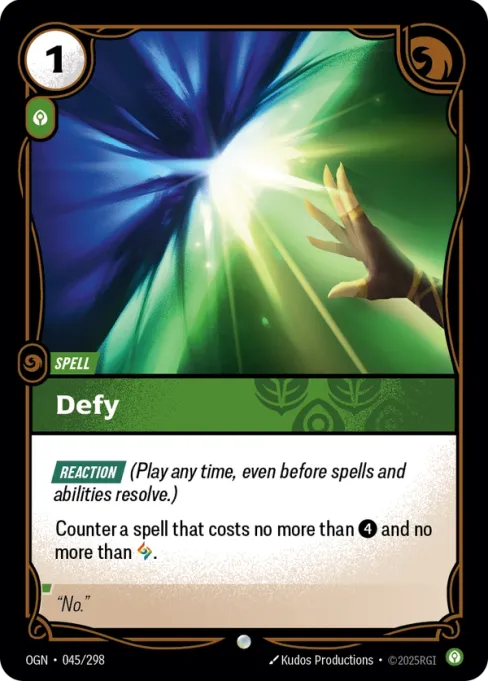
Defy
OGN-045/298
Defy counters only spells costing up to 4 Energy and 1 Power.
Without Defy, Retreat would have resolved first and the unit would have gone back to hand. Void Seeker would still have resolved after it: no damage, because its target was gone, but you would still draw 1. The next section explains why.
When a target is gone: Riftbound has no fizzling
Magic players expect a spell whose only target is gone to do nothing at all. In Riftbound the spell still resolves. The instructions about the illegal target are skipped, along with any later instruction that refers back to it, such as "Its controller draws 2." Every other instruction still happens. Riot's own example uses Void Seeker: if the unit it chose moves to base in response, it deals no damage, but its controller still draws 1.
A spell whose every instruction was skipped this way still counts as played. Abilities that trigger when you play a spell, or that count spells played this turn, still see it.
Countering
A countered card or ability does nothing and is removed from the chain. A countered card goes to its owner's trash, and it doesn't count as played for abilities that trigger on a card being played. Countering never refunds any cost, including additional costs, so the runes you spent stay spent.
Read what a counter can hit. Wind Wall says "Counter a spell," so it can't touch an ability on the chain. Some counters reach further: Repulse counters an enemy spell or ability that chooses one friendly unit at a battlefield and no other friendly unit.
Triggered abilities on the chain
Triggered abilities go on the chain as soon as their condition is met, in any turn state, including while a chain already exists. They don't need Reaction to get there. If one player has several triggers at the same moment, that player chooses the order they go on. If several players do, the turn player puts theirs on first, then each other player in turn order.
Because the newest item resolves first, the triggers put on last resolve first. In a two-player game, that means the non-turn player's simultaneous triggers resolve before the turn player's. The guide to Riftbound ability types covers how to tell a triggered ability from the other kinds.
Common chain mistakes
Holding a counter for an opponent's big unit. Units resolve as soon as they are paid for; counter the spells, or answer the unit's play effect.
Resolving the oldest item first. The newest finalized item resolves first, then everyone gets another chance to respond.
Treating a spell as fizzled when its target leaves. It still resolves and does everything that doesn't need that target.
Playing an Action card while a spell is waiting to resolve. Only Reaction cards and abilities can join an existing chain.
Taking back runes after being countered. Countering never refunds costs.
Frequently Asked Questions
What is the chain in Riftbound?
The chain is the zone where spells and abilities wait to resolve. It exists while anything is on it, and while it exists only cards and abilities with Reaction can be played. When every player passes in a row, the newest item on the chain resolves first.
Can you respond to a unit being played in Riftbound?
Not to the unit itself. Units, gear and abilities that add Energy or Power resolve as soon as they are finalized, so there is no window to counter them. A unit's "When you play me" ability is a separate triggered ability that goes on the chain after the unit enters, and that can be answered.
Does a Riftbound spell fizzle if its target is gone?
No. Riftbound has no fizzling. The spell still resolves; only the instructions about the illegal target, and any that refer back to it, are ignored. A spell that deals 4 to a unit and draws a card still draws the card if the unit has moved to base.
Does the chain resolve first in, first out in Riftbound?
No. The newest finalized item resolves first, so a Reaction played in answer to a spell resolves before that spell. After each item resolves, players get another chance to add Reactions before the next one.
Do you get your runes back if your spell is countered?
No. Countering never refunds costs, including additional costs. The countered card goes to the trash and doesn't count as played for abilities that trigger on playing a card.
Who orders triggered abilities that happen at the same time?
The controller of the abilities picks their order on the chain. If several players have triggers at once, the turn player puts theirs on first, then the others in turn order, which means the last player's triggers resolve first.
Track every game you play
TurnZero HQ's Riftbound score tracker records each point by battlefield and whether it came from a conquer or a hold. Free to start.
Create Free AccountTurnZero was created under Riot Games' "Legal Jibber Jabber" policy using assets owned by Riot Games. Riot Games does not endorse or sponsor this project. Card data comes from Riot Games' official Riftbound card gallery, and prices from TCGplayer via TCGCSV.