Riftbound
Riftbound Ability Types: Triggered, Activated, Passive and Replacement
Riftbound cards don't label their abilities by type, but the rules sort them into a few kinds, and each kind follows its own timing. You can tell them apart by their wording. This guide shows how, and which kinds use the chain, under Riot's Core Rules as of October 2026.
The kinds of ability
The Core Rules name five structures an ability can have. Four of them show up on most cards, and the wording tells you which one you are reading:
The fifth kind, a delayed ability, is one that is active only for a window the card names, such as "this turn." Keywords are shorthand for one of these kinds: Deathknell is a triggered ability, Assault is a passive ability, and Accelerate creates a replacement effect. The Riftbound keywords list has each keyword's full meaning.
Passive abilities
A passive ability is a rule the card adds to the game. It doesn't go on the chain, it can't be answered, and it applies the moment its condition is true. Bilgewater Bully has Ganking for as long as it is buffed, and loses it the moment the buff is gone.
Passive abilities of cards on the board work while the card is on the board. A passive ability that works from another zone says so, such as a card that can be played from your trash.
Activated abilities
An activated ability is something you choose to do, and the colon is how to spot it: everything before the colon is the cost, everything after is the effect. You can use it as often as you can pay the cost. When you use one, it goes on the chain like a spell without a card, and opponents can answer it with Reactions.
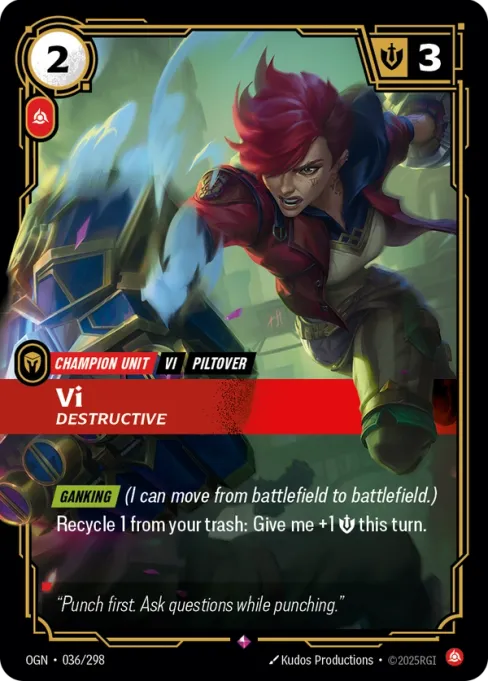
The cost has to be payable in full. Vi, Destructive pays for its +1 Might by recycling a card from your trash, so with an empty trash you can't use it at all. An exhaust cost works the same way: an exhausted card can't be exhausted again. Abilities that add Energy or Power are the one exception to the chain: they resolve as soon as they are used, and nobody can respond to them.

Triggered abilities
A triggered ability happens on its own when something occurs. You can't choose to use it, and you don't need priority or a timing keyword for it: it goes on the chain as soon as its condition is met, in any state, on any turn, including while a chain already exists. Once on the chain, it can be answered like anything else.
The order matters because the newest item on the chain resolves first. How the chain works covers resolution order.
Play, conquer, hold and attack effects
The rules give names to the most common triggers, and each name comes with a timing detail worth knowing:
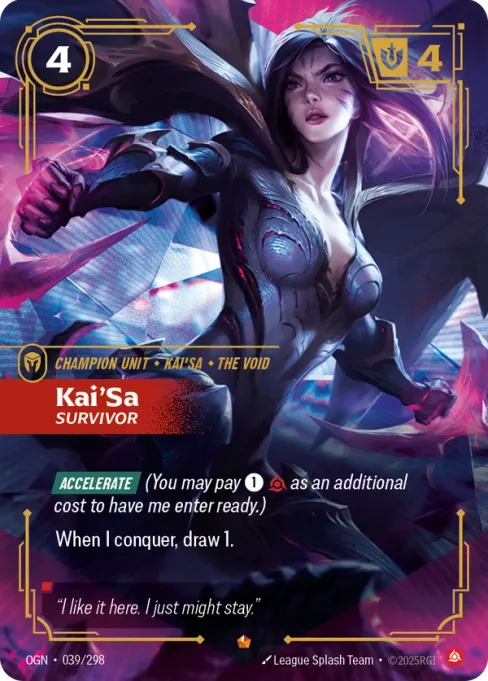
The conquer row is the one that comes up in close games. When you are one point from winning, a conquer that doesn't complete the final point rule draws you a card instead of a point. Your conquer effects still trigger, so Kai'Sa, Survivor still draws you a card on top of it. How scoring works explains the final point rule.

Replacement effects
A replacement effect changes an event while it happens, instead of reacting after it. It doesn't use the chain, so there is no moment to answer it once the event it changes is under way. Look for "would," "instead" or "as."
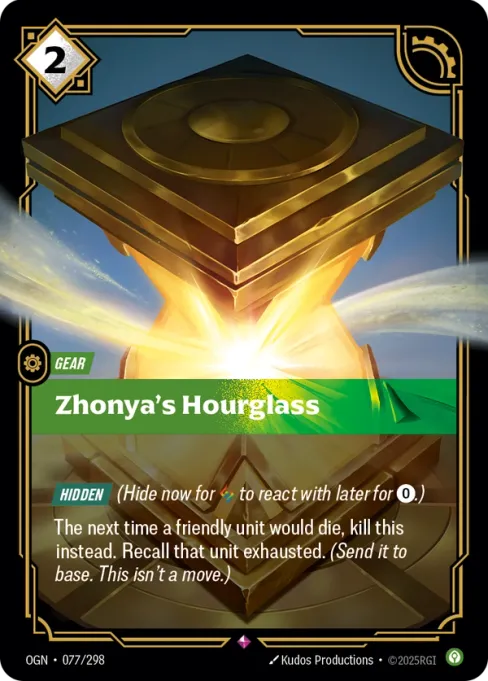
Zhonya's Hourglass is the classic example. Its current text, from Riot's Origins errata of October 2025, reads "If a friendly unit would die, kill this instead. Heal that unit, exhaust it, and recall it." (the printed card words it differently). The death never happens. Tactical Retreat does the same for one unit as a spell. "I enter ready" is a replacement effect too: the unit enters ready instead of exhausted.
If two or more replacement effects apply to the same event, the controller of the thing being affected chooses the order they apply. For a player, that player chooses; for an uncontrolled battlefield, the turn player does.

When Deathknell doesn't trigger
Deathknell is short for "When I die," and its trigger requires the card to actually be killed and sent to the trash. The trigger goes on the chain just before the card moves to the trash. If a replacement effect turns the death into something else, the card was never killed, and the Deathknell ability is removed from the chain.
Soaring Scout and Zhonya's Hourglass
Your Soaring Scout ([Deathknell]: channel 1 rune exhausted) is dealt lethal damage in combat. You have Zhonya's Hourglass on the board.
As the Scout would die, the Hourglass's replacement effect applies: the Hourglass is killed instead, and the Scout is healed, exhausted and recalled to your base.
The Scout never went to the trash, so its Deathknell doesn't happen. You keep the unit but don't channel the rune.

Riot's own example in the rules is the same pairing with a "When I die in combat" ability: once Zhonya's Hourglass replaces the death, the trigger is removed. Choose between the unit and its death trigger before you decide to save it.
Common ability mistakes
Using a unit's colon ability in a showdown. Without Action or Reaction, activated abilities work only in your Main Phase outside showdowns.
Forgetting a trigger because nobody had priority. Triggered abilities go on the chain whenever their condition is met.
Expecting Deathknell after a save. A replaced death is not a death.
Skipping conquer effects when the final point rule denies the point. They still trigger.
Trying to answer a replacement effect with a Reaction. It never goes on the chain.
Frequently Asked Questions
What is the difference between triggered and activated abilities in Riftbound?
An activated ability has a cost, a colon and an effect, and you choose when to use it. A triggered ability starts with "when," "at" or "the first time," and it happens on its own when that event occurs. Both go on the chain, and both can be answered with Reactions, except abilities that add Energy or Power, which resolve at once.
When can you use an activated ability in Riftbound?
By default only in your own Main Phase, outside showdowns, when no chain exists. An ability marked Action can also be used in showdowns on any turn, and one marked Reaction can be used on a chain as well.
Does Deathknell trigger if the unit is saved by Zhonya's Hourglass?
No. Deathknell means "when I die," and the trigger needs the unit to actually go to the trash. A replacement that heals, exhausts and recalls the unit instead means it never died, so the Deathknell ability is removed from the chain.
Does a "When I conquer" ability trigger if the final point rule stops my point?
Yes. Conquer and hold abilities still trigger when the point itself is negated or replaced. If the final point rule has you draw a card instead of gaining the point, your conquer abilities still happen.
What is a replacement effect in Riftbound?
An ability that changes how an event happens instead of reacting after it. You can spot one by "would," "instead" or "as." Replacement effects don't use the chain, so they can't be answered once the event they change is happening.
Can you respond to a "When you play me" ability in Riftbound?
Yes. The unit itself enters as soon as it is paid for, but its play effect is a triggered ability that goes on the chain, and players can answer it with Reactions before it resolves.
Track every game you play
TurnZero HQ's Riftbound score tracker records each point by battlefield and whether it came from a conquer or a hold. Free to start.
Create Free AccountTurnZero was created under Riot Games' "Legal Jibber Jabber" policy using assets owned by Riot Games. Riot Games does not endorse or sponsor this project. Card data comes from Riot Games' official Riftbound card gallery, and prices from TCGplayer via TCGCSV.