Yu-Gi-Oh! TCG
1st Edition Yu-Gi-Oh! Cards Worth Checking
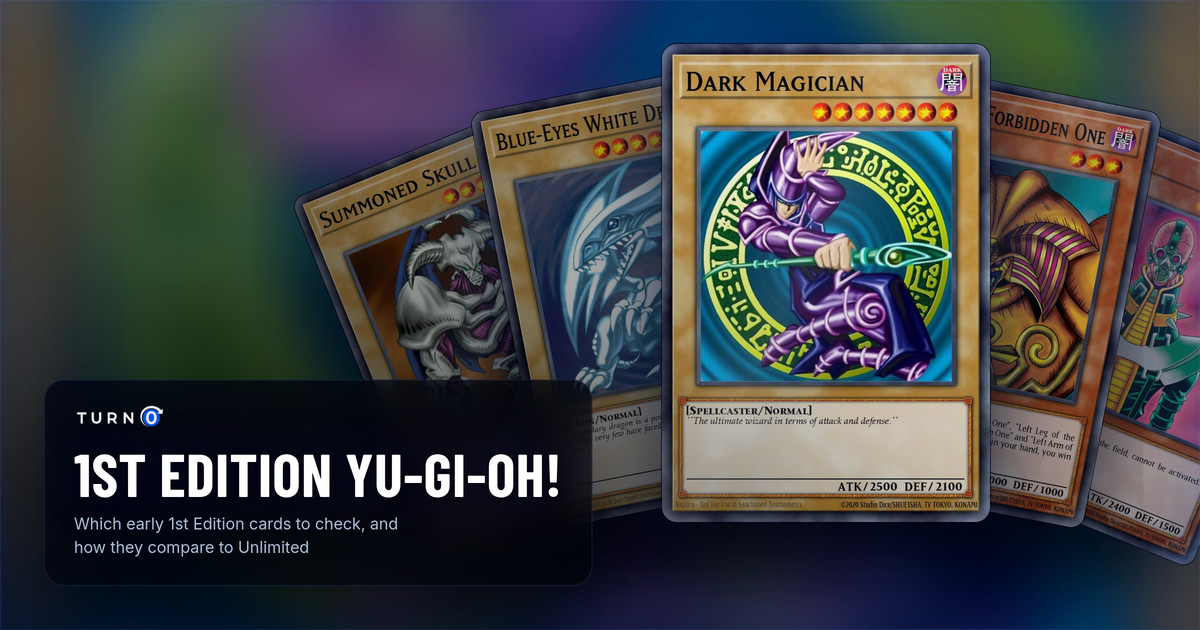
The 1st Edition cards worth looking for are the foils from the first North American sets of 2002, where a 1st Edition copy often sells for ten times the Unlimited copy of the same printing or more. On modern sets the mark matters far less. Here's where the premium is, how to tell an original early print, and what to check before you trust a copy.
Where 1st Edition matters
Start with the first four North American booster sets: Legend of Blue Eyes White Dragon (LOB, March 2002), Metal Raiders (MRD, June 2002), Magic Ruler (MRL, September 2002, later sold as Spell Ruler) and Pharaoh's Servant (PSV, October 2002). Their foil cards carry the largest 1st Edition premiums in the catalog, and the Super Rare, Ultra Rare and Secret Rare copies are the ones to check first.
This page assumes you know what the mark is. If you don't, the short version is the words "1st Edition" printed under the bottom left corner of the artwork, and a blank spot there means Unlimited. 1st Edition vs. Unlimited, explained →
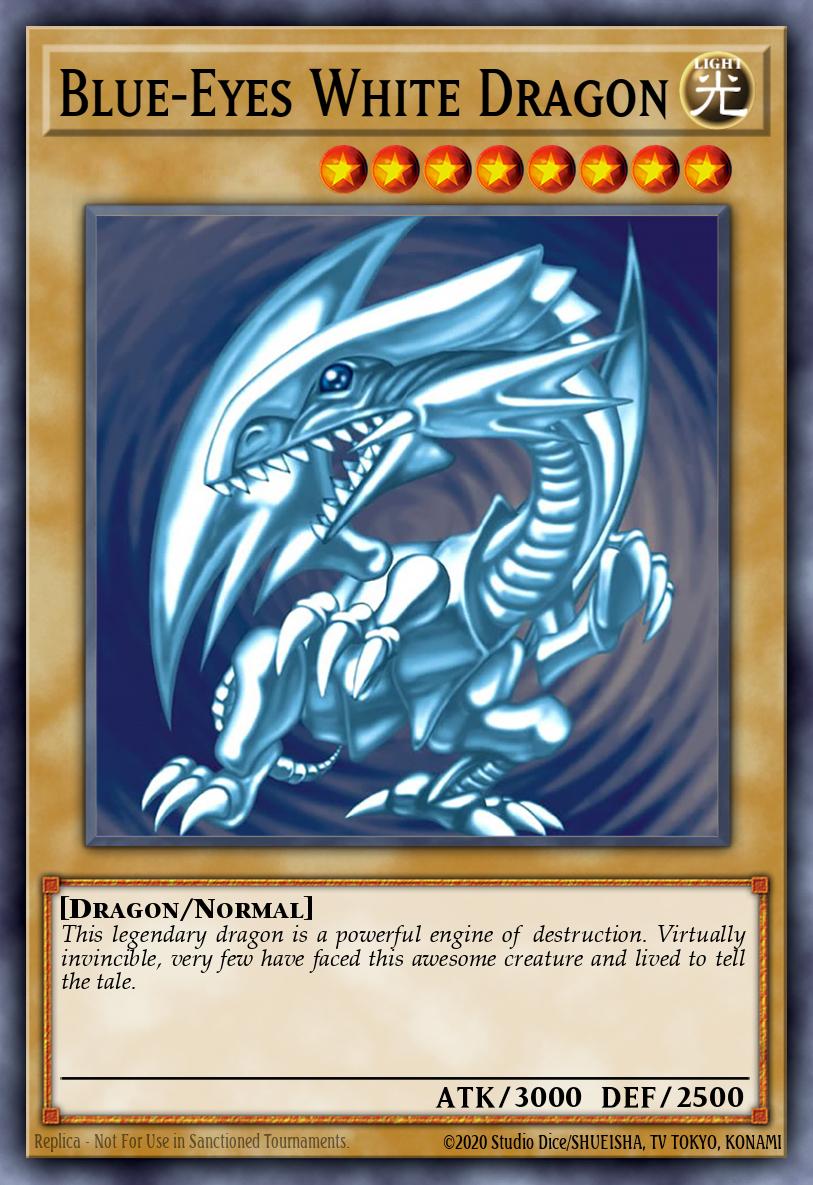
Blue-Eyes White Dragon
LOB-001 · Ultra Rare
1st Edition: $3,799.92. Unlimited: $122.77.

Dark Magician
LOB-005 · Ultra Rare
1st Edition: $1,207.76. Unlimited: $42.15.
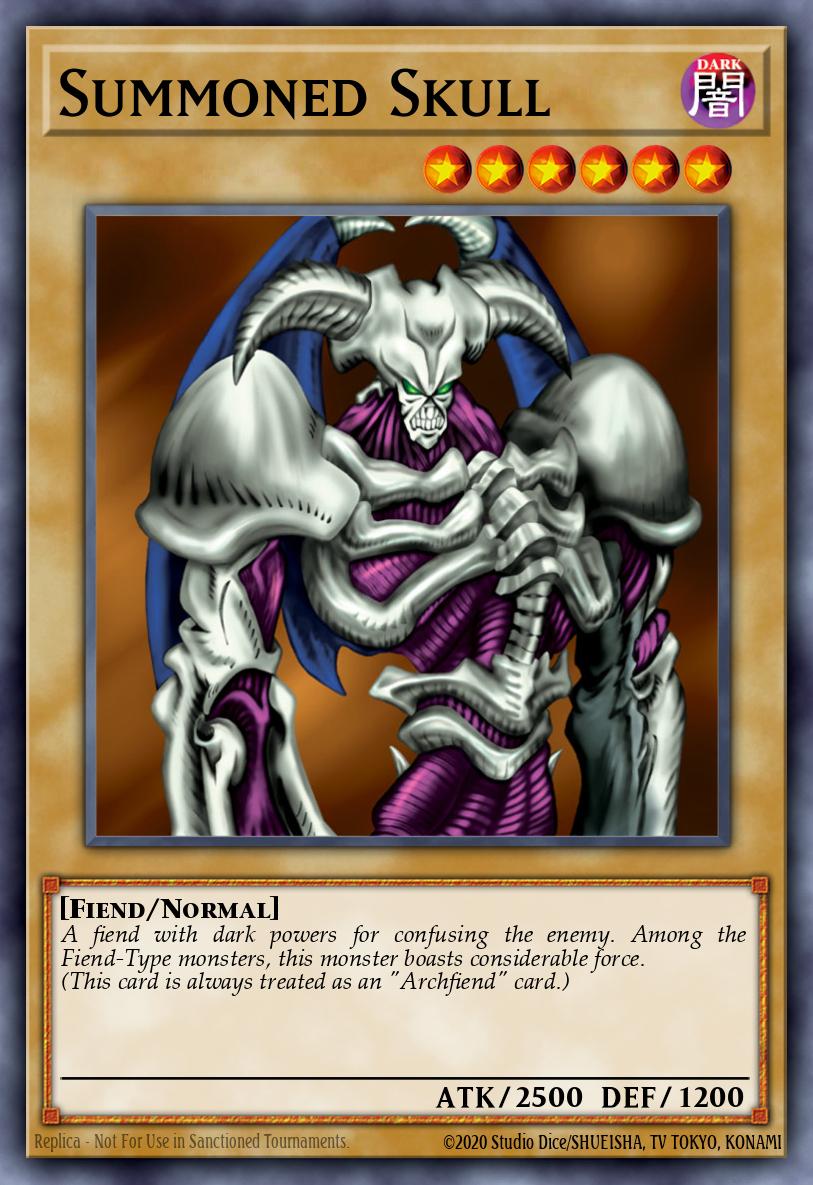
Summoned Skull
MRD-003 · Ultra Rare
1st Edition: $596.48. Unlimited: $32.88.
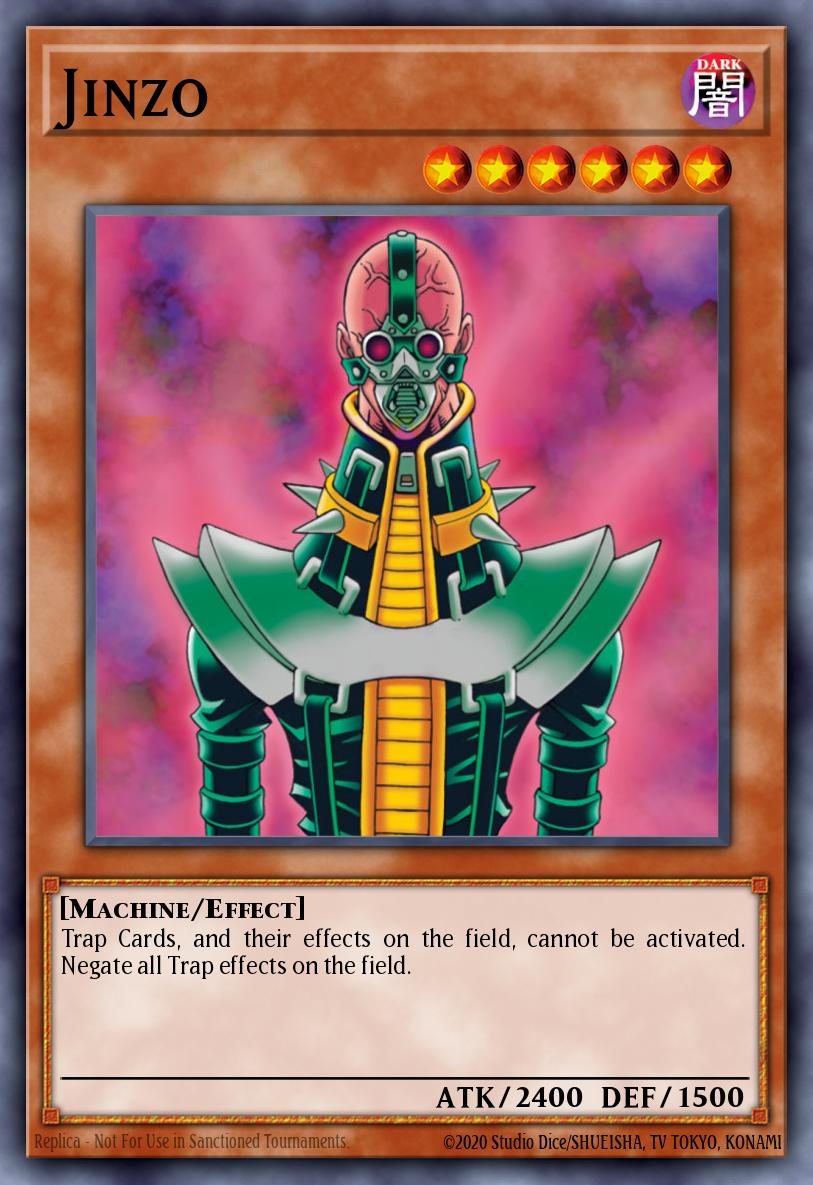
Jinzo
PSV-000 · Secret Rare
1st Edition: $613.33. Unlimited: $51.23.
The early sets, priced
The useful number is the ratio: how many times the Unlimited price a 1st Edition copy of the same printing sells for. Every figure below is a TCGplayer market price for an ungraded copy as of October 2, 2026, and both columns are the same set code and rarity.
Two patterns stand out. The iconic monsters have the highest prices in both editions, but cards like Raigeki and Dark Hole show the widest ratios, because their Unlimited copies sell for a few dollars while 1st Edition copies are scarce. The edition can matter more than the card's fame, so check every foil from these sets, not only the famous ones.
The premium isn't uniform
Not every early foil multiplies. Gaia The Fierce Knight from the same first set (LOB-006, Ultra Rare) is $24.99 in 1st Edition and $18.56 in Unlimited, about a third more. A blanket rule like "1st Edition LOB is worth twenty times Unlimited" will misprice your binder; look up each printing.
How to tell an original early print
The set code is the quickest check. The first North American print of Legend of Blue Eyes White Dragon uses codes with no language letters, such as LOB-001. The same set was later printed for Europe with an "E" (LOB-E001, released in late 2002) and again with an "EN" (LOB-EN001, from 2004). Metal Raiders, Magic Ruler and Pharaoh's Servant follow the same pattern: MRD-003, MRD-E003 and MRD-EN003 are three printings of Summoned Skull.
The European print was numbered differently, so the numbers don't line up across codes: Dark Magician is LOB-005 in the North American print and LOB-E003 in the European one. TurnZero HQ's catalog lists the E and EN printings of these sets as separate printings, and most of them have no TCGplayer market price there, so make sure a price you read is for the code on your card.
Magic Ruler is the one with two names. It was released in North America as Magic Ruler with MRL codes, and later printings were sold as Spell Ruler after Magic Cards were renamed Spell Cards. The catalog lists Relinquished at MRL-029 in both editions and at SRL-029 in Unlimited. Where the set code sits on a card →
Condition and grading
Condition decides how much of that 1st Edition premium you actually get. A card printed in 2002 has had a long time to pick up whitewear on the edges and back, scratches across the foil and creases, and many early cards were played hard. Market prices are quoted by condition, and a heavily played copy sells for a fraction of a clean one.
Check the back edges under a bright light, tilt the foil to find scratches, and look along the card's edge for bends. For an early 1st Edition foil in very good shape, a grade from a grading company can add a lot, though grading costs money and only pays off when the card and condition justify it. The prices on this page are for ungraded copies.
Counterfeit warning signs
Early chase cards are counterfeited because they're expensive. No single check proves a card is real, but a fake usually fails more than one of these.
For a card worth hundreds of dollars, buy from a seller with a return policy, or buy it already graded. You can check which codes and rarities a card was printed in on its card page here.
1st Edition on modern sets
On modern sets the edition gap is much smaller than on the early sets, and on the most recent ones it is often a few dollars. Prices below are TCGplayer market prices for ungraded copies as of October 2, 2026.
For many recent printings the catalog has only a 1st Edition price, such as Fiendsmith Engraver in The Infinite Forbidden, so there is no Unlimited copy to compare against. On a modern card, rarity and play demand move the price much more than the edition. The Quarter Century Secret Rare of that Fiendsmith Engraver printing is $91.35, against $4.72 for the Secret Rare. How each rarity looks and what it's worth →
If you track a collection in TurnZero HQ, each copy carries its printing, edition, condition and grade, and it's priced from TCGplayer's market price for that edition, updated daily, so a 1st Edition LOB-001 isn't valued as an Unlimited one. The scanner reads the set code and records 1st Edition when it sees the mark. How the scanner reads a card →
Frequently Asked Questions
Which 1st Edition Yu-Gi-Oh! cards are worth the most?
The foil cards from the first North American sets: Legend of Blue Eyes White Dragon, Metal Raiders, Magic Ruler (later sold as Spell Ruler) and Pharaoh's Servant. As of October 2, 2026, an ungraded 1st Edition Blue-Eyes White Dragon (LOB-001) had a TCGplayer market price of $3,799.92, and 1st Edition Dark Magician (LOB-005), Exodia the Forbidden One (LOB-124), Summoned Skull (MRD-003) and Jinzo (PSV-000) each sold for several hundred dollars or more.
Are all 1st Edition Yu-Gi-Oh! cards valuable?
No. Most booster sets were printed in 1st Edition, so the mark alone means little. It matters most on the early sets, and even there the premium varies by card: a 1st Edition Gaia The Fierce Knight (LOB-006) sells for only about a third more than its Unlimited copy.
How do I know if my Blue-Eyes White Dragon is an original?
Check the set code under the artwork. The first North American print reads LOB-001. LOB-E001 is the European English print and LOB-EN001 is a later worldwide English print, each with its own price. Then check for the words "1st Edition" under the art and a gold Eye of Anubis seal in the bottom right corner.
Does 1st Edition matter on new Yu-Gi-Oh! sets?
Much less. On recent sets the 1st Edition and Unlimited copies of a card are often within a few dollars of each other, and many recent printings only have a 1st Edition price listed. What moves a modern card is whether it's played and its rarity.
Should I get my 1st Edition cards graded?
It depends on the card and its condition. Grading costs money, so it makes most sense for an early 1st Edition card in very good condition, where a high grade can add far more than the fee. For a card worth a few dollars, the fee usually outweighs any gain.
Value your 1st Edition cards as 1st Edition.
Add your Yu-Gi-Oh! cards by printing and edition, and TurnZero HQ prices each copy from daily TCGplayer market prices. Free to start.
Create Free AccountYu-Gi-Oh! card names and images are the property of Konami Digital Entertainment and their respective owners. ©Studio Dice/SHUEISHA, TV TOKYO, KONAMI. TurnZero HQ is not affiliated with, sponsored, or endorsed by Konami. Card data comes from YGOPRODeck, and prices from TCGplayer via TCGCSV.