Star Wars: Unlimited Rules Explained
The Unique Rule in Star Wars: Unlimited
The dot before a card's name limits what you control in play, not what goes in your deck. You can run 3 copies of a unique unit and play the second one on purpose. This guide covers the rule, what happens when a copy enters play, and the cases that trip players up.
The short answer
A unique card has a unique icon before its name. Rule 8.29.3: a player can control only one copy of each unique card with the same name and subtitle at a time. If you ever control two copies in play, you must defeat one of them, and that happens immediately.
The usual misreading is that unique means one per deck. It doesn't. A Premier deck can hold up to 3 copies of any non-leader, non-base card, unique or not (rule 8.5.5), and holding the extra copies in hand or in your resources is fine. The limit only bites when a second copy is in play under your control.
This page follows the publisher's Comprehensive Rules version 9.0, dated October 9, 2026, and the rule numbers are from that document. To find the icon and the subtitle on a card, see how to read a card.
What counts as the same card
Every unique card has a subtitle, and the subtitle is part of what makes two cards the same (rule 8.29.2). Same name and same subtitle means the same card. Same name with a different subtitle means a different card, even when both show the same character.

Luke Skywalker, Faithful Friend
Spark of Rebellion #005
Faithful Friend: a leader

Luke Skywalker, Jedi Knight
Spark of Rebellion #051
Jedi Knight: a unit. Both can be in play.
Both Lukes are from Spark of Rebellion, now rotated out of Premier, and are the rules document's own example. The same logic covers leaders in every set: your leader is unique, but a unit of the same character has a different subtitle. In the card catalog as of October 2026, no unit shares both its name and subtitle with a leader.
When a second copy enters play
The rule doesn't stop you playing the second copy. You pay for it and play it as normal. Then, because you control two, you choose one and defeat it. The rules treat this as a game-state check, not a triggered ability, so it happens before anything waiting to resolve (rule 1.16.5.b). Your abilities still trigger normally: the defeated copy's When Defeated ability and the new copy's When Played ability both resolve (rule 8.29.3).
Playing isn't the only way to end up with two. Taking control of an opponent's copy of a unique card you already control, or getting a captured copy back while you control another, puts two under your control, and the same rule makes you defeat one.
Replaying a unique unit on purpose
Because you pick which copy to defeat, a second copy can replace a damaged first one, and you get both of their triggered abilities. It costs a full card and its cost, so it's usually only worth doing with a unit whose abilities pay you back.
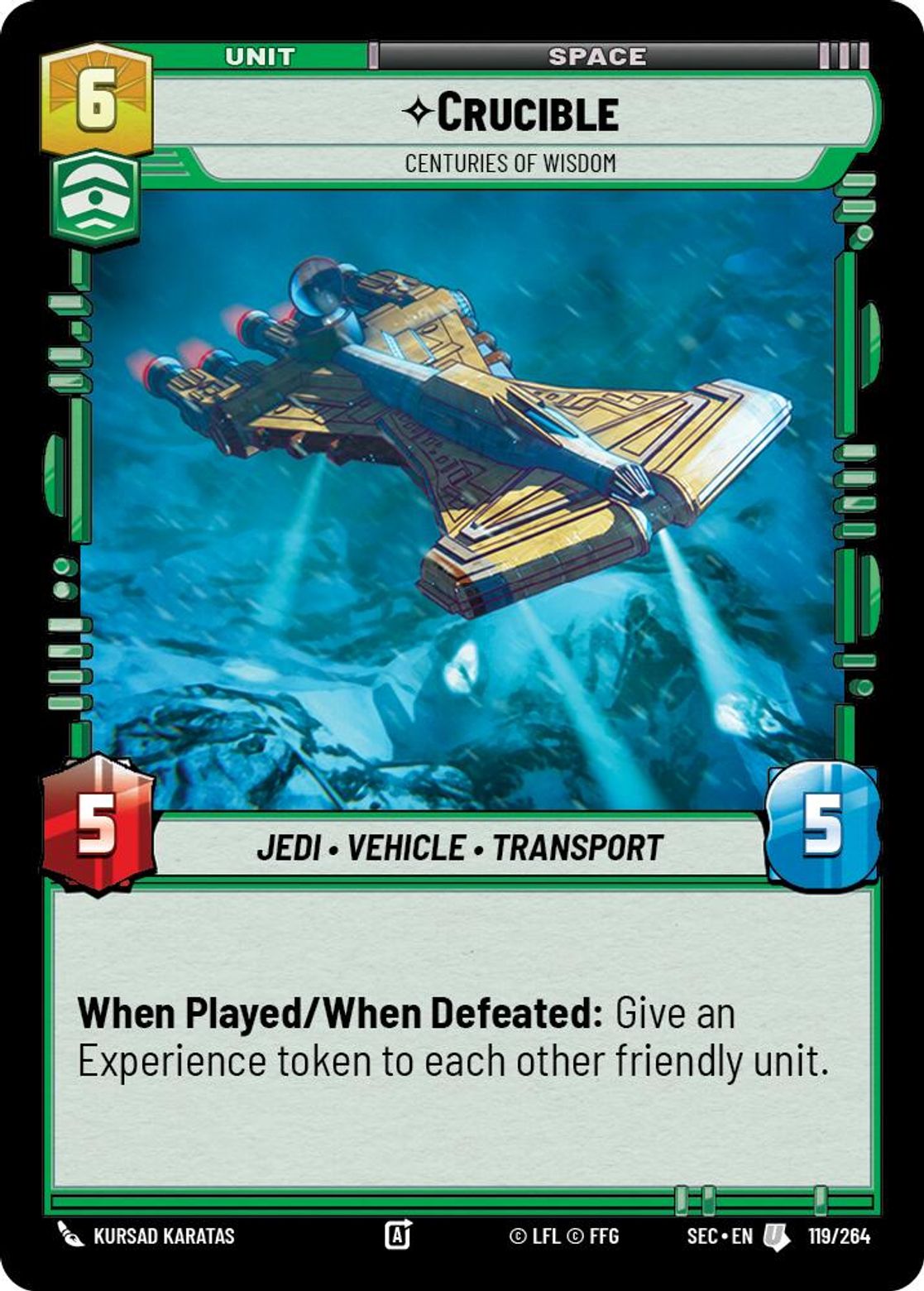
Crucible, played over Crucible
You control a Crucible with 4 damage on it. Its text is "When Played/When Defeated: Give an Experience token to each other friendly unit."
You play a second Crucible from your hand. For a moment you control two copies.
Before anything else resolves, you defeat one copy. You choose the damaged one.
Its When Defeated ability and the new copy's When Played ability both trigger. They're both yours, so you choose the order.
Your other units get an Experience token from each ability. You're left with an undamaged Crucible, which also gets a token from the old copy's When Defeated, since it's another friendly unit.
Where the rule applies, and where it doesn't
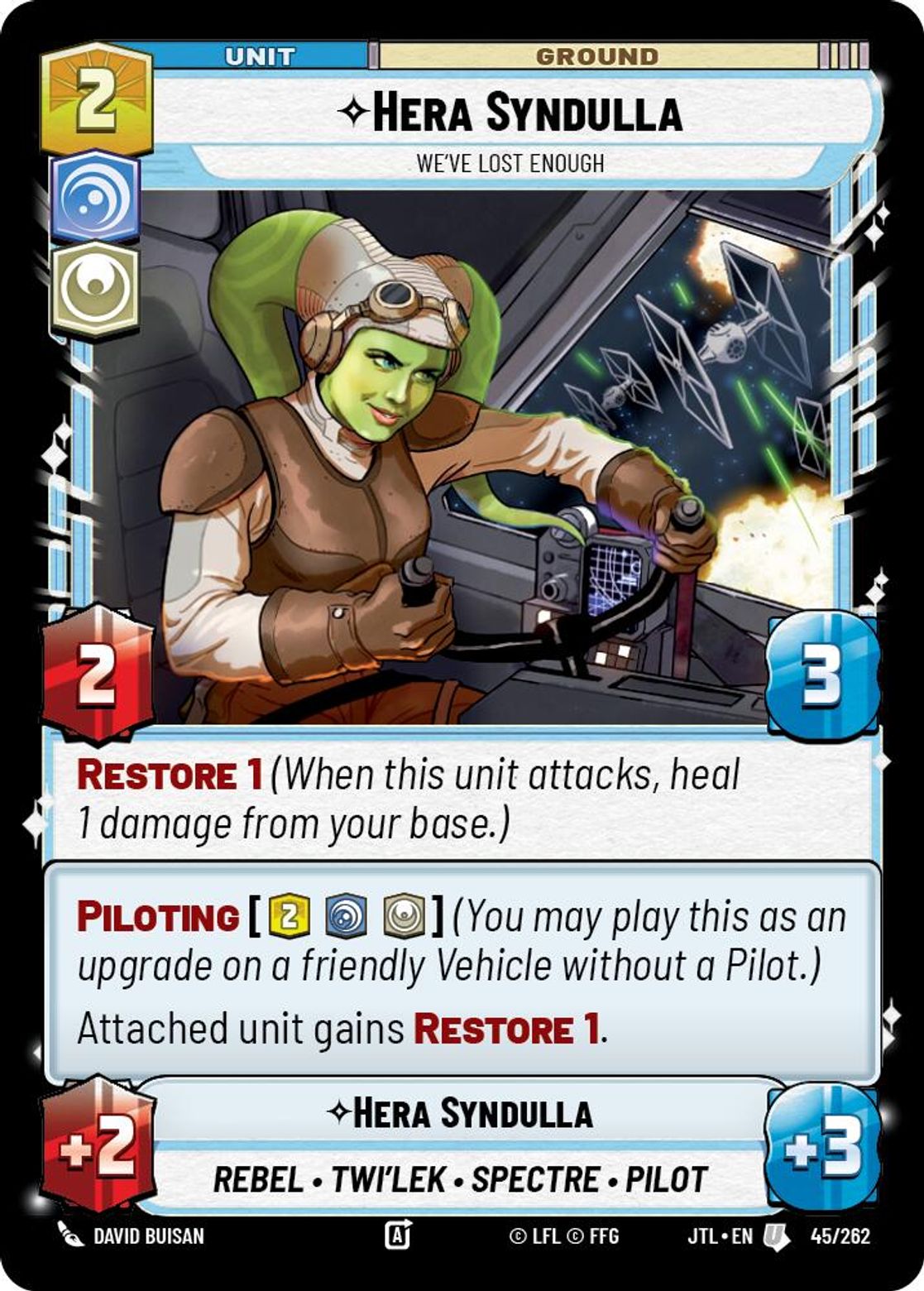
Hera Syndulla, We've Lost Enough
Jump To Lightspeed #045
A unique Pilot: one copy in play, as unit or upgrade

Yoda's Lightsaber
Legends of the Force #102
A unique upgrade
Pilots are where this comes up most. The rules' own example: if you control Hera Syndulla, We've Lost Enough attached as an upgrade to a Vehicle, and you play another copy as a ground unit, you have to defeat one of them.
Unique cards in your deck
In Premier, three copies of a unique unit is a normal choice, and the rule changes what the second and third copies are for. They're backups for when the first is defeated, or cards you resource without losing much, since a copy you can't use well in play is still a resource. How many to run depends on how much the deck needs that unit early and how likely it is to survive.
Twin Suns, the multiplayer format, allows only one copy of each card in a deck, unique or not (rule 12.2.2). Its two leaders may share a name but can't be copies of each other, so they don't break the unique rule (rule 12.3.1). TurnZero HQ's deck builder checks Premier's 3-copy limit by full card name.
Common mistakes
Building with one copy of each unique card. Premier allows 3.
Refusing to let a player play a second copy. They can; then they defeat one.
Always defeating the new copy. The player chooses which one goes.
Skipping the When Played or When Defeated ability. Both still resolve.
Treating same name as same card. The subtitle has to match too.
Frequently Asked Questions
What does unique mean in Star Wars: Unlimited?
A unique card has a small icon before its name. You can control only one copy of a unique card with the same name and subtitle in play at a time. If a second copy enters play under your control, you immediately defeat one of them.
How many copies of a unique card can be in a Star Wars: Unlimited deck?
Up to 3 in a Premier deck, the same as any non-leader, non-base card. Uniqueness only limits how many copies you control in play, not how many you own or draw. Twin Suns decks are limited to one copy of every card, unique or not.
Can I play a second copy of a unique unit I already control?
Yes. You pay for it and play it, then immediately defeat one of the two copies, your choice. The defeated copy's When Defeated ability and the new copy's When Played ability both still resolve. Players use this to replace a damaged copy with a fresh one.
Can both players have the same unique card in play?
Yes. The limit is per player. You and your opponent can each control a copy of the same unique card at the same time.
Can I control two Luke Skywalkers?
Yes, if their subtitles are different. Luke Skywalker, Faithful Friend and Luke Skywalker, Jedi Knight are different cards, so you can have both in play. Two copies of Luke Skywalker, Jedi Knight would break the rule.
Does a unique card in my resources count?
No. The limit only applies to cards in play, and a resource is a facedown blank card. You can have a copy face up in an arena and another copy face down as a resource. Cards in your hand, deck and discard pile don't count either.
Build decks that follow the rules.
TurnZero HQ checks a Star Wars: Unlimited deck against Premier's construction rules, including the 3-copy limit, and shows each card's real cost with aspect penalties. Free to start.
Create Free AccountStar Wars: Unlimited card names and images are the property of Lucasfilm Ltd. and Fantasy Flight Games. © & ™ Lucasfilm Ltd. TurnZero HQ is not affiliated with, sponsored, or endorsed by Lucasfilm Ltd., Disney, Fantasy Flight Games, or Asmodee. Card data comes from swu-db.com, and prices from TCGplayer.