Star Wars: Unlimited · Aspect Combinations
Vigilance Heroism (Blue-White) in Star Wars: Unlimited
Vigilance Heroism is the hero side's defensive pairing. Its leaders heal, hand out Shield tokens and turn units into Sentinels, and its decks usually win by outlasting the opponent rather than racing them.
Vigilance Heroism means a leader with the Vigilance (blue) and Heroism (white) aspects. The hero side's defensive pairing: healing, Shield tokens and Sentinels, with Rebels, Jedi and Mandalorians to protect.
Also called Blue Heroism or blue-white. As of October 2026, 12 of the 108 leaders in the six Premier-legal sets have exactly these two aspects.
How Vigilance Heroism Plays
A Vigilance Heroism leader gives your deck Vigilance's tools (Sentinel units, Shield tokens, healing and removal) and Heroism's characters: Rebels, Jedi, Mandalorians and the Republic. The base adds a third aspect, so the leader sets the plan and the base decides how wide the card pool is.
The leaders are built around keeping units alive. Luke Skywalker, I Can Save Him heals a unit after its attack ends, Kanan Jarrus gives Shield tokens to Creature and Spectre units, and Ahsoka Tano, Fighting For Peace makes a friendly unit a Sentinel for the phase so you choose which unit the opponent must attack. The effect is that your units survive trades that would be even in another deck, and keep attacking the next round.
Games tend to be won late. The early rounds go to blocking with Sentinels and keeping your base healthy, and the deck then takes over with expensive cards the opponent can't answer cheaply, such as Bo-Katan Kryze, Alone, which gives every enemy unit -3/-3 for the phase when she is played.
How aspects and the aspect penalty work →What It Does Well, and What It Doesn't
Strengths
- Holds up against fast decks: Sentinel units and healing blunt an opponent who wants the game over early.
- Units last longer than their printed HP suggests, because Shield tokens and repeated healing keep resetting them.
- A strong late game, with expensive units that swing a board on the round they arrive.
Weaknesses
- Little direct damage, so it rarely ends a game quickly and gives a slower opponent time to set up.
- Effects that defeat a unit outright skip past healing, and a defeated unit's Shield tokens go with it.
- Villainy cards cost at least 2 more, which puts the Imperial and Sith removal out of reach at printed cost.
Vigilance Heroism Leaders
Four leaders that show what the pairing does, not a ranking. Each has exactly the Vigilance and Heroism aspects; the leader's front is shown, and its card page has the deployed side.
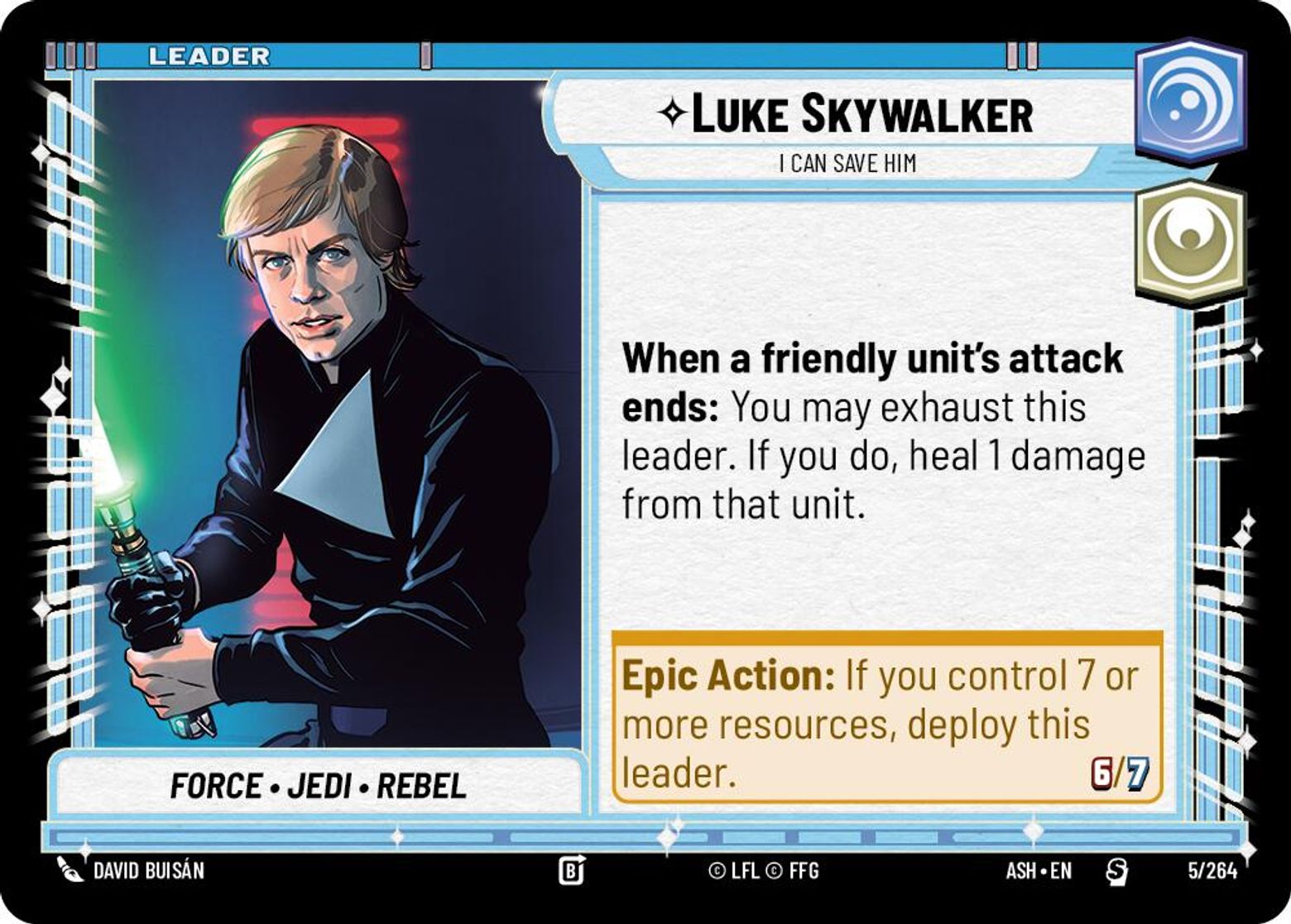
Luke Skywalker, I Can Save Him
Ashes of the Empire #005
Heals after attacks

Satine Kryze, Standing on Principles
Secrets of Power #005
Moves damage to your base

Ahsoka Tano, Fighting For Peace
Legends of the Force #003
Sentinel on demand

Kanan Jarrus, Help Us Survive
Legends of the Force #004
Shields for Creatures and Spectres
- Luke Skywalker, I Can Save Him: When a friendly unit's attack ends, you may exhaust him to heal 1 damage from that unit. Deployed at 7 resources, he heals 2 from that unit or your base after every friendly attack.
- Satine Kryze, Standing on Principles: Her action heals up to 2 damage from a unit and deals that much to your base. Deployed, she is a 0/8 with Restore 4, so each of her attacks heals 4 from your base.
- Ahsoka Tano, Fighting For Peace: Uses the Force to give a friendly unit Sentinel for the phase. Deployed, she does the same on each attack without spending the Force, so pair her with cards that create your Force token.
- Kanan Jarrus, Help Us Survive: For 1 resource, gives a Shield token to a Creature or Spectre unit. Deployed, he enters with a Shield and gets +2/+2 while you control another Creature or Spectre, so he leads a trait deck rather than a general one.
Signature Cards
Cards printed in exactly these two aspects, so any Vigilance Heroism leader plays them at printed cost whatever the base.

Bo-Katan Kryze, Alone
Secrets of Power #051
9-cost board sweep

The Mandalorian, Devoted Rescuer
Ashes of the Empire #062
Shields the team
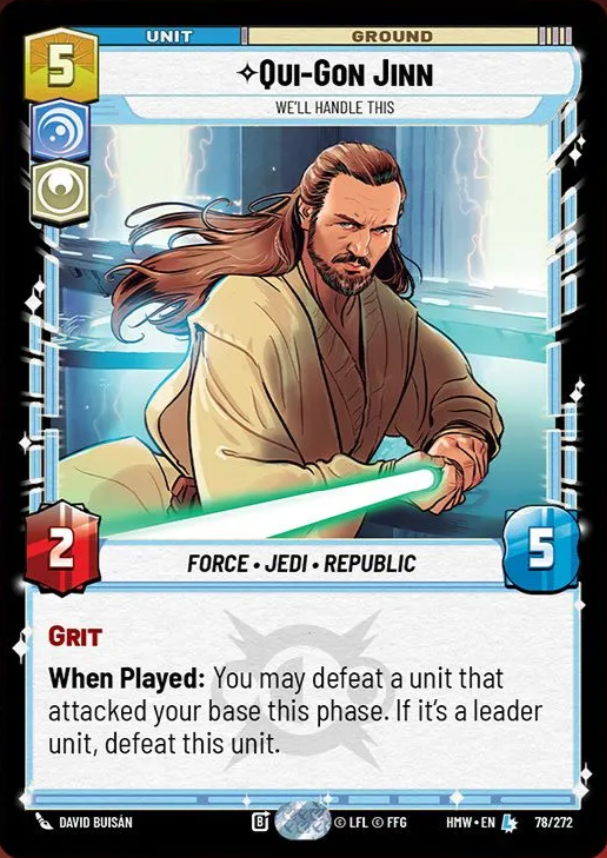
Qui-Gon Jinn, We'll Handle This
Homeworlds #078
Punishes base attacks
- Bo-Katan Kryze, Alone: When played, gives each enemy unit -3/-3 for the phase, and each enemy unit defeated while she is in play gives a friendly unit an Experience token.
- The Mandalorian, Devoted Rescuer: Enters with a Shield token and can spend it to prevent damage that would be dealt to another friendly unit.
- Qui-Gon Jinn, We'll Handle This: Grit, and when played he may defeat a unit that attacked your base this phase. If that unit is a leader, Qui-Gon is defeated too.
Choosing a Base
Your base adds one aspect icon to the two on your leader. A base of another aspect gives the deck a third aspect; a Vigilance base gives it a second Vigilance icon instead. The third column counts the cards each choice plays at printed cost, out of the 1,409 non-leader, non-base cards in the Premier sets as of October 2026 (a reprint counted once).
Vigilance Heroism already knows how to survive, so the base mostly answers how the deck closes a game. Command adds bigger units and Experience tokens to finish with; Aggression adds the direct damage this pairing otherwise lacks; Cunning adds Ambush units and tempo events. A Vigilance base keeps the deck tight around its defensive cards and its double-Vigilance cards, at the cost of about 220 cards.
Only 5 cards in the Premier sets print two Vigilance icons, such as Nala Se, Silent Survivor and Size Matters Not. That is why a doubled base is the exception. Every Villainy card costs at least 2 more whichever base you pick, since bases never provide Heroism or Villainy.
Other Aspect Combinations
Frequently Asked Questions
What leaders are Vigilance Heroism in Star Wars: Unlimited?
As of October 2026, 12 leaders in the six Premier-legal sets have exactly Vigilance and Heroism, including Luke Skywalker (I Can Save Him), Satine Kryze (Standing on Principles), Ahsoka Tano (Fighting For Peace) and Kanan Jarrus (Help Us Survive). Older sets add more for Eternal.
What base should a Vigilance Heroism deck use?
A base of another aspect adds a third aspect and raises the cards you can play at printed cost from about 314 to between 529 and 536 of the Premier pool. Command and Aggression bases give the deck a way to finish games; a Vigilance base only makes sense if you want its double-Vigilance cards or that base's own ability.
What is the difference between Vigilance Heroism and Vigilance Villainy?
Both use Vigilance's healing, Sentinels and removal, but the side changes the cards around them. Vigilance Heroism protects its own units with Shield tokens and healing; Vigilance Villainy leans harder on defeating the opponent's units, with leaders like Grand Admiral Thrawn and Aurra Sing. The two share Vigilance cards and neutral cards, and each pays 2 more for the other's side cards.
Build a Vigilance Heroism deck and see what it really costs.
TurnZero HQ's deck builder checks the Premier rules and shows each off-aspect card's real cost under your leader and base. Track your games and Stats breaks your results down by Leader and by Base. Free to start.
Create Free AccountStar Wars: Unlimited card names and images are the property of Lucasfilm Ltd. and Fantasy Flight Games. © & ™ Lucasfilm Ltd. TurnZero HQ is not affiliated with, sponsored, or endorsed by Lucasfilm Ltd., Disney, Fantasy Flight Games, or Asmodee. Card data comes from swu-db.com, and prices from TCGplayer.