Star Wars: Unlimited Rules Explained
How Upgrades Work in Star Wars: Unlimited
An upgrade is only as safe as the unit it's on. When that unit leaves play for any reason, every upgrade on it is defeated. This guide covers attaching upgrades, playing them on enemy units, who controls what, and the Pilots and Fortify upgrades that bend the usual rules.
The short answer
An upgrade attaches to a unit and changes it: a power modifier, an HP modifier, often an ability. It stays until the unit leaves play or something defeats the upgrade, and then it goes to its owner's discard pile (rule 3.6.11). Upgrades have no ready or exhausted state of their own (rule 1.5.4).
Two things surprise new players. The first is that a returned unit doesn't take its upgrades with it: bounce a unit to its owner's hand and every upgrade on it is defeated. The second is that upgrades aren't only for your own units. Unless the card restricts it, you can attach an upgrade to an enemy unit, and some upgrades are written to be played that way.
This page follows the publisher's Comprehensive Rules version 9.0, dated October 9, 2026, and the rule numbers are from that document. Card examples are from the Premier-legal sets as of October 2026 unless noted. For what the numbers on an upgrade mean, see how to read a card.
Playing and attaching
You play an upgrade like any other card: pay its cost, then attach it to a unit in play by tucking it halfway under the unit (rule 3.6.2). The rules that decide where it can go:

A unit counts as upgraded while it has at least one upgrade attached, and token upgrades count (rule 3.6.13). That matters for cards like Nebula Ignition, which defeats each unit that isn't upgraded: a single Shield or Experience token protects a unit from it.
Upgrades on enemy units
If you play an upgrade on an enemy unit, you still control the upgrade (rule 3.6.5). Your opponent controls the unit, and if the upgrade gives that unit an ability, your opponent is the one who resolves it, because a unit's controller resolves the unit's abilities (rule 1.5.2.f). When the upgrade is defeated, it goes to your discard pile, since you own it.

Shadow of Stygeon Prime is built for an enemy unit. It attaches to a non-leader unit, stops it from readying, and gives it "When the regroup phase starts: Deal 2 damage to your base." The unit's controller resolves that ability, so "your base" is their base.
Token upgrades work differently. A player owns and controls any token upgrades attached to units they control (rule 1.5.2.g). If a card lets you give a Shield token to an enemy unit, that Shield is your opponent's.
"Gains" and other upgrade text
The wording on an upgrade decides whose ability it is. Text that says "Attached unit gains..." gives the unit an ability, and that ability can be lost, ignored or affected by other cards like any of the unit's own (rule 3.6.8). Text that just describes the attached unit, such as "Attached unit can't attack bases," is the upgrade's ability, not the unit's, so it keeps working even if the unit loses all its abilities (rule 3.6.10).

Protector
Spark of Rebellion #057
"Attached unit gains Sentinel" (Spark of Rebellion)

Entrenched
Spark of Rebellion #072
"Attached unit can't attack bases" (Spark of Rebellion)
Protector and Entrenched are the rules document's own examples. Both are from Spark of Rebellion, which has rotated out of Premier, but the wording works the same on every upgrade. Two upgrades that give the same keyword don't add anything unless the keyword has a number: two "gains Raid 1" upgrades make Raid 2, while two "gains Sentinel" upgrades are still just Sentinel (rule 3.6.9).
When the unit leaves play
Whenever a unit leaves play, every upgrade attached to it is defeated (rule 8.12.1). Non-token upgrades go to their owners' discard piles, and token upgrades are set aside (rules 3.6.11 and 3.6.12). It doesn't matter how the unit left:
This is why piling upgrades onto one unit is a risk. A single bounce or capture effect answers the unit and every card attached to it at once. Spreading them out costs you a bigger threat but protects the investment; which is better depends on how many answers the opposing deck is likely to have.
Moving and removing upgrades
Some cards defeat an upgrade directly, and some move one. An upgrade that moves detaches from the first unit and attaches to the new one at the same moment (rule 3.6.14), so it's never unattached in between.

System Shock
Jump To Lightspeed #175
Defeat a non-leader upgrade, then 1 damage to that unit

Hondo Ohnaka, Superfluous Swindler
Jump To Lightspeed #056
On Attack: take control of a non-Pilot upgrade and move it
Hondo Ohnaka, Superfluous Swindler's On Attack takes control of a non-Pilot upgrade on any unit and attaches it to a different eligible unit, so an opponent's best upgrade can end up on your unit. Defeating the upgrade instead removes its modifiers at once: if the unit's damage now equals or passes its lower HP, it's defeated.
Units as upgrades: Pilots
Piloting, from Jump to Lightspeed, lets a unit be played as an upgrade on a friendly Vehicle unit without a Pilot on it, for the cost in brackets instead of its printed cost (rule 7.5.17). Aspect penalties still apply to that cost. While attached, the card is an upgrade and not a unit for all purposes (rule 3.5.6).

If an ability attaches a unit that's already in play as an upgrade, all damage is removed from it and all of its own upgrades are defeated first (rule 3.5.6). And a Pilot attached as an upgrade is still the same card for the unique rule: you can't have a unique Pilot attached to a Vehicle and another copy in play as a unit. The unique rule guide covers that case.
Upgrades on your base
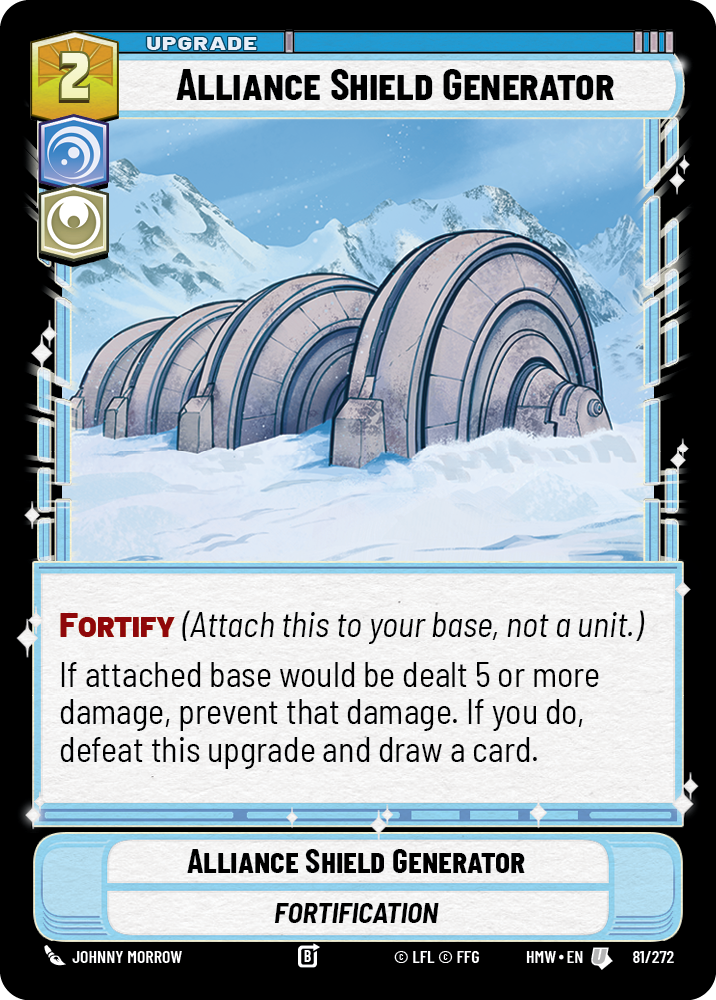
Fortify, from Homeworlds, changes the attachment restriction to "Attach to your base" (rule 7.5.21). A Fortify upgrade can't go on a unit or an enemy base, and it ignores the usual need for an eligible unit, so you can play one with no units in play. It can give your base abilities, and anything that defeats an upgrade can defeat it.
Common mistakes
Returning upgrades to hand with a bounced unit. They're defeated.
Taking an upgrade's control along with a stolen unit. The upgrades stay attached and keep their original controllers.
Playing an upgrade with no eligible unit in play. You can't, unless it has Fortify.
Removing an upgrade when its unit stops meeting the restriction. Eligibility is checked only when it attaches.
Counting a Pilot upgrade as a unit for "friendly units" effects. While attached, it's only an upgrade.
Frequently Asked Questions
Can you play an upgrade on an enemy unit in Star Wars: Unlimited?
Yes, unless the upgrade says otherwise. An upgrade with no printed restriction can attach to any unit, and many say "Attach to a friendly unit" or similar. If you put one on an enemy unit, you still control the upgrade, but the unit's controller resolves any abilities the upgrade gives the unit.
What happens to upgrades when a unit is defeated?
They are defeated too and go to their owners' discard piles. Token upgrades, such as Shield and Experience, are set aside instead. The same happens whenever the unit leaves play for any reason, including being returned to its owner's hand or captured.
Is there a limit on how many upgrades a unit can have?
No. A unit can have any number of upgrades, and each upgrade is attached to one unit at a time. Their power and HP modifiers add together.
Can you play an upgrade if there are no units in play?
No. An upgrade can only be played if there is a unit it is allowed to attach to. Upgrades with Fortify are the exception, since they attach to your base instead.
If I take control of a unit, do I get its upgrades?
No. When control of a unit changes, its upgrades stay attached and keep their original controllers.
Does a Pilot played as an upgrade count as a unit?
No. While a card is attached as an upgrade, it is an upgrade and not a unit for all purposes. It is still the same card for the unique rule, so you can't control a unique Pilot as an upgrade and another copy as a unit at the same time.
Track the game, not the paperwork.
TurnZero HQ's Star Wars: Unlimited board keeps each base's HP, the initiative, the round, each leader and your resources on one phone. Free to start.
Create Free AccountStar Wars: Unlimited card names and images are the property of Lucasfilm Ltd. and Fantasy Flight Games. © & ™ Lucasfilm Ltd. TurnZero HQ is not affiliated with, sponsored, or endorsed by Lucasfilm Ltd., Disney, Fantasy Flight Games, or Asmodee. Card data comes from swu-db.com, and prices from TCGplayer.