Star Wars: Unlimited · Aspect Combinations
Vigilance Villainy (Blue-Black) in Star Wars: Unlimited
Vigilance Villainy pairs Vigilance's removal and healing with the Empire, the Sith and the bounty hunters. Its leaders defeat enemy units, and its decks grind toward a late game the opponent can't match.
Vigilance Villainy means a leader with the Vigilance (blue) and Villainy (black) aspects. Control for the dark side: Imperial officers, Sith and bounty hunters who defeat units outright and win the long game.
Also called Blue Villainy or blue-black. As of October 2026, 13 of the 108 leaders in the six Premier-legal sets have exactly these two aspects.
How Vigilance Villainy Plays
Vigilance gives this pairing its removal and its staying power, and Villainy gives it the Empire, the Sith, the First Order, the Separatists and much of the Underworld. Where Vigilance Heroism protects its own units, Vigilance Villainy is more often about taking the opponent's units off the board.
Grand Admiral Thrawn, Victory is Mine shows the plan: deployed, he can defeat a non-leader unit whenever he attacks while you control more units than the defending player. Aurra Sing, Assassin defeats any non-leader unit with 1 or less remaining HP as an action, and one with 5 or less when she is deployed. Grand Moff Tarkin ignores the aspect penalty on Fortify upgrades and, deployed as The Death Star, can defeat a base with 10 or less remaining HP when the regroup phase starts.
There is also an upgrade plan. Kylo Ren, We're Not Done Yet discards a card each action and draws if it was an upgrade, then replays any number of upgrades from your discard pile onto himself when deployed, and Lama Su plays upgrades for 1 less. Either way, the deck's best cards are expensive, so it needs to survive the early rounds to use them.
How aspects and the aspect penalty work →What It Does Well, and What It Doesn't
Strengths
- Removal that defeats units outright, so a large or freshly healed unit is no safer than a small one.
- Healing and high-HP units let it trade early and still be ahead in the late game.
- Big Villainy finishers play at printed cost, up to Annihilator, an 11-cost 12/12 that defeats an enemy unit when played and when defeated.
Weaknesses
- Slow starts: many of its strongest cards cost 5 or more, and an Aggression deck can do a lot of base damage before they land.
- Little damage to bases, so it closes games slowly once it is ahead.
- Heroism cards cost at least 2 more, so the hero side's Sentinels and healing are out of reach at printed cost.
Vigilance Villainy Leaders
Four leaders that show what the pairing does, not a ranking. Each has exactly the Vigilance and Villainy aspects; the leader's front is shown, and its card page has the deployed side.

Grand Admiral Thrawn, Victory is Mine
Ashes of the Empire #004
Defeats units on attack

Aurra Sing, Assassin
A Lawless Time #004
Finishes damaged units
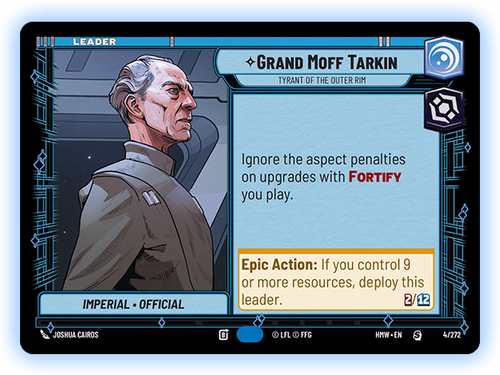
Grand Moff Tarkin // The Death Star, Tyrant of the Outer Rim // Icon of Tyranny
Homeworlds #004
Fortify, then the Death Star

Kylo Ren, We're Not Done Yet
Legends of the Force #001
Upgrades from the discard
- Grand Admiral Thrawn, Victory is Mine: His action attacks with a unit and gives it Restore 2 if you control as many units as the defender. Deployed at 8 resources, he has Restore 2 and, while you control more units, may defeat a non-leader unit when he attacks.
- Aurra Sing, Assassin: Exhausts to defeat a non-leader unit with 1 or less remaining HP, which turns any 1 damage into a kill. When deployed, she defeats a non-leader unit with 5 or less remaining HP.
- Grand Moff Tarkin // The Death Star, Tyrant of the Outer Rim // Icon of Tyranny: Ignores the aspect penalties on Fortify upgrades you play. Deployed at 9 resources as The Death Star, a 2/12 space unit, it may defeat a base with 10 or less remaining HP when the regroup phase starts.
- Kylo Ren, We're Not Done Yet: Discards a card from your hand as an action and draws if it was an upgrade. Deployed, he is a Sentinel and plays any number of upgrades from your discard pile on himself, paying their costs.
Signature Cards
Cards printed in exactly these two aspects, so any Vigilance Villainy leader plays them at printed cost whatever the base.

Darth Vader, Twilight of the Apprentice
Legends of the Force #037
Shield, then defeat

Chimaera, A Frightening Reality
Ashes of the Empire #052
Trade one for one

No Glory, Only Results
Jump To Lightspeed #043
5-cost removal event
- Darth Vader, Twilight of the Apprentice: When played, gives a Shield token to a friendly unit and to an enemy unit. On attack, he defeats an enemy unit with a Shield token on it.
- Chimaera, A Frightening Reality: When played, you may defeat a friendly unit and an enemy non-leader unit. Each enemy unit defeated afterward heals 2 damage from your base.
- No Glory, Only Results: Take control of a non-leader unit, then defeat it, so its When Defeated ability triggers for you rather than its owner.
Choosing a Base
Your base adds one aspect icon to the two on your leader. A base of another aspect gives the deck a third aspect; a Vigilance base gives it a second Vigilance icon instead. The third column counts the cards each choice plays at printed cost, out of the 1,409 non-leader, non-base cards in the Premier sets as of October 2026 (a reprint counted once).
The base decides what this control deck does besides removal. Command adds the Empire's large units and capital ships; Cunning adds exhaust and capture effects that buy time for the expensive cards; Aggression adds damage to close a game the deck has already won on the board. A Vigilance base suits a deck that wants Vigilance's double-icon cards or plans to spend almost every card on defense and removal.
Only 5 cards in the Premier sets print two Vigilance icons, such as Nala Se, Silent Survivor and Size Matters Not. That is why a doubled base is the exception. Every Heroism card costs at least 2 more whichever base you pick, since bases never provide Heroism or Villainy.
Other Aspect Combinations
Frequently Asked Questions
What leaders are Vigilance Villainy in Star Wars: Unlimited?
As of October 2026, 13 leaders in the six Premier-legal sets have exactly Vigilance and Villainy, including Grand Admiral Thrawn (Victory is Mine), Aurra Sing (Assassin), Grand Moff Tarkin (Tyrant of the Outer Rim) and Kylo Ren (We're Not Done Yet). Chancellor Palpatine (How Liberty Dies) and Agent Kallus are Vigilance Villainy leaders too, even though Palpatine is a Republic official there.
What base should a Vigilance Villainy deck use?
Most builds want a third aspect, which raises the cards you can play at printed cost from about 318 to between 534 and 538 of the Premier pool. Command adds big units, Cunning adds tempo, and Aggression adds base damage. Which is best depends on the leader: a Thrawn deck that wants more units than the opponent leans toward Command.
Is Vigilance Villainy a control deck?
Usually. Its leaders and signature cards defeat, damage and steal enemy units more than they pressure the base, and its strongest cards are expensive. That makes it slower than an Aggression pairing and better the longer the game goes.
Build a Vigilance Villainy deck and see what it really costs.
TurnZero HQ's deck builder checks the Premier rules and shows each off-aspect card's real cost under your leader and base. Track your games and Stats breaks your results down by Leader and by Base. Free to start.
Create Free AccountStar Wars: Unlimited card names and images are the property of Lucasfilm Ltd. and Fantasy Flight Games. © & ™ Lucasfilm Ltd. TurnZero HQ is not affiliated with, sponsored, or endorsed by Lucasfilm Ltd., Disney, Fantasy Flight Games, or Asmodee. Card data comes from swu-db.com, and prices from TCGplayer.