Yu-Gi-Oh! Rules Explained
Yu-Gi-Oh! Card Text: Colons, Semicolons and Costs
Since 2011, Konami has written cards in Problem-Solving Card Text, where the punctuation tells you when each part happens. Before the colon is the condition, before the semicolon is what you do to activate (costs and targets), and the rest happens when the effect resolves. Once you can split a card at those marks, most rules questions answer themselves.
Condition, activation, resolution
Every effect that starts a chain can be read in three parts. Konami's rulebook glossary defines them by the punctuation:
Konami Official Rulebook, Version 10 · Glossary, page 52
"Text before the colon gives information on conditions to activate the effect, and timing on when it happens. Text before a semi-colon is what you do when the effect is activated. Text at the end of a sentence, after all colons and semi-colons, is what you do at resolution of the effect."
Raigeki Break is a clean example: "Discard 1 card, then target 1 card on the field; destroy it." There is no condition, so it has no colon. Discarding and targeting come before the semicolon, so you do both when you activate it. The destruction comes after, so it happens only when Raigeki Break resolves. If your opponent chains a card that removes the target first, the discard has already happened and the destruction does nothing.


Does it start a chain?
Konami's Problem-Solving Card Text articles give a simple test for monsters and for effects of face-up Continuous Spells and Traps: a colon or a semicolon means the effect starts a chain. No colon and no semicolon means it does not, and nothing can be chained to it.
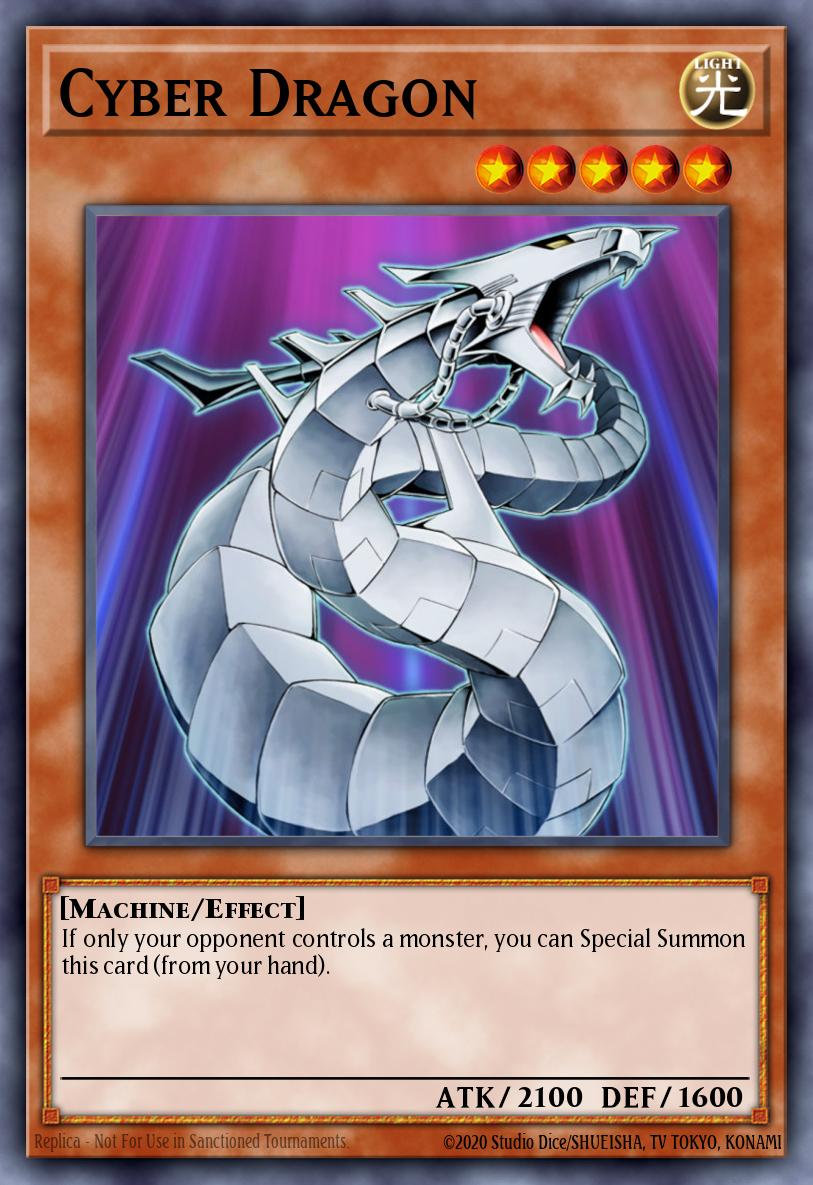
Cyber Dragon reads "If only your opponent controls a monster, you can Special Summon this card (from your hand)." There is no colon, so this is a built-in Summon rather than an effect. It does not start a chain, which also means a card like Divine Wrath, which answers a monster effect being activated, has nothing to respond to. Konami's Part 5 article puts Xyz and Synchro Summons in the same group.
Spells and Traps are the exception. Activating a Spell or Trap Card starts a chain by itself, so a card such as Dark Hole ("Destroy all monsters on the field.") starts a chain even though it has neither mark. For what can respond once a chain has started, see Chains and Spell Speed.
Costs vs. effects
A cost is the price of activating, and it is not part of the effect. Konami's rulebook says so in two glossary entries:
Konami Official Rulebook, Version 10 · Glossary, pages 53 and 54
"Costs that are needed to activate an ability are not part of the effect." / "You have to pay any costs before you declare the activation of the card. Even if the activation of the card is negated, you cannot get a refund of the cost that you have paid."
Konami's Part 4 article gives the reading rule: if the card tells you to pay, discard, Tribute or destroy before the semicolon, that is a cost. The rulebook's glossary names Tributing, discarding, paying LP and banishing as common costs.
Two practical results follow. A cost is paid even when the card is negated, so you lose the discarded card or the LP either way. And because the cost happens at activation, a card sent to the GY as a cost is already there before your opponent decides whether to respond. Konami's glossary also notes that a card sent to the Graveyard as a cost or a Tribute is not "destroyed", which matters for cards that care about destruction.
When conditions are checked
Konami's Part 4 article says that activation conditions, the text before the colon, only have to be met when you activate. If they stop being true before the effect resolves, it still resolves. A condition that must still be true at resolution is written out separately.
Zombie Master shows the separate sentence. Its effect ends "This monster must be face-up on the field to activate and to resolve this effect." Konami's Part 4 article points to that line as the condition that is checked again: if Zombie Master is no longer face-up on the field when the effect resolves, the effect does nothing.
Targets have their own wording rules, and they are the most common source of resolution questions. The page on targeting covers "that target", "it" and "both".
Then, also, and if you do, and
When an effect does more than one thing, the word joining the parts tells you two things: whether the parts happen in sequence or at the same time, and whether the second part depends on the first. Konami's Part 7 article (December 2012) sets out all four:
Konami notes that plain "and" is now rare. Many older cards were rewritten to "and if you do", and plain "and" is kept for all-or-nothing effects. Memory of an Adversary uses "and if you do": "You take damage equal to the attacking monster's ATK, and if you do, banish that monster." If another card stops you taking the damage, the monster is not banished.
The timing column matters for effects that respond to "the last thing that happened". After "then", the last thing is B. After the other three, A and B both count. That is the rule behind missing the timing, which has its own page.

Memory of an Adversary
ABYR-EN075
"And if you do": damage and banishing happen together.

Heraldry Change
CBLZ-EN070
"Then": the Battle Phase ends after the Summon.

Ignition Beast Volcannon
CBLZ-EN091
"Also" and "then" in one effect.
Ignition Beast Volcannon is Konami's example of several conjunctions in one effect: "destroy that target, also destroy this card, then if both monsters were destroyed, inflict damage". Because of "also", you destroy whichever of the two you still can. Because of "then", the damage is checked afterward and only happens if both were destroyed.
Reading a chain with punctuation
Konami's Part 3 article sums up chains in one line: everything before the semicolons happens first, in the order the cards are activated, and everything after them happens as the chain resolves backwards. Here is a chain built from cards in this guide.
Raigeki Break, answered by Gemini Spark
Your opponent activates Raigeki Break as Chain Link 1. Before the semicolon: they discard 1 card, then target your face-up Level 4 Gemini monster.
You respond with Gemini Spark as Chain Link 2. Before the semicolon: you Tribute that same Gemini monster, then target 1 card on the field, such as one your opponent controls.
Both players pass. Chain Link 2 resolves: destroy it, and if you do, draw 1 card.
Chain Link 1 resolves: destroy it. The Gemini monster already left the field as your cost, so nothing is destroyed. Your opponent's discard stays in their GY.

Common card text mistakes
Asking for a cost back after a negation. The cost was paid at activation and is not part of the effect.
Waiting until resolution to discard or pay LP. Anything before the semicolon happens when you activate.
Responding to Cyber Dragon's Summon with a card that answers effect activations. A built-in Summon with no colon or semicolon does not start a chain.
Reading "then" as if both parts happen together. With "then", the second part happens afterward, and it is the last thing that happened.
Treating a Tribute or a discarded cost as "destroyed". Konami's glossary says neither counts as destruction.
Frequently Asked Questions
What does the colon mean on a Yu-Gi-Oh! card?
Text before a colon (:) is the condition and timing for activating the effect. Konami's rulebook says it gives information on the conditions to activate the effect and when it happens. Those conditions only have to be true when you activate, unless the card says otherwise.
What does the semicolon mean on a Yu-Gi-Oh! card?
The semicolon (;) separates what you do when you activate the effect from what happens when it resolves. Costs and targets come before the semicolon and happen at activation. Everything after it happens when the effect resolves, after any chain built on top of it.
What is a cost in Yu-Gi-Oh!?
A cost is something you must do to activate a card or effect, such as discarding, paying LP, Tributing or banishing. Konami's rulebook says you pay it before you declare the activation, and Problem-Solving Card Text puts it before the semicolon. A cost is not part of the card's effect, so it is never refunded, even if the activation is negated.
Does a card without a colon or semicolon start a chain?
For a monster, or an effect of a face-up Continuous Spell or Trap, no colon and no semicolon means the effect does not start a chain and cannot be chained to. Cyber Dragon's Special Summon from the hand is an example. Activating a Spell or Trap Card always starts a chain, even when its text has no colon or semicolon.
What is the difference between "then" and "and if you do"?
With "then", the second action happens after the first, so it becomes the last thing that happened. With "and if you do", both happen at the same time. In both cases the first action is required: if it does not happen, the second does not either.
Build and check your Yu-Gi-Oh! deck in TurnZero HQ.
Every card page shows the card's current text, so you can read the colon and semicolon for yourself. Build a deck, deal sample hands, and check the list against the Forbidden & Limited List. Free on iPhone, Android and the web.
Create Free AccountYu-Gi-Oh! card names and images are the property of Konami Digital Entertainment and their respective owners. ©Studio Dice/SHUEISHA, TV TOKYO, KONAMI. TurnZero HQ is not affiliated with, sponsored, or endorsed by Konami. Card data comes from YGOPRODeck, and prices from TCGplayer via TCGCSV.