One Piece Card Game · Rules Explained
How [Trigger] Works in the One Piece TCG
A [Trigger] works only when your Leader takes damage. A card effect that moves your Life card to your hand or the trash doesn't let you use it, even though the card leaves your Life area either way. This page covers when a Trigger can be used, what happens to the card, and how Triggers interact with [Double Attack] and [Banish].
How a [Trigger] works
Each point of damage to your Leader moves the top card of your Life area to your hand (rule 4-6-2). If that card has [Trigger], you may reveal it and use the [Trigger] instead of adding it to your hand. The rules here are from Bandai's Comprehensive Rules, version 1.2.1, last updated August 28, 2026, current as of October 2026, and Bandai's rules Q&A.
Comprehensive Rules · 10-1-5-1
[Trigger] is a keyword effect that, on taking damage when there is a card in your Life area with [Trigger], allows you to reveal that card and activate its [Trigger], instead of adding the card to your hand.
Using it is your choice. You see the card, decide, and if you'd rather keep it, add it to your hand without showing it (rule 10-1-5-2). That choice is the real tradeoff: a Trigger gives you an effect now, and declining gives you a card to play or Counter with later. Why Life works this way is covered in how to win the One Piece TCG.
Damage, not effects
Bandai's rules Q&A is direct about this: Triggers can only be activated upon taking damage. A Life card that leaves because an effect says so doesn't let you use its Trigger, whoever's effect it is.

Nico Robin
EB03-055
[On K.O.] may deal 1 damage: effect damage, so a [Trigger] can be used

Sabo
P-105
Adds a Life card to your hand as a cost: no [Trigger]

Eustass"Captain"Kid
OP10-112
Trashes your opponent's top Life card: no [Trigger]

Howling Gab
OP17-024
[Banish]: the Life card is trashed and its [Trigger] can't be used
That makes effects like Eustass"Captain"Kid's a clean way past a Yellow deck's Life: the card is gone and its Trigger never happens.
Where the card goes afterward
While its Trigger resolves, the card isn't in any area. When the effect is finished, it goes to the trash unless the Trigger says otherwise (rule 10-1-5-3).

Pacifista
OP12-109
[Trigger] K.O. a 1-cost-or-less Character and add this card to your hand

Avalo Pizarro
OP16-102
[Trigger] Activate this card's [On K.O.] effect
A Trigger that uses another of the card's effects follows that effect's costs. Bandai's Q&A gives the example of Top Knot (OP03-074), whose Trigger reads "Activate this card's [Main] effect": you still have to pay the [Main] effect's DON!! −2 cost to use it. Using an Event's Trigger also isn't "activating an Event" for effects that check for one, according to the same Q&A.
Triggers that play a Character
"[Trigger] Play this card" puts the Character into play, usually on your opponent's turn, active (rule 3-7-5). Placing a Character in the Character area is playing it (rule 3-7-3), so its [On Play] effect activates as well (rule 10-2-6-1). Bandai's card Q&A confirms this for Triggers that play a Character, such as Straw Sword (ST02-017).
The timing of that [On Play] comes from rule 8-6-2: an effect whose timing comes up during damage processing can be activated after all of the damage processing is finished. Read that way, if the attack deals 2 damage, the [On Play] waits until both points have been dealt. Bandai's Q&A has no ruling on this exact case. The closest one, on the Enel Leader (OP05-098), has an effect that comes up during [Double Attack] damage wait until both points are dealt and the Damage Step has ended.

Who's.Who
OP17-071
[Trigger] Play this card; its [On Play] DON!! −1 K.O.s up to 2 Characters with a cost of 2 or less
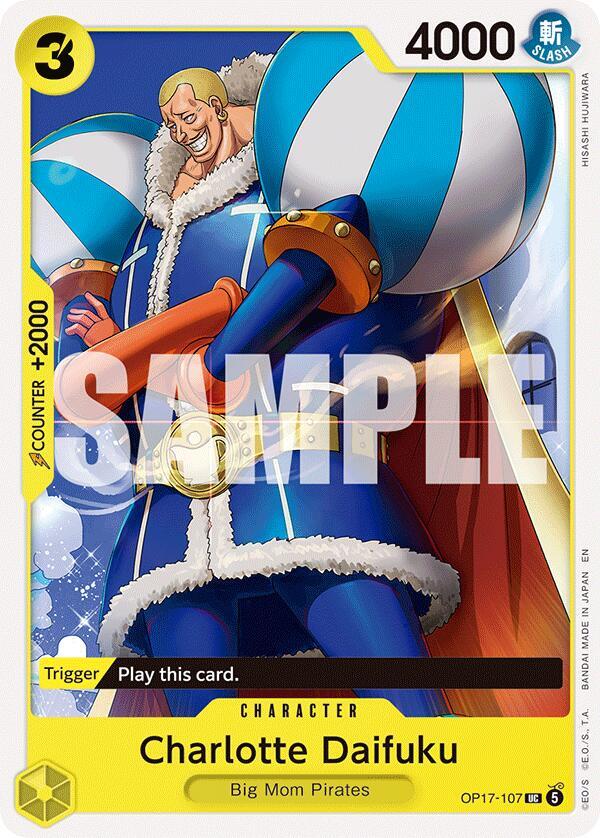
Charlotte Daifuku
OP17-107
[Trigger] Play this card: a 3-cost, 4000-power Character for free
A Character played this way on your opponent's turn wasn't played on your turn, so rule 3-7-4 doesn't stop it attacking on yours. If it has [Blocker], it is active and can block your opponent's next attack that same turn.
Triggers, [Double Attack] and [Banish]
[Double Attack] deals 2 damage, and each point is processed one at a time (rule 7-1-4-1-1-3). Bandai's Q&A says a Trigger from the first damage is used before the second damage is dealt, and that the second damage happens anyway: it is fixed at 2 even if the Trigger K.O.s the attacker or takes away its [Double Attack].
A [Double Attack] Character hits your Leader at 2 Life
The attack succeeds. The first damage moves your top Life card. It is Pacifista, so you reveal it and use its [Trigger]: K.O. a Character with a cost of 1 or less, then add Pacifista to your hand.
Even if that K.O. had hit the attacker, the second damage is still dealt. You have 1 Life card left, so it moves too.
You are now at 0 Life and still in the game. The next damage your Leader takes ends it (rule 7-1-4-1-1-1).
[Banish] is the opposite case. The Life card is trashed instead of going to your hand, and its Trigger can't be used (rule 10-1-3-1). Bandai's Q&A adds that the attacker can't choose to skip it. Both keywords apply only to damage dealt to a Leader, so a [Blocker] stops both; see after the block.
Other rulings worth knowing
- A face-up Life card's [Trigger] can still be used when it is taken by damage (Q&A).
- At 0 Life there is no card to take, so there is no Trigger: the next damage that would be dealt ends the game instead (rule 7-1-4-1-1-1).
- A [Counter] Event's Trigger that says "Activate this card's [Counter] effect" is one of the stated exceptions that lets [Counter] be used outside the Counter Step (rule 10-2-4-1-1). The Counter Step itself is covered in the Counter Step.
- "Up to" in a Trigger lets you choose 0, so a Trigger whose only targets would hurt you can still be used with no target chosen, or declined (rules 1-3-5-1 and 4-8-1).
Common mistakes
Using a Trigger when an effect moved your Life card. Only damage lets you use it.
Showing the card when you decline the Trigger. Declined cards go to hand unrevealed.
Keeping a used Trigger card in hand. It goes to the trash unless its text says otherwise.
Stopping a [Double Attack] by K.O.ing the attacker with the first Trigger. The second damage still lands.
Skipping the cost of an "Activate this card's ..." Trigger. That effect's own cost still applies.
Frequently Asked Questions
When can you use a [Trigger] in the One Piece TCG?
When your Leader takes damage and the Life card that would go to your hand has [Trigger]. You may reveal it and use its [Trigger] instead of adding it to your hand (rule 10-1-5-1). Damage from an attack or from an effect both count.
Does a [Trigger] activate if an effect moves my Life card to my hand?
No. Bandai's rules Q&A says Triggers can only be activated on taking damage. Effects such as "add 1 card from the top of your Life cards to your hand" or "trash up to 1 card from the top of your Life cards" don't let you use the [Trigger].
Where does a card go after its [Trigger]?
To the trash, unless the [Trigger] says otherwise (rule 10-1-5-3). "Play this card" puts it into play, and some Triggers end with "add this card to your hand".
Do you have to use a [Trigger]?
No. You can choose not to, and then you add the card to your hand without revealing it (rule 10-1-5-2).
Does a [Trigger] resolve before the second [Double Attack] damage?
Yes. Bandai's Q&A says the [Trigger] from the first damage is used before the second damage is dealt. The second damage still happens even if the Trigger K.O.s the attacker or removes its [Double Attack].
Can a Character played by a [Trigger] attack?
Usually not that turn, because you usually take damage on your opponent's turn. A Character played on their turn can attack on your next turn like any other Character. If effect damage makes you use the [Trigger] on your own turn, the Character can't attack that turn (rule 3-7-4). It enters active, so a [Blocker] played this way can block your opponent's next attack.
Keep score at the table.
Track each player's Life and record who won, build and check a One Piece deck, and keep your collection in one place. Free on iPhone, Android and the web.
Create Free AccountONE PIECE CARD GAME card names and images are the property of Bandai and their respective owners. ©Eiichiro Oda/Shueisha, Toei Animation. TurnZero HQ is not affiliated with, sponsored, or endorsed by Bandai, Shueisha, or Toei Animation. Card data and prices come from TCGplayer.