One Piece Card Game
Rare One Piece Cards
The rarity letter on a One Piece card tells you less than you might think. A card's rarest versions keep the same letter as its common printing. This guide covers what each rarity means, which printings are rarer still, and what both are worth.
The One Piece rarities
Every One Piece card prints a rarity letter in the bottom right corner, next to its card number. The letter belongs to the card, not the printing, so a Parallel or Manga version keeps the letter of the standard card. Here is what each means, with the median price of a standard printing from the main booster sets on October 2, 2026:
Standard printings are cheap below Secret Rare, because each one is printed in large numbers. The money in One Piece is in the alternate printings, covered below, and in promo cards.
How a main set is made up
Recent main booster sets have the same shape. OP09, OP13 and OP17 each have 45 Commons, 30 Uncommons, 26 Rares, 10 Super Rares and 6 Leaders, with two or three Secret Rares at the top. OP01 had 8 Leaders. On top of those standard cards, each set adds its alternate printings: OP17 has 26 Alternate Arts, 11 SPs, 4 Manga cards, 6 Pandaman Art cards, a TR and three Super Alternate Arts, one of them a Leader.
Bandai's product pages list a set's rarities but not its pull rates. The rates you will see quoted come from players opening boxes, so treat them as estimates.
Printings rarer than any letter
The rarest cards in a booster set are alternate printings of cards that already have a letter. These are the main kinds, from the most numerous in a set to the fewest:
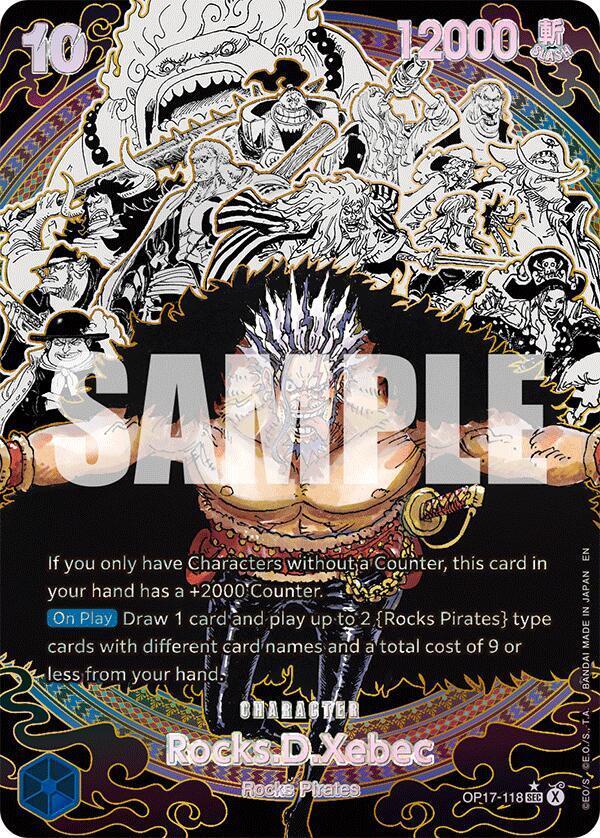
Rocks.D.Xebec (Super Alternate Art)
OP17-118
Super Alternate Art, OP17
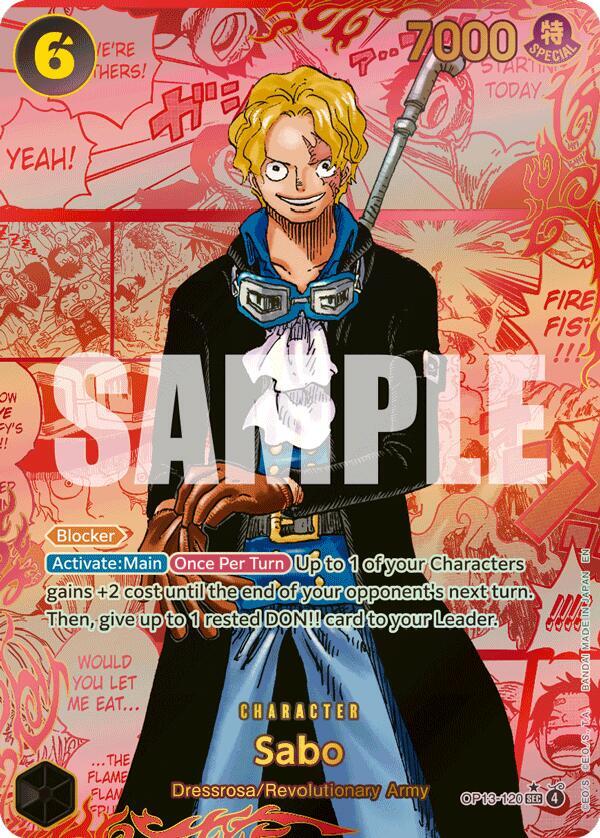
Sabo (Red Super Alternate Art)
OP13-120
Red Super Alternate Art, OP13

Nami (TR)
ST01-007
TR, OP06
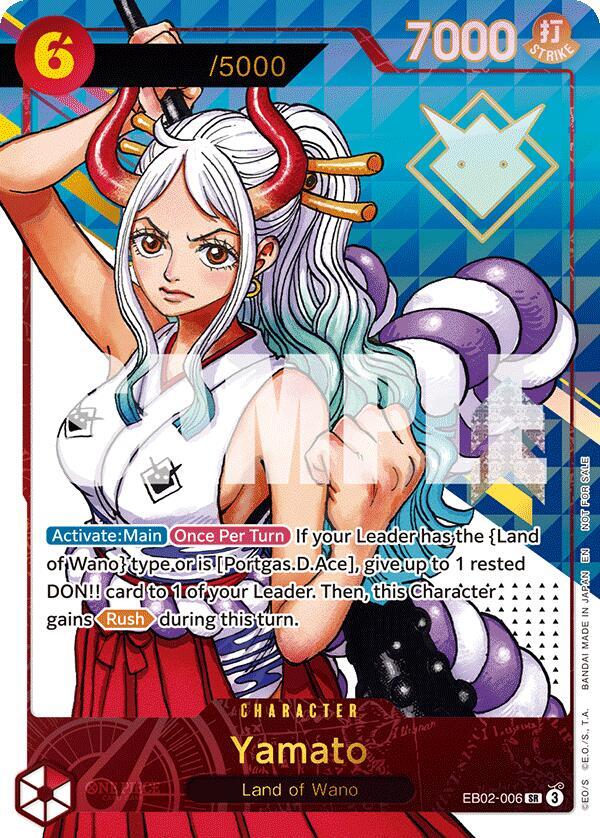
Yamato (Serial Numbered)
EB02-006
Serial Numbered promo
This is why "rare" and "valuable" don't line up with the letter. OP16's Manga Kuzan is an R and sells for $1,100.15, while the standard Secret Rares of most sets are under $10. The Parallel vs. Alternate Art guide explains each label, and One Piece Manga cards lists every Manga printing.
Treasure Rares
Treasure Rare (TR) is the one rarity letter that marks a special printing on its own. Every main set from OP06 to OP17 has exactly one TR, most of them reprints of a card from an earlier product. Here they are with TCGplayer market prices on October 2, 2026:
The rarest One Piece cards
The rarest cards are not in booster packs at all. Championship trophy cards, serial-numbered promos and tournament winner prizes exist in very small numbers, and several have sold so rarely that TCGplayer has no market price for them, such as the serial-numbered Shanks from Championship 2023. Among those with a price, the serial-numbered Yamato (EB02-006) sells for $4,250.00 and the Gold-Stamped Signature Luffy (ST01-012) for $4,999.99.
Scarcity and price usually move together, but not always. A card with no market price may be rarer than the most expensive card on TCGplayer, and a popular card can outsell a scarcer one. The most expensive One Piece cards list ranks the top 20 by price.
Checking your own cards
Read the rarity letter, then compare the art with the standard printing of the same card number. TurnZero HQ's One Piece card pages list every printing of a card number with its price, so you can tell a $0.20 Rare from its $1,000 alternate. Set completion counts a set's standard cards as the main set and tallies Parallels, alternate arts, Manga, Wanted Posters and DON!! cards as extras. The set completion guide and How Much Are My One Piece Cards Worth? cover both.
Frequently Asked Questions
What is the rarest One Piece card?
There is no single answer, because Bandai doesn't publish print runs. The scarcest cards are one-of-a-kind or near it: championship trophy cards, serial-numbered promos and winner prizes, several of which have sold too rarely to carry a market price. Among booster cards, Manga printings, Gold SPs and Super Alternate Arts are the hardest pulls.
What do the rarities on One Piece cards mean?
C is Common, UC Uncommon, R Rare, SR Super Rare, SEC Secret Rare, L Leader, TR Treasure Rare and PR Promotion. The letter is in the bottom right corner beside the card number, and it stays the same on every printing of a card.
Is a Secret Rare the rarest One Piece rarity?
It is the rarest of the regular rarity slots: a main set has only two or three. But the alternate printings of a card, such as a Parallel, SP or Manga, are scarcer than its standard printing, and they keep the original rarity letter. A Manga Rare can be much harder to find than a standard Secret Rare.
What is a TR card in One Piece?
TR is Treasure Rare. Since OP06, each main set has had one TR printing, usually a reprint of a card from an earlier product with new art. They sold for between $22.16 and $249.70 on October 2, 2026.
How do I know if my One Piece card is rare?
Check the rarity letter first, then compare the art with the standard printing of the same card number. If the art differs, you have an alternate printing, which is usually worth more than the letter suggests. Look up that exact printing's price.
Find the rare printings in your collection.
Add your One Piece cards by printing and see each priced daily from TCGplayer. Free on iPhone, Android and the web.
Create Free AccountONE PIECE CARD GAME card names and images are the property of Bandai and their respective owners. ©Eiichiro Oda/Shueisha, Toei Animation. TurnZero HQ is not affiliated with, sponsored, or endorsed by Bandai, Shueisha, or Toei Animation. Card data and prices come from TCGplayer.