Riftbound
How to Win at Riftbound
You win Riftbound by reaching 8 points with more points than anyone else (11 in 2v2). Points come from taking and keeping battlefields, and the last point has a rule of its own: a conquer only gives it to you if you've scored every battlefield that turn. This guide covers every way to score and how to plan the final point.
The short answer
The game checks for a winner each time it cleans up, which happens after almost anything that changes the board. You win at that moment if you have at least the victory score and more points than every opponent. The victory score is 8 in 1v1 and in free-for-all games, and 11 in 2v2. Most of those points come from the battlefields in the middle of the table, so the whole game is a fight over which units are standing where.
The four ways to gain points
Each battlefield can score for you only once per turn, by conquer or by hold, never both. In 1v1 there are two battlefields, so a normal turn is worth at most 2 points from them. A battlefield you take on your turn and keep through your opponent's turn scores twice: once for the conquer, once more for the hold at the start of your next turn.
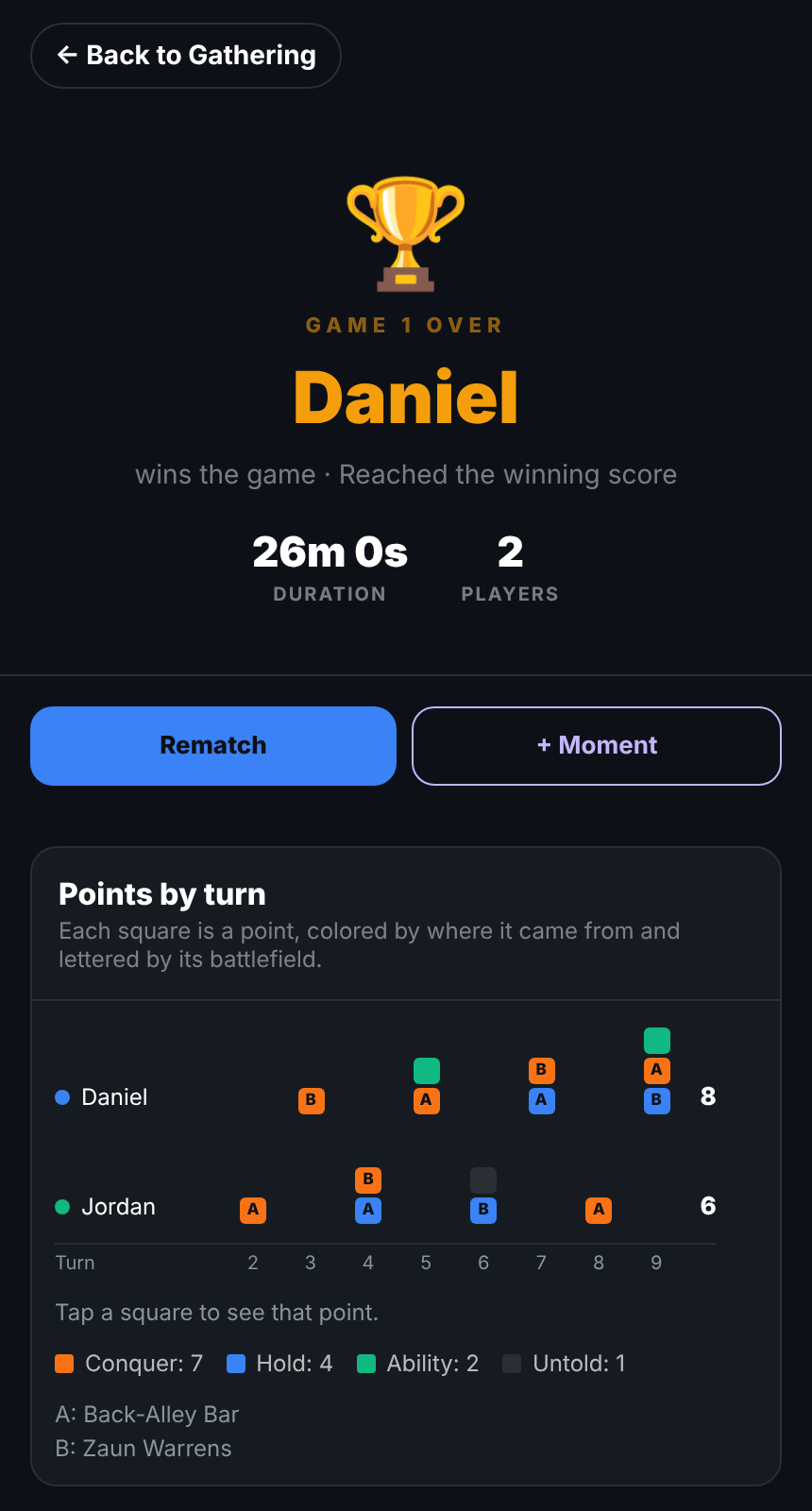
You only control a battlefield while you have units there. If your last unit at one dies or goes home, you stop controlling it, and there is nothing to hold next turn. Keeping a unit at each battlefield you want to hold is most of what defending means in Riftbound.
The 8th point: the final point rule
The last point is harder to get on purpose. When you are one point from the victory score, a conquer gives you that point only if you have scored every battlefield this turn. If you haven't, you still take control of the battlefield, but you draw a card instead of gaining the point.
The rule only touches conquering. A hold, a point from a card and a point from an opponent's burn out all count normally, at 7 points or at any other score.
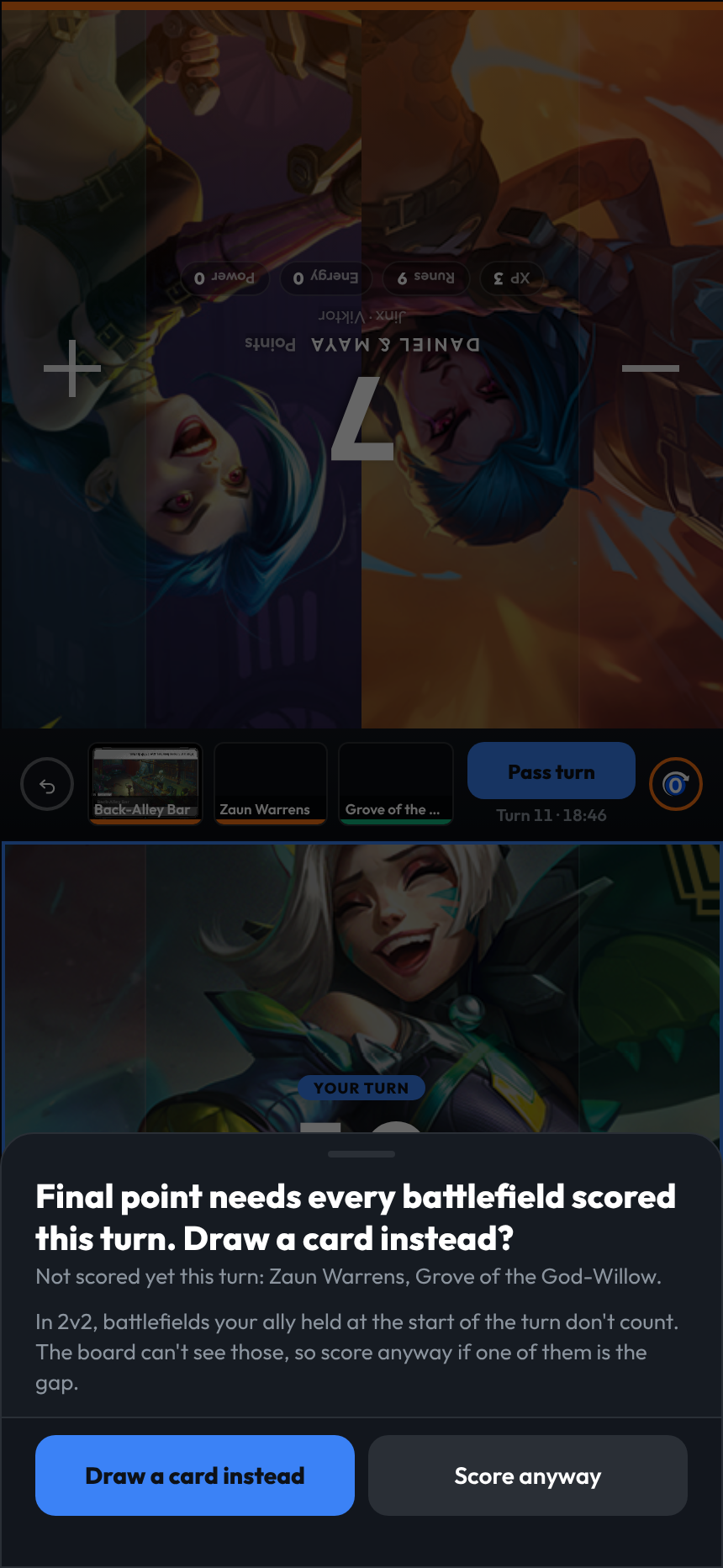
Without this rule, a player at 7 could win with a single attack on an empty battlefield. With it, winning by conquest means controlling the whole board for a turn, which gives the player behind a real chance to stop it.

Three ways to get the 8th point in 1v1
The second plan is the one beginners miss. A hold counts as scoring that battlefield for the turn, so holding one battlefield at 6 points takes you to 7 and also unlocks the final point for a conquer later the same turn.
There is one more route: a card that says you score a point. Those points ignore the final point rule, so a deck with one can finish a game without controlling the board.
Ties, burning out and conceding
If two players are at or above the victory score at the same time, the one with more points wins. If they are tied, nobody wins yet, and the game goes on until one of them is ahead when the game checks again.
You don't lose for running out of cards. When you have to draw from an empty main deck, you burn out: shuffle your trash into a new main deck, choose an opponent to gain 1 point, then draw. With a 40-card deck this is rare, but a long game or a deck that draws a lot can get there, and that 1 point can be your opponent's last.
A player can concede at any time. When only one player is left in the game, that player wins.
Beginner strategy: playing for points
These are habits rather than rules, and good players break them when the board calls for it. They are a solid starting point for your first games.
Count both scores every turn
Before you move anything, count what you can score this turn and what your opponent can score on theirs. A battlefield they will hold next turn is worth a point to them, so taking it away is often worth as much as scoring one yourself.
Leave units behind to hold
A conquer is 1 point. A conquer you keep through your opponent's turn is 2. Moving every unit out to chase a second battlefield can leave the first one empty, and an empty battlefield can't be held.
Don't attack into a fight you can't win
If the defender still has units after damage, your survivors go back to your base and nothing is scored. Add up both sides' Might before you move, and remember your opponent may have an Action or Reaction card waiting for the showdown. How combat works walks through the math.
Plan the last point a turn early
At 5 or 6 points, look at how you will get to 8, not just to the next point. Ending your turn with units on a battlefield sets up a hold, and a hold at the start of the next turn opens the hold-one, conquer-the-other route. Your opponent knows the final point rule too, and will spend their turn trying to clear the battlefield you plan to hold.
Keep a trick for the showdown
Most close fights are decided by a card played during the showdown. Holding one Action or Reaction card, and the runes to pay for it, makes attacking into you riskier for your opponent and defending against you harder.
Winning in other modes
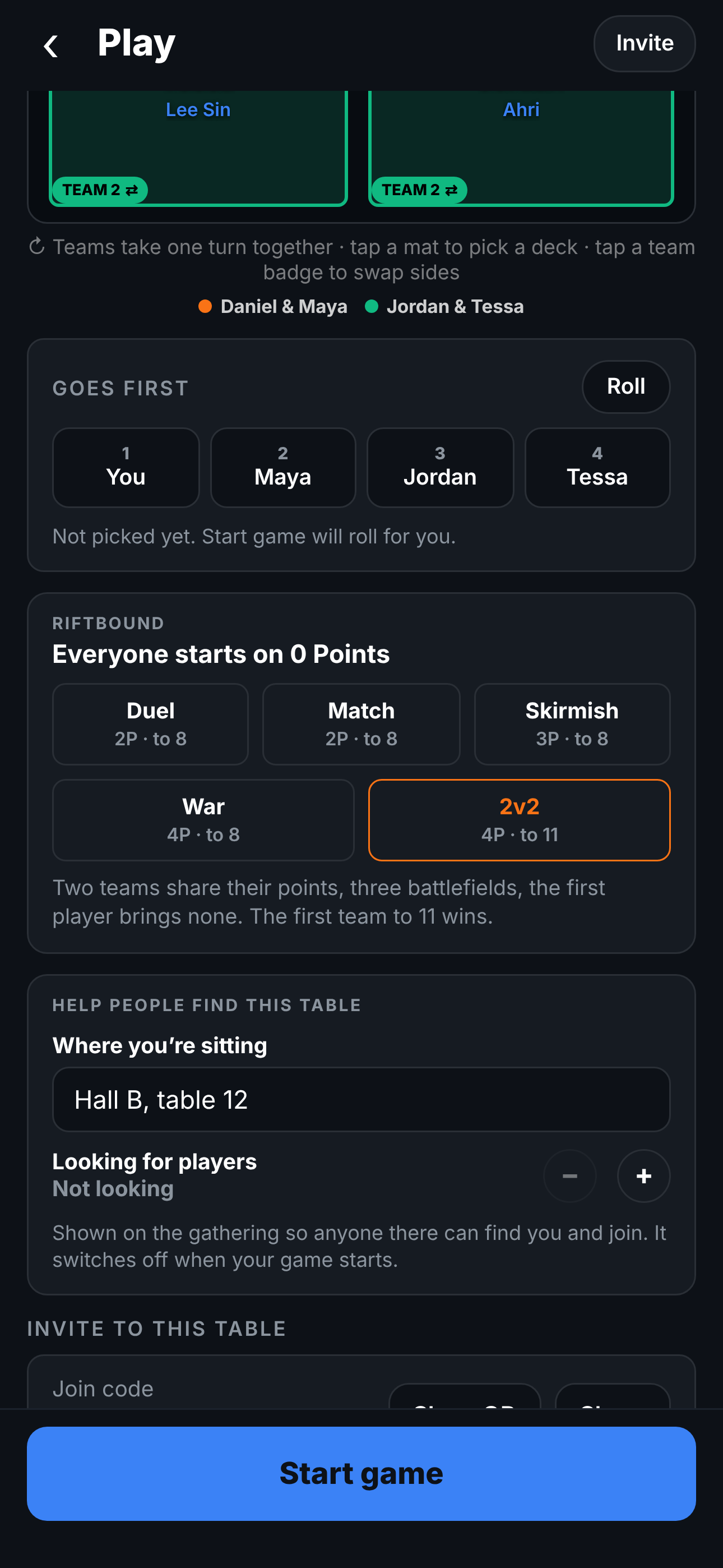
With three battlefields in play, the final point by conquest needs all three scored in one turn, which is harder than in 1v1. In 2v2, a battlefield your teammate controlled during your Beginning Phase doesn't count against you. How scoring works in Riftbound has the full scoring rules for each mode and what happens when time is called at a tournament.
Frequently Asked Questions
How do you win a game of Riftbound?
Reach the victory score with more points than every opponent: 8 points in 1v1 and free-for-all, 11 in 2v2. Most points come from battlefields: 1 for conquering one and 1 for each one you hold at the start of your turn.
How do you get the 8th point in Riftbound?
At 7 points, a conquer only gives you the 8th point if you have scored every battlefield this turn. So you either hold a battlefield at the start of your turn (a hold is never restricted), conquer the other battlefield after holding the first one, or conquer both battlefields in the same turn. Points from card effects also count without the restriction.
Why did I draw a card instead of scoring my last point?
Because of the final point rule. When a conquer would take you to the victory score, you gain the point only if you have scored every battlefield that turn. If you haven't, you draw a card instead, and you still take control of the battlefield.
Can you win Riftbound by holding a battlefield?
Yes. The final point rule only applies to conquering. If you start your turn at 7 points and control a battlefield, the hold in your Beginning Phase gives you the 8th point and you win.
What happens if both players reach 8 points in Riftbound?
The player with more points wins. If they are tied at or above 8, play continues until one of them has more points when the game checks for a winner.
Do you lose if you run out of cards in Riftbound?
No. When you have to draw from an empty deck, you burn out: shuffle your trash into a new deck, choose an opponent to gain 1 point, then draw. That point can win the game for them.
How many points do you need to win Riftbound 2v2?
11, and teammates share one score. Every other sanctioned mode, including three- and four-player free-for-all, is played to 8.
Never miscount the last point
TurnZero HQ's Riftbound score tracker keeps each player's points by battlefield and source, and reminds you of the final point rule before a conquer counts. Free to start.
Create Free AccountTurnZero was created under Riot Games' "Legal Jibber Jabber" policy using assets owned by Riot Games. Riot Games does not endorse or sponsor this project. Card data comes from Riot Games' official Riftbound card gallery, and prices from TCGplayer via TCGCSV.