Pokémon TCG
How to Organize Pokémon Cards
The right way to sort a Pokémon collection depends on what you're collecting for. This guide covers the common sorting schemes and which goal each suits, how to choose and plan a binder, the Michi method, and where your bulk should go instead.
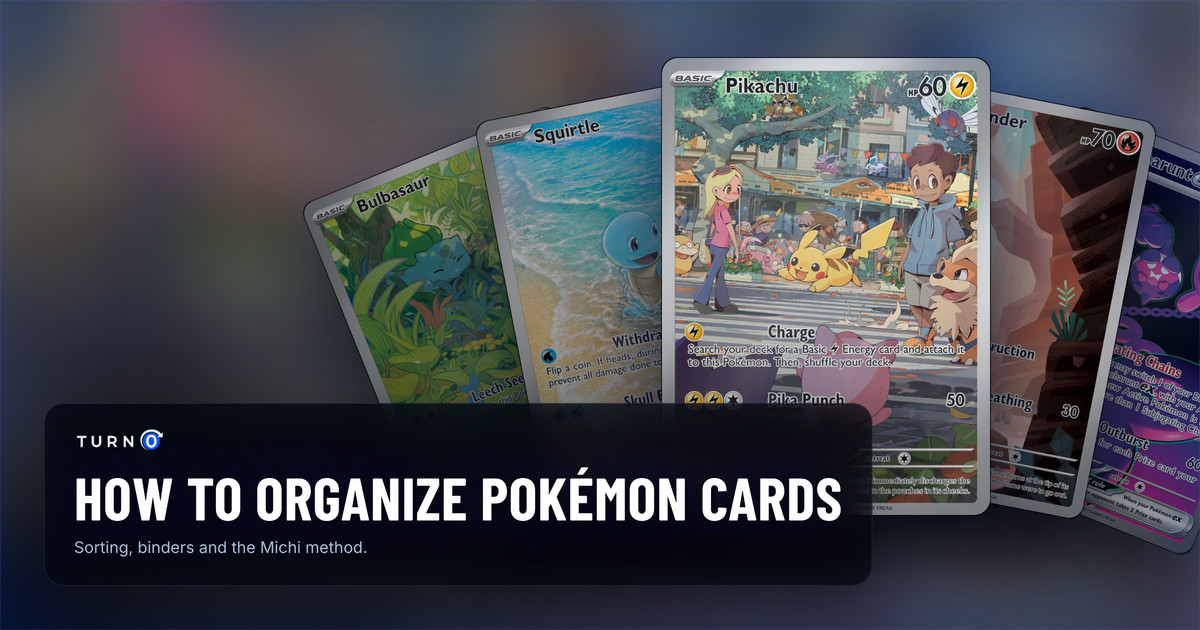
Start with your goal
Decide what the collection is for before you sort a single card, because each goal wants a different order. A set collector needs to see which numbers are missing. A Pokédex collector needs one slot per Pokémon. Someone who trades needs to find a card in seconds. Most collections end up as a mix: a binder or two for the goal, and boxes for everything else.
Sorting schemes
Sorting by set is the most common choice, because every card is printed with its set symbol and number, so there is never a question of where it goes. The number at the bottom of the card, such as 125/094, tells you its place. A number above the printed total marks a secret rare. How to read a Pokémon card →
A Pokédex binder has 1,025 slots for every Pokémon through the ninth generation, from Bulbasaur to Pecharunt. That is 114 nine-pocket pages, so plan on two large binders or one binder per generation. The count will grow when the next generation's games release.
Choosing a binder
Buy a binder with pages bound into the spine, side-loading pockets and a zip closure. Side-loading pockets open toward the spine, so a card can't slide out when the binder tips, and the zip keeps out dust and stops the binder from falling open.
Put each card in a penny sleeve before it goes in a pocket if it's worth more than a few dollars. The sleeve protects the surface from the pocket itself. Keep the most valuable cards in a sleeve and a rigid toploader instead, or graded, in a box rather than a binder.
Planning binder pages
Plan the pages before you fill them, so a set doesn't run out of room halfway through. Divide the number of cards you'll keep by the pockets per page. A set like Phantasmal Flames, with 94 cards in its printed total and 130 in all, needs 11 nine-pocket pages for the main set and 15 with every secret rare.
Binder planners do this for you. They lay out a set's card list as binder pages in collector-number order, count the pages, and print placeholders for the cards you don't have yet, so each missing card has its pocket waiting. A placeholder also makes a gap easy to see when you flip through.
The Michi method
The Michi method lays out binder pages as displays rather than full grids. The Instagram collector @peeplop is widely credited with popularizing it, and it has spread from Pokémon to other card games. Each page follows a theme, such as one Pokémon's evolution line or a single set's illustrations, and uses empty pockets on purpose so the best card stands out.
It works best in side-loading binders, where an image split across facing pockets lines up. It also holds far fewer cards per page, so keep it for a display binder and sort the rest of the collection a faster way.
Bulk and storage
Most of a collection is commons, uncommons and Energy, and those belong in cardboard storage boxes rather than binders. Sort them the same way as your binders, by set and number or by type, and use dividers so you can find a card for a deck or a trade.
Store boxes and binders upright, somewhere dry and away from direct sunlight, which fades the ink. Don't stack heavy binders flat on top of each other for long periods, since the weight can bend the cards inside.
Digital binders
Sorting a physical collection only tells you where a card is. A digital record also tells you what you have, what it's worth and what's missing. In TurnZero HQ, set completion shows each set against its printed total with the secret rares counted apart, so it works like a set binder that always knows which pockets are empty. How set completion works →
Binders in the app group cards the way your physical binders do, by set, by Pokémon or for trading. You get 3 binders free and 50 with Premium, and a binder can be shared with a friend before a trade. Scanning a card by its set code and number adds it without typing. How the collection tracker works →
Frequently Asked Questions
What is the best way to organize Pokémon cards?
Sort by set and collector number if you want to complete sets, by National Pokédex number if you collect every Pokémon, and by type or by Pokémon if you collect favorites. Keep your best cards in a side-loading zip binder and bulk in labeled storage boxes.
What is the Michi method for Pokémon binders?
A way of laying out binder pages as displays instead of full grids. Each page follows a theme, such as one Pokémon's evolution line, with a standout card in the center, art or inserts spanning several pockets, and some pockets left empty on purpose. The Instagram collector @peeplop is widely credited with popularizing it.
Are ring binders bad for Pokémon cards?
Many collectors avoid them, because cards in the pockets nearest the rings can be dented when the binder closes. A zip binder with pages bound into the spine avoids the problem. If you use a ring binder, keep valuable cards away from the inner column.
How many cards does a Pokédex binder need?
1,025 slots for every Pokémon through the ninth generation, ending with Pecharunt. That's 114 nine-pocket pages, so most collectors use two large binders or a binder per generation. The count will rise when the next generation's games come out.
How should I store bulk Pokémon cards?
In cardboard storage boxes, sorted by set and number or by type, with dividers. Commons and uncommons don't need sleeves. Sleeve and binder anything you'd be upset to see scratched.
See which pockets are still empty.
Add your Pokémon cards to TurnZero HQ for set completion, binders and daily prices. Free to start.
Create Free AccountPokémon and Pokémon character names are trademarks of Nintendo. ©Pokémon. ©Nintendo/Creatures Inc./GAME FREAK inc. TurnZero HQ is not affiliated with, sponsored, or endorsed by Nintendo, The Pokémon Company, Creatures Inc., or GAME FREAK inc. Card data comes from the open PokemonTCG dataset, and prices from TCGplayer.