Pokémon TCG
Pokémon ex Cards
A Pokémon ex is stronger than a regular Pokémon, and it costs you more when it is Knocked Out: your opponent takes 2 Prize cards, or 3 for a Mega Evolution Pokémon ex. Here is what the mark means in play, how it has changed since 2003, and which versions collectors pay for.

The short answer
"ex" after a Pokémon's name means it plays by the Pokémon ex rule: it is stronger than a regular Pokémon, and when it is Knocked Out your opponent takes more Prize cards. Since a player wins by taking all six Prize cards, every Pokémon ex you put in play is a target worth a third of the game, or half for a Mega Evolution Pokémon ex.
The ex rule
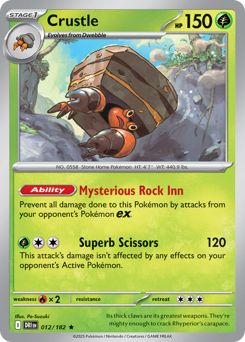
Every Pokémon ex has a box at the bottom of the card with the rule printed in it: "Pokémon ex rule: When your Pokémon ex is Knocked Out, your opponent takes 2 Prize cards." That box is a Rule Box, and it matters beyond the Prize count. Some cards only work on Pokémon without a Rule Box, and some protect against Pokémon that have one. Crustle's Mysterious Rock Inn Ability, for example, prevents all damage done to it by attacks from your opponent's Pokémon ex.
In return for the extra Prize card, a Pokémon ex has much more HP and stronger attacks than a regular Pokémon. A deck built around one or two Pokémon ex plays a race: it hits hard and expects to give up Prize cards two at a time. How Prize cards decide a game →
Mega Evolution Pokémon ex
The Mega Evolution series, which began with the Mega Evolution set in September 2025, brought back Mega Pokémon as Mega Evolution Pokémon ex. Their rule is different: "When your Mega Evolution Pokémon ex is Knocked Out, your opponent takes 3 Prize cards." Two Knock Outs on Mega ex is all six Prize cards, so these are the highest-stakes Pokémon in the game.
Unlike the Mega Pokémon-EX of the XY era, Mega Evolving no longer ends your turn. Some, like Mega Kangaskhan ex, are Basic Pokémon that go straight into play; others, like Mega Lopunny ex, evolve from a regular Pokémon.


Tera Pokémon ex
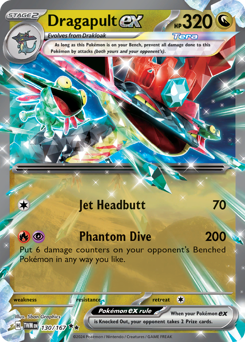
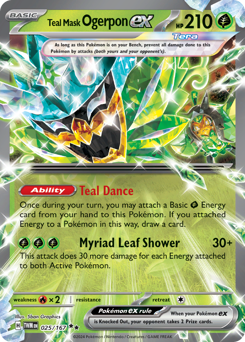
In the Scarlet & Violet sets, some Pokémon ex are Tera Pokémon ex, drawn with a crystal crown and often a type different from the Pokémon's usual one. They carry one more rule: as long as a Tera Pokémon ex is on your Bench, attacks do no damage to it, yours or your opponent's. That protects it while it waits to attack. It does not stop effects that place damage counters, like the 6 counters Dragapult ex's Phantom Dive spreads across the Bench, and it gives up 2 Prize cards like any other Pokémon ex.

ex, EX, GX and V
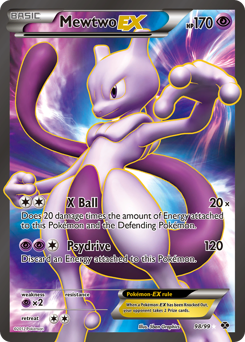
The Pokémon TCG has used a stronger-Pokémon-for-more-Prize-cards mark under several names. The names are the easiest way to date a card.
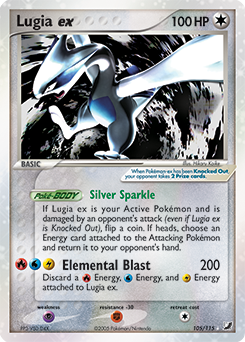
Only the current marks are legal in Standard, which uses the regulation marks H, I and J. A 2005 Lugia ex and a 2026 Pokémon ex share a name and a Prize count and nothing else in play.

ex rarities and prices
The same Pokémon ex is printed several times in a set, and the printings differ only in art and finish. In the current sets the regular version is a Double Rare, marked with two black stars, and the others are an Ultra Rare (full art), a Special Illustration Rare (new art across the whole card) and the gold Hyper Rare, called a Mega Hyper Rare for a Mega Evolution Pokémon ex. They play identically, so a player only needs the Double Rare and a collector chases the rest.
Mega Charizard X ex in Phantasmal Flames shows how wide the gap is. Prices on October 2, 2026:

Mega Charizard X ex
Phantasmal Flames #13
Double Rare. $4.67.

Mega Charizard X ex
Phantasmal Flames #109
Ultra Rare. $19.30.

Mega Charizard X ex
Phantasmal Flames #125
Special Illustration Rare. $659.68.

Mega Charizard X ex
Phantasmal Flames #130
Mega Hyper Rare. $233.78.
The Special Illustration Rare is the most expensive here, not the gold card, which is common for a popular Pokémon: collectors tend to pay most for the art. The most valuable Pokémon ex from 2023 on was the Prismatic Evolutions Umbreon ex Special Illustration Rare, at $1,337.97. Older ex cards can cost more: the 2005 Lugia ex above was $2,500.00, ungraded. How Pokémon card rarity works →
TurnZero HQ tracks each printing as its own card, so a Double Rare and a Special Illustration Rare of the same Pokémon ex are valued separately in your collection.
Frequently Asked Questions
What does ex mean on a Pokémon card?
It marks a stronger Pokémon with a drawback. A Pokémon ex has more HP and stronger attacks than a regular Pokémon, and when it is Knocked Out your opponent takes 2 Prize cards instead of 1. A Mega Evolution Pokémon ex gives up 3. The rule is printed in a box at the bottom of the card.
What is the difference between ex and EX Pokémon cards?
They come from different eras. Lowercase ex was used from 2003 to 2007 and again from 2023 on; uppercase Pokémon-EX was used from 2012 through the XY era. All of them give up 2 Prize cards when Knocked Out, except the Mega Evolution Pokémon ex of the current series, which give up 3. Older ex and EX cards are not legal in Standard today.
What is a Tera Pokémon ex?
A Pokémon ex from the Scarlet & Violet sets that has Terastallized, shown by a crystal crown and a type that can differ from the Pokémon's usual one. As long as it is on your Bench, attacks do no damage to it, yours or your opponent's. Effects that place damage counters still work on it.
Are Pokémon ex cards rare?
The regular printing of a Pokémon ex is a Double Rare, which appears in many packs and is usually inexpensive. The same Pokémon ex is also printed as an Ultra Rare, a Special Illustration Rare and a Hyper Rare (gold), and those are much harder to pull and cost much more.
Are Pokémon ex cards worth money?
Most regular Double Rare ex cards sell for a few dollars or less. The Special Illustration Rare versions of popular Pokémon are the expensive ones, often hundreds of dollars. Older ex cards from 2003 to 2007 in good condition can be valuable too. Check the price of the exact printing you have.
Value every ex you own, printing by printing.
TurnZero HQ prices each Pokémon card from daily TCGplayer prices, by variant. Free to start.
Create Free AccountPokémon and Pokémon character names are trademarks of Nintendo. ©Pokémon. ©Nintendo/Creatures Inc./GAME FREAK inc. TurnZero HQ is not affiliated with, sponsored, or endorsed by Nintendo, The Pokémon Company, Creatures Inc., or GAME FREAK inc. Card data comes from the open PokemonTCG dataset, and prices from TCGplayer.