Pokémon TCG
Prism Star Cards
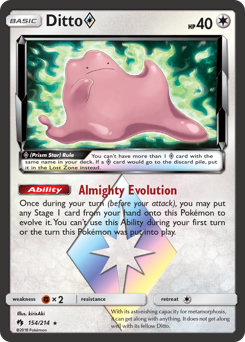
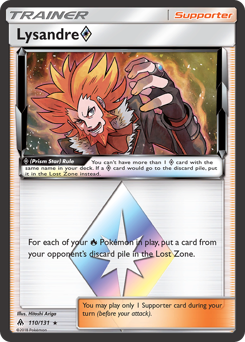
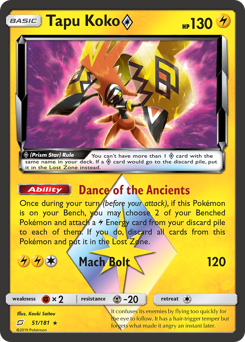
A Prism Star card has a ◇ after its name, a limit of one copy of that name per deck, and goes to the Lost Zone instead of the discard pile. Here is how both rules work, and every set that printed them.
The short answer
Prism Star is a mark from the Sun & Moon era, shown as a ◇ after the card's name. Prism Star cards can be Pokémon, Trainers or Special Energy, and each carries this rule: "You can't have more than 1 ◇ card with the same name in your deck. If a ◇ card would go to the discard pile, put it in the Lost Zone instead."
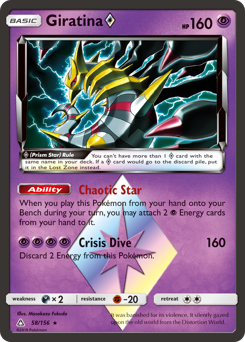
Giratina ◇
Ultra Prism #58
Ultra Prism. A Basic Pokémon that attaches 2 Psychic Energy when you Bench it.
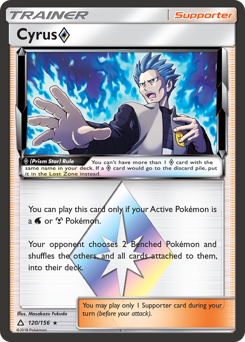
Cyrus ◇
Ultra Prism #120
Ultra Prism. A Supporter that has your opponent shuffle all but 2 Benched Pokémon into their deck.
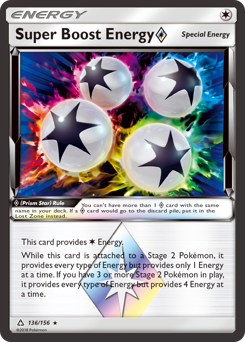
Super Boost Energy ◇
Ultra Prism #136
Ultra Prism. On a Stage 2, provides 4 Energy once you have 3 Stage 2 Pokémon in play.
One per name, not one per deck
The Prism Star limit is by name, which makes it looser than the other one-of rules. A deck can hold one Giratina ◇, one Cyrus ◇ and one Super Boost Energy ◇ at once. ACE SPEC and Radiant Pokémon are limited to one in the whole deck.
The ◇ is part of the name, so Giratina ◇ and Giratina are different cards for the four-copy rule. A deck may play four regular Giratina and one Giratina ◇. The TurnZero HQ deck builder counts them that way and flags a second copy of any Prism Star name. Every deck building rule →
Why Prism Star cards go to the Lost Zone
The Lost Zone is a pile beside the play area for cards that are out of the game. Cards in the discard pile can often be brought back with cards that recover them; cards in the Lost Zone almost never can. A Prism Star card that would be discarded goes to the Lost Zone instead, which means you get one use of it each game.
That covers every route to the discard pile: a Supporter after you play it, a Pokémon when it is Knocked Out, a Special Energy when it is discarded to pay for an attack. A Prism Star Pokémon is still a regular Pokémon for Prize cards and gives up 1 when Knocked Out. Every Prism Star Pokémon is a Basic Pokémon. What a Basic Pokémon is →
Every set with Prism Star cards
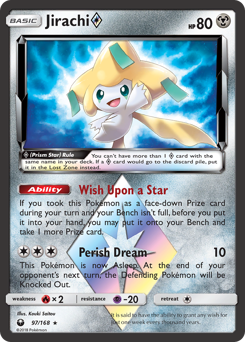
Prism Star cards were printed for one year, from Ultra Prism in February 2018 to Team Up in February 2019, 27 in all with the Rare Prism Star rarity.
Where Prism Star cards are legal
Sun & Moon cards have no regulation mark, so no Prism Star card is legal in Standard, which allows H, I and J since April 10, 2026. All of them are legal in Expanded, which reaches back to the Black & White series, and none is on the Expanded banned list as of October 2026. They are legal in Unlimited too. Banned and legal Pokémon cards →
Frequently Asked Questions
What does the Prism Star symbol mean on a Pokémon card?
The ◇ after a card's name marks a Prism Star card, printed in the Sun & Moon sets of 2018 and early 2019. Its rule: you can't have more than 1 ◇ card with the same name in your deck, and if a ◇ card would go to the discard pile, it goes to the Lost Zone instead.
How many Prism Star cards can you have in a deck?
One of each name, and as many different ones as you like. That differs from ACE SPEC and Radiant Pokémon, which allow one in the whole deck. A deck could play Giratina ◇, Cyrus ◇ and Super Boost Energy ◇ together.
Can I play four Giratina and a Giratina ◇ in the same deck?
Yes. The Prism Star symbol is part of the card's name, so Giratina ◇ and Giratina are different names. Each regular Giratina counts toward the usual four-copy limit, and the Giratina ◇ is limited to one.
What is the Lost Zone?
A pile of cards that are out of play for the rest of the game. Unlike the discard pile, almost nothing can bring a card back from it. A Prism Star card that would be discarded goes there instead, so it cannot be recovered and played again.
Are Prism Star cards legal in Standard?
No. They are from the Sun & Moon series and carry no regulation mark, so they are legal only in Expanded and Unlimited.
Build an Expanded deck with the limits checked.
TurnZero HQ checks a Pokémon deck against Standard or Expanded, including every one-of rule. Free to start.
Create Free AccountPokémon and Pokémon character names are trademarks of Nintendo. ©Pokémon. ©Nintendo/Creatures Inc./GAME FREAK inc. TurnZero HQ is not affiliated with, sponsored, or endorsed by Nintendo, The Pokémon Company, Creatures Inc., or GAME FREAK inc. Card data comes from the open PokemonTCG dataset, and prices from TCGplayer.