Pokémon TCG
Where to Buy Pokémon Cards
The right place to buy depends on what you want. A specific card is cheapest as a single from a marketplace. New packs and boxes are cheapest at retail, if you can find them. Graded and vintage cards are a different market again. Here is where to go for each, and how to tell a fair price.
Singles or packs?
Buy singles for the cards you want and packs for the fun of opening them. A single is one specific card, bought on its own at a known price. A pack is a random assortment where most cards are worth little each and the chance of the card you want is small, so opening packs to find one card almost always costs more than buying it outright.
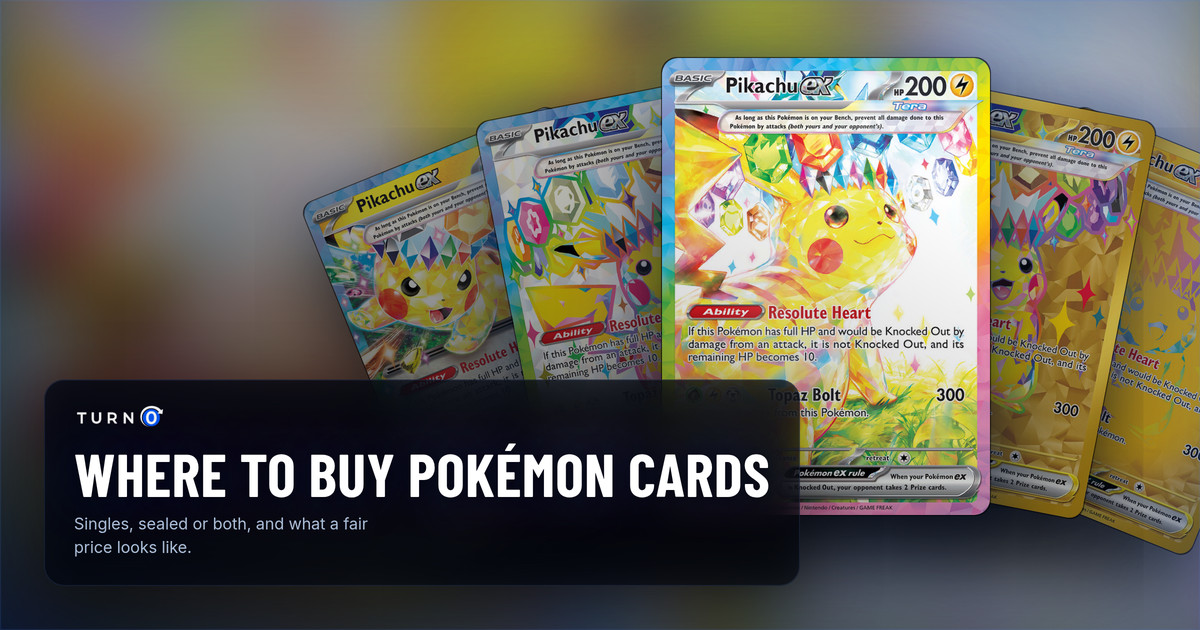
The same Pokémon can be several very different purchases. These five are all Pikachu ex, with the same attacks, and their prices on October 2, 2026 show why you should always check which printing a listing is for.
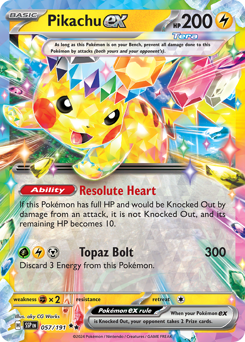
Pikachu ex
Surging Sparks #57
Double Rare, Surging Sparks. $5.12.
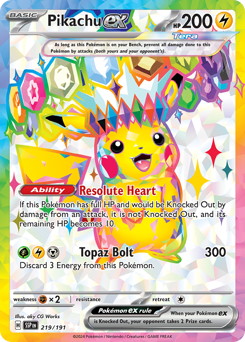
Pikachu ex
Surging Sparks #219
Ultra Rare, Surging Sparks. $27.98.
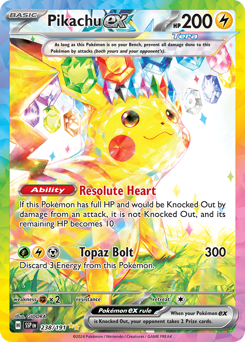
Pikachu ex
Surging Sparks #238
Special Illustration Rare, Surging Sparks. $284.71.
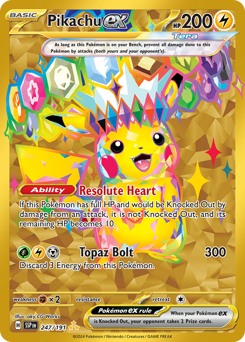
Pikachu ex
Surging Sparks #247
Hyper Rare, Surging Sparks. $79.77.
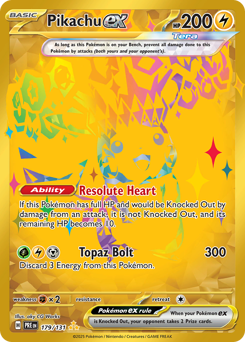
Pikachu ex
Prismatic Evolutions #179
Hyper Rare, Prismatic Evolutions. $59.86.
Sealed product is its own purchase. A booster box, an Elite Trainer Box or a collection makes sense as a gift, for a prerelease or League, or to keep sealed. What each one contains is in the guide to Pokémon card packs.
Where to buy Pokémon cards
TCGplayer
Best for singles in the US
A marketplace of many independent sellers, so it usually has the lowest price on a specific card and lists every variant separately (Normal, Reverse Holofoil, Holofoil, 1st Edition). It is also where the market price most price guides quote comes from. Each seller ships separately, so a 20-card order from 20 sellers pays 20 shipping charges; the cart's optimizer groups an order into fewer sellers. It carries Japanese cards too, as a separate Pokemon Japan product line.
Pokémon Center
Best for new sealed product at retail price
The Pokémon Company's own store. It sells new booster packs, Elite Trainer Boxes and collections at their retail price, including Pokémon Center exclusive Elite Trainer Boxes with extra packs. Popular releases sell out quickly and some use a queue on release day. It does not sell singles.
eBay
Best for graded cards, vintage and hard-to-find items
The widest selection of graded cards, older sets and one-off items like sealed product from years ago. Prices vary more than on a card marketplace, and so does seller quality, so read the listing photos and the seller's feedback before you pay. Recently sold listings are a useful check on what a card actually sells for.
Cardmarket
Best for singles in Europe
The European counterpart to TCGplayer, and the better default in the EU and UK, where a US order means international shipping, customs and a long wait. Prices are in euros and follow the European market, so they won't match a US price for the same card.
Your local game store
Best for seeing a card before you buy it
You can check condition in person, buy today without shipping, and many stores run Pokémon Leagues and prereleases. Singles often cost a little more than the lowest online listing. Sealed product at a store is often closer to retail than a marketplace listing in the first weeks after release.
Big-box retailers
Best for packs at retail, if you find them
Target, Walmart and other large stores sell booster packs, blisters, Elite Trainer Boxes and collections at retail price. Popular sets can be hard to find on the shelf soon after release, and these stores do not sell singles.
Other collectors
Best for trades and fair prices, with more care
Buying from or trading with someone you know, at a League or a card show, avoids marketplace fees and shipping. It is also where you have the least protection, so check the card in hand and be wary of a deal that looks much better than the market price.
What a fair price is
For a single, the TCGplayer market price is the usual reference. It is worked out from recent sales of that exact card and variant, usually Near Mint, so a listing close to it is a fair price and one far above it needs a reason (better condition, a grade, a seller you trust). It moves every day, and it is a selling price, not what a store would pay you. How market prices work →
For new sealed product, the reference is the retail price. New sets often sell above retail for the first few weeks after release, when stores have sold out and demand is highest, and older products can climb once they are out of print. Paying a premium for something you could buy at retail next month is a choice worth making on purpose rather than by default.
Condition
Sellers grade raw cards on the same short scale: Near Mint, Lightly Played, Moderately Played, Heavily Played and Damaged. Market prices are for Near Mint, and each step down costs less. For a card you will sleeve and play, Lightly Played saves money with little visible difference. For a card you want to keep, display or grade, buy Near Mint and read the photos, because the seller is the one judging the condition. What graders look for →
Avoiding fakes
Counterfeit Pokémon cards are common, especially of popular cards and in cheap bulk lots. The best protection is where you buy: a seller with a long record of good feedback, on a platform with buyer protection. Then check the card against a real scan of the same printing. Fakes often get the font, the colors or the energy symbols slightly wrong, use thinner or glossier card stock, or misspell text. A price far below every other listing is a warning sign on its own.
Every card page on TurnZero HQ shows the printed scan for that exact card, which is a quick reference when a listing photo looks off. What each part of a card means →
After you buy
Add the card to your collection in TurnZero HQ with its variant and condition, and it is valued from daily TCGplayer prices with a 90-day price chart on its card page. A wishlist keeps track of the cards you are still looking for, and set completion shows what is left in each set. TurnZero HQ does not track sealed product, so a sealed box you keep is not part of your collection's value. How the collection tracker works →
Frequently Asked Questions
Where is the best place to buy Pokémon cards?
For a specific card in the US, a marketplace like TCGplayer, because many sellers compete on price and each variant is listed separately. For new sealed product at retail price, the Pokémon Center, a local game store or a big-box retailer. For graded and vintage cards, eBay, where you should read the photos and seller feedback carefully. In Europe, Cardmarket.
Is it cheaper to buy Pokémon packs or singles?
If you want a particular card, singles are almost always cheaper. A booster pack's chance at a top card is small, and most packs hold cards worth little each. Buy packs for the fun of opening them, and buy singles for the cards you actually want.
Why do new Pokémon products cost more than retail?
Demand for a new set is highest in its first weeks, and when stores sell out, marketplace sellers charge what buyers will pay. Prices often settle as more product is printed and shipped, though some sets stay above retail. If a listing is well above the retail price, check a local game store first.
How do I avoid fake Pokémon cards?
Buy from sellers with a long record of good feedback, be wary of prices far below the market, and compare the card to a real scan of the same printing. Fakes often have the wrong font, color, thickness or texture, a glossy finish where the real card isn't, or text errors. For expensive cards, a graded card from an established grader adds a layer of checking.
What condition should I buy a Pokémon card in?
Near Mint if you want to keep, display or resell it, since market prices are for Near Mint copies. Lightly Played is cheaper and fine for a card you sleeve and play. Read the seller's photos for anything expensive, because condition labels are judged by the seller.
Know what you own before you buy more.
Track your Pokémon cards by variant and condition, valued daily from TCGplayer prices. Free to start.
Create Free AccountPokémon and Pokémon character names are trademarks of Nintendo. ©Pokémon. ©Nintendo/Creatures Inc./GAME FREAK inc. TurnZero HQ is not affiliated with, sponsored, or endorsed by Nintendo, The Pokémon Company, Creatures Inc., or GAME FREAK inc. Card data comes from the open PokemonTCG dataset, and prices from TCGplayer.