Pokémon TCG
Banned and Legal Pokémon Cards
Whether a Pokémon card is legal depends on the format. Standard decides it by regulation mark and bans nothing, Expanded reaches back to 2011 and has a banned list, and Unlimited allows every card. Here is how each works, and the banned list as of October 2026.
The short answer
Each format has its own card pool. These are the rules as of October 9, 2026, from The Pokémon Company International's published banned list and the current Standard rotation.
Basic Energy is legal in every format. The other deck building limits, such as four copies by name and one ACE SPEC, apply in all three. Every deck building rule →
Standard and regulation marks
Standard is the format of most tournaments and of Pokémon TCG Live's ranked play, and it uses regulation marks instead of a banned list. The mark is a single letter in a small box at the bottom left of every card printed since Sword & Shield. Once a year, The Pokémon Company International rotates the oldest mark out, and every card carrying only that mark leaves Standard.
That means some well-known kinds of card are out of Standard entirely: every Radiant Pokémon carries mark F, and every Prism Star card and Black & White ACE SPEC carries no mark. Where to find the regulation mark →
Reprints and old printings
An old printing is legal wherever a printing of the same card is. If a Trainer from 2013 is reprinted in a 2024 set with a legal mark, your 2013 copy can go in a Standard deck too. Master Ball is an example: the Plasma Blast printing from 2013 is the same ACE SPEC Item as the Temporal Forces one.
The catch is what counts as the same card. A shared name is not enough for a Pokémon: the HP, attacks and Abilities have to match. Every set prints a new Pikachu, and a Base Set Pikachu is a different card from any of them. Trainers and Energy are usually reprinted with the same text, so the name is a good guide for those.
The Expanded banned list
Expanded allows cards from the Black & White series onward, which is more than a decade of cards, so it needs a banned list for combinations Standard never sees. As of October 9, 2026, these cards are banned: 27 cards under 26 names, since two different Unown cards are on it. A ban names specific printings, listed beside each card, and covers any reprint of the same card.
Many of these disrupt an opponent's hand or Abilities (Hex Maniac, Reset Stamp, Red Card) or let a deck draw and search through itself too easily (Shaymin-EX, Puzzle of Time). Medicham V is a recent one: Japan banned it from its own Expanded format in January 2026, and it is on the international list too.
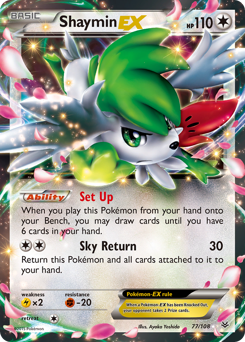
Shaymin-EX
Roaring Skies #77
Roaring Skies. Banned in Expanded.
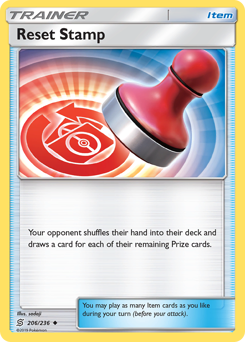
Reset Stamp
Unified Minds #206
Unified Minds. Banned in Expanded.
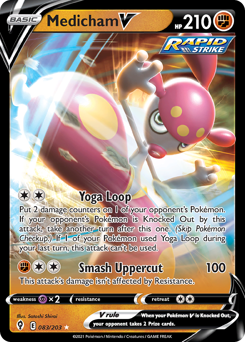
Medicham V
Evolving Skies #83
Evolving Skies. Banned in Expanded.
Bans change between sets, and the official list is the one that counts at a tournament. Check The Pokémon Company International's banned card list before an event.
Unlimited
Unlimited allows every card from 1999 on, and the official list bans none. It is a casual format, played with the old cards you own rather than at sanctioned events. Oversized cards and cards with a different back, such as World Championships deck cards, are not legal in any format.
Checking a deck
The TurnZero HQ deck builder checks every card against the format you choose. For Standard it reads the regulation mark, counting a reprint's mark for an older printing, and for Expanded it reads each card's Expanded legality from the card data. A ban can take effect before card data catches up, so check the official list before a tournament too.
Frequently Asked Questions
Are any Pokémon cards banned in Standard?
No. As of October 9, 2026, The Pokémon Company International's banned list names no cards in Standard. Standard controls its card pool through regulation marks and a yearly rotation instead.
What cards are legal in Standard right now?
Cards with regulation mark H, I or J, since the rotation on April 10, 2026. The mark is the single letter in a small box at the bottom left of the card. An older printing is also legal if the same card, with the same name and text, has a printing with a legal mark. Basic Energy is always legal.
What cards are banned in Expanded?
Twenty-seven cards under 26 names (two different Unown cards share one), listed by printing on this page, including Shaymin-EX, Hex Maniac, Puzzle of Time, Reset Stamp, Scoop Up Net and Medicham V. Expanded allows cards from the Black & White series onward except these.
What does a regulation mark mean?
It is the letter printed at the bottom left of Pokémon cards since Sword & Shield, and it decides Standard legality. Each April, the oldest legal mark usually rotates out. Cards printed before regulation marks have none and are never Standard-legal on their own.
Can I play an old printing of a card that was reprinted?
Yes, if the reprint is legal in the format and the card is the same card: same name, and for a Pokémon the same HP, attacks and Abilities. An old Pikachu with different attacks is a different card from today's Pikachu, even with the same name.
Know your deck is legal before you sit down.
TurnZero HQ checks a Pokémon deck against Standard or Expanded and compares it with the cards you own. Free to start.
Create Free AccountPokémon and Pokémon character names are trademarks of Nintendo. ©Pokémon. ©Nintendo/Creatures Inc./GAME FREAK inc. TurnZero HQ is not affiliated with, sponsored, or endorsed by Nintendo, The Pokémon Company, Creatures Inc., or GAME FREAK inc. Card data comes from the open PokemonTCG dataset, and prices from TCGplayer.