One Piece Card Game
One Piece TCG Formats
Most One Piece events use Standard Regulation, which rotates by the block number on each card. Extra Regulation allows every card, and Sealed builds a deck from the packs you open. This is every format and the current ban list, as of October 24, 2026.
Every format at a glance
Bandai's Tournament Rules Manual lists three kinds of event: Constructed, where you bring a deck, and Sealed and Draft, where you build from product opened at the event. Constructed play comes in two regulations, Standard and Extra, which differ only in the card pool.
Standard Regulation
Standard is the format almost every official event uses. On Bandai's English events list in October 2026, Store Tournaments, Pirates Party, Treasure Cups and the whole Championship 26-27 series are all Standard. A Standard deck follows the construction rules in rule 5-1-2 of the Comprehensive Rules, then two tournament limits on top.
The first five rules are the game's own deck rules, the same in every constructed format. The deck-building guide explains them with examples, and the Leader cards guide covers how a Leader's colors and Life shape a deck. The last two rules are what make a deck Standard legal, and both change over time.
Block rotation
Standard rotates once a year by the block number printed in the lower right corner of each card. Bandai started the Block Number System on April 1, 2026. From then until March 31, 2027, Standard allows Blocks 2 to 5, and Block 1, which is the first four booster sets and most of OP-05, is out. From April 1, 2027, Standard allows Blocks 3 to 6, so Block 2 leaves too.
Bandai keeps some older card numbers legal. Super Parallel cards and every card that shares their number will generally remain legal in Standard, Bandai says, 15 card numbers count as Block 4 until March 31, 2029, and a card reprinted with a newer block number is legal in all of its printings. One Piece TCG rotation has the full schedule, how to read the block number, every exception list and which sets carry which block.

Extra Regulation
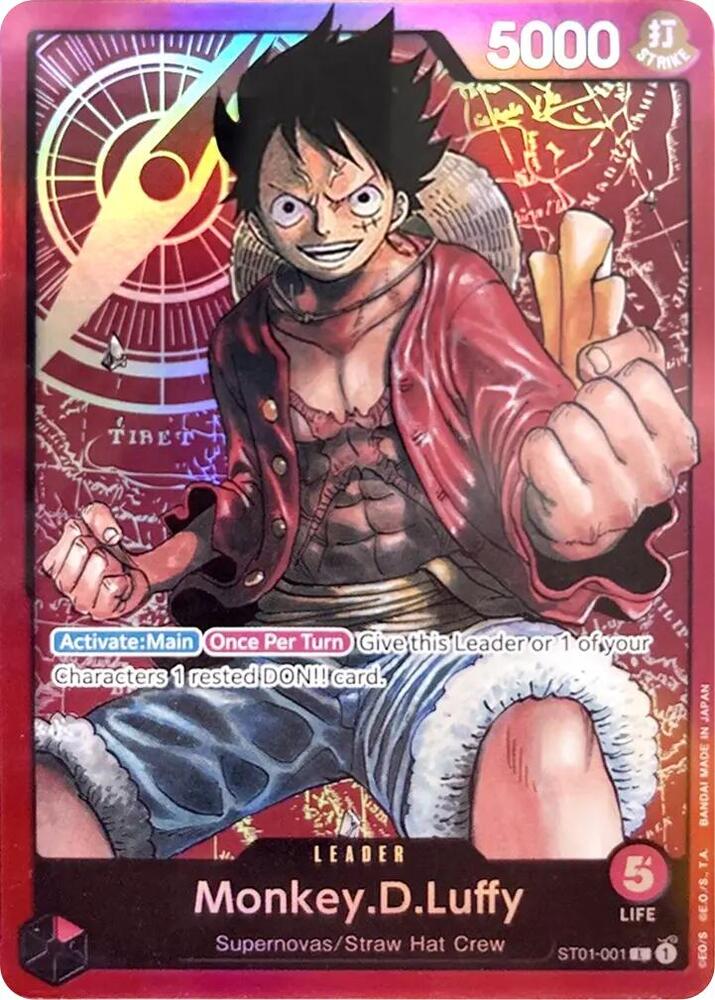
Extra Regulation is the format for every card. It started on April 1, 2026, alongside the Block Number System, and lets you build from Block 1 through the newest set. Bandai's Extra Grand Battle page puts it as "all cards released to date are legal for play, except for a limited number of banned cards." The deck rules are the same as Standard's: a Leader, 50 cards, four per card number and the Leader's colors.
Extra is where a rotated deck still has an official event. A Block 1 deck such as an early starter deck is legal in Extra as long as none of its cards are banned. Extra events are less common than Standard ones. Bandai ran Extra Grand Battle for Stores from May 15 to 31, 2026, a Swiss event in North America, Europe, Oceania and Latin America, and in October 2026 its English events list shows one Extra event, Large Scale Extra Grand Battle 2026. Look for "Extra" in an event's regulation line before you build for it.
Bandai said at the launch that more Extra-specific details would follow. As of October 24, 2026, the format has no separate deck rules or separate ban list on the English site.
The banned list
Six cards are banned and three pairs of cards cannot share a deck, on Bandai's list effective October 12, 2026. No cards are restricted. A ban covers every printing of the card number, Parallels and alternate arts included. Bandai's English site publishes one list for official and sanctioned tournaments, and its January 2026 announcement says the Standard and Extra lists were unified from April 1, 2026, so the same cards are banned in both.
Nami (OP03-040) is a Block 1 card, so it was already out of Standard and its ban matters for Extra. A banned pair leaves both cards legal on their own: you can play OP11-040 Luffy, just not with Katakuri or Linlin. Bandai replaced the banned Mihawk Leader with a new one, P-163 Dracule Mihawk, to be handed out at future events.

Dracule Mihawk (Alternate Art)
OP14-020
OP14-020, banned from October 12, 2026
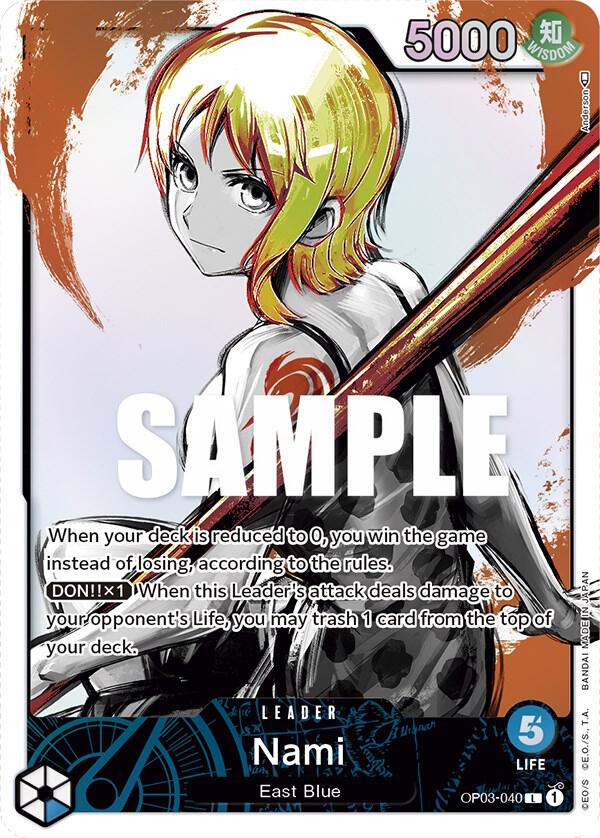
Nami (Alternate Art)
OP03-040
OP03-040, a banned Block 1 Leader
The list also shrinks. On April 1, 2026, Bandai unbanned six cards: Jinbe (OP07-045), Kingdom Come (EB01-059), Great Eruption (ST06-015), Moby Dick (OP02-024), Enies Lobby (OP03-098) and Ice Age (OP02-117). The last four are Block 1 cards, so their return matters mainly in Extra.
Bandai says it weighs a deck's win rate, results at major tournaments and how often it is played, and it usually revises the list after Japan's Championship Season 1 and after the World Championship. It can add a card at any time if the card is hurting the game. Best One Piece cards explains what made each banned card so strong.
Sealed and Draft
In Sealed, every player opens the same number of booster packs at the event and builds a deck from those cards only. Release events are where most players meet it: for the OP15-EB04 Release Event, Bandai let each store choose Constructed or Sealed. Bandai's Sealed Format Rules, linked from that event page, change the deck rules in several ways.
The color rule goes away, but nothing else on the Leader does. If your Leader's effect names a color or a type, it still means that color or type: a Leader that searches for a type of Character still finds only that type. Another version of the same rules, published for OP-03 events, says to use the Leader card handed out at the event instead, so check the event page for which one applies. You keep the cards you open.
Draft is in the Tournament Rules Manual as an approved format: each player gets six packs from a booster box, players draft in pods of four, and each builds a deck from the drafted pool. Bandai's sealed rules document covers Sealed only, so ask the store what deck size and Leader rules its draft uses.
Casual play
Outside an event, the only rules that matter are the ones your group agrees on. The Comprehensive Rules say the block symbol doesn't affect gameplay (rule 2-15-1), so a rotated or banned card plays exactly as printed at a kitchen table. The simplest default is to keep the game's own deck rules (a Leader, 50 cards, four copies and the Leader's colors), because the cards are designed around them, and to agree before you shuffle up whether rotated or banned cards are in.
Starter decks are the easiest way into casual games, since two decks out of the box are ready to play against each other. Bandai's Level 1 events, such as store constructed nights and release events, are casual by its own definition, focused on learning, though the rules are still enforced.
Event levels and match rules
Bandai sorts official events into three levels, and the level decides when new cards are legal and how strictly the rules are enforced.
At Professional events, Swiss rounds are best-of-one with 30 minutes plus 5 minutes of extra time, and the top cut is best-of-three with 60 minutes plus 10. The final two players play best-of-three with no time limit. Bring the deck in opaque, identical sleeves, with the Leader and DON!! cards sleeved so they can't be mixed up with the deck, and be ready to hand in a decklist. A new promo with a new card number follows the same timing as a set, counted from the first event that gives it out.
Formats in the deck builder
TurnZero HQ's One Piece deck builder, the Deck Lab, has one format, Standard, and it checks the construction rules: one Leader, exactly 50 cards, four per card number with every printing counted together, and colors that match the Leader. It checks a ban list only when one has been entered for the game, and it does not check block numbers, so look at the block number on each card and at Bandai's current list before a Standard event. The Lab is built for constructed decks, so a 40-card sealed pool will show as needing fixes.
How to build a One Piece deck walks through the Lab's checks and lenses, and published decks appear on the One Piece decks page.
Frequently Asked Questions
What formats are there in the One Piece Card Game?
Bandai runs two constructed regulations, Standard and Extra, and its tournament rules also define Sealed and Draft events. Standard uses the block number printed on each card to limit the card pool, Extra allows every card ever released, and both use the same deck rules and the same ban list. Sealed and Draft are built from packs opened at the event.
What is Standard Regulation in One Piece TCG?
The main tournament format. You build a Leader, a 50-card deck and a 10-card DON!! deck, and from April 1, 2026 to March 31, 2027 only cards with block numbers 2 to 5 are legal, plus the cards on Bandai's exception lists, minus the banned cards and pairs.
What is Extra Regulation in One Piece TCG?
A format that started on April 1, 2026, in which every card from Block 1 to the newest set is legal except the banned cards. It uses the same deck rules as Standard and is where rotated cards, such as the first four booster sets, can still be played at official events.
Has One Piece TCG rotated?
Yes. Block 1 left Standard on April 1, 2026, and Bandai has said Block 2 leaves on April 1, 2027. Cards on Bandai's treated-as-Block-4 list stay legal, Bandai says Super Parallel cards will generally remain legal, and a card reprinted with a newer block number is legal in every printing.
Does the One Piece ban list apply to Extra Regulation?
Yes. Bandai's English site publishes one banned list for official and sanctioned tournaments, and its January 2026 announcement says the Standard and Extra lists were unified from April 1, 2026. Sealed is the exception: Bandai's sealed rules say no cards are banned or restricted.
How many cards are in a One Piece sealed deck?
40 cards plus a 10-card DON!! deck and a Leader, built from six booster packs. In sealed you can use cards of any color and as many copies of a card number as you open. The sealed rules Bandai links from its current release event let you bring your own Leader; a version published for OP-03 events says to use the Leader handed out at the event, so check the event page.
Build a One Piece deck for your next event.
Build a Leader deck, check the construction rules, compare it to your collection and publish it when it's ready. Free on iPhone, Android and the web.
Create Free AccountONE PIECE CARD GAME card names and images are the property of Bandai and their respective owners. ©Eiichiro Oda/Shueisha, Toei Animation. TurnZero HQ is not affiliated with, sponsored, or endorsed by Bandai, Shueisha, or Toei Animation. Card data and prices come from TCGplayer.