One Piece Card Game
One Piece TCG Rotation and the Block Number System
Standard Regulation rotates once a year by the block number printed on each card. Block 1 left on April 1, 2026, and Block 2 leaves on April 1, 2027. This is how to read the number, what is legal now and every exception Bandai has listed, as of October 24, 2026.
How rotation works
Every One Piece card has a block number printed in its lower right corner, and Standard allows only the most recent blocks. Bandai announced the Block Number System on July 23, 2025 and started it on April 1, 2026. Each April the window moves forward by one block, so the oldest block in Standard leaves and a new one joins. Bandai describes the result as a card pool of "approximately 3 years' worth of the latest cards."
The block number is for legality only. The Comprehensive Rules say the block symbol does not affect gameplay (rule 2-15-1), so a Block 1 card plays exactly as printed wherever it is allowed. Cards printed before the system started already carry a block number, which is why a 2022 card can be checked the same way as a new one.
Rotation applies to Standard Regulation only. Extra Regulation, which started the same day, allows every block from 1 to the newest set. The ban list applies to both, and the One Piece TCG formats guide covers how the two regulations compare.
The rotation schedule
Bandai has published two seasons of the schedule. Standard has four block numbers in each.
The next rotation is April 1, 2027, when Block 2 leaves. Bandai's exception list for cards treated as Block 4 runs to March 31, 2029, which fits the same yearly pattern, but Bandai hasn't published a season past March 2028, so this page doesn't list one.
Which sets are in which block
Bandai's announcement describes Block 1 as booster packs 1 to 4 and Block 2 as packs 5 to 8, but the number printed on the card is what counts, and the sets don't split cleanly. On Bandai's English card list, read on October 24, 2026, 98 of OP-05's 154 entries carry Block 1 and 56 carry Block 2, so most of OP-05 has already rotated. Each row below is the block most of a product's cards carry.
Most sets have a few cards with an older or newer number. Those are usually reprints of an earlier card number, which keep that card's block, and the Super Parallel cards in OP-16 and OP-17 carry X. Check the card in your hand rather than its set, especially in OP-05 and in starter decks that reprint older cards. Our guide to reading a One Piece card shows where the card number sits.
The exceptions
Bandai keeps three kinds of older card legal in Standard, and lists them on its block number page. All three are by card number, so they cover every printing that shares the number.
The Super Parallel list reaches back to the first set. It includes Shanks (OP01-120), Monkey.D.Luffy (OP05-119) and Portgas.D.Ace (OP02-013), so a standard printing of one of those numbers is Standard legal even though the card number comes from a Block 1 set. Bandai's wording is that these cards "generally" remain legal, so recheck the list before a major event.

Shanks (Reprint)
OP01-120
OP01-120 as reprinted in PRB-01: on the Super Parallel list, so legal in Standard

Brook
ST01-011
ST01-011, treated as Block 4 until March 31, 2029
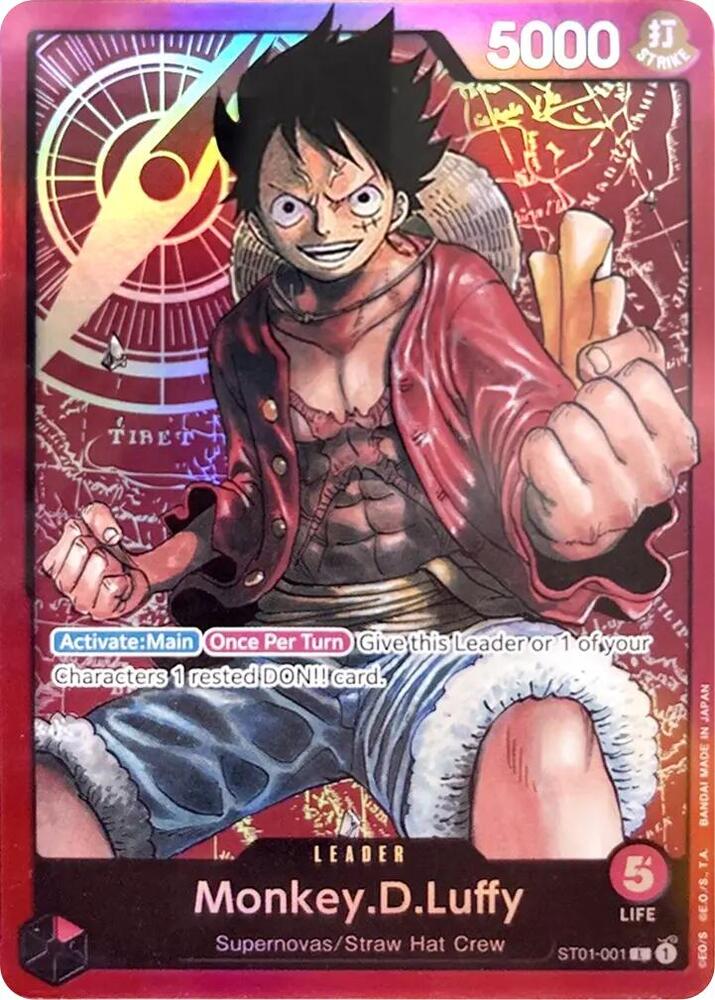
Monkey.D.Luffy
ST01-001
ST01-001 from the same deck, Block 1 and out of Standard
When a card's block number is updated, Bandai says every past illustration of that card becomes usable. That matters for collectors: an OP01-016 Nami from the original 2022 set is as legal as the new reprint, because the four-copy rule and the block rule both go by card number.
What to do with rotated cards
A rotated card is still a legal card in Extra Regulation and at any casual table. Rotation removes it from Standard events only. If you own a Block 1 deck, Extra is the official format built for it, as long as the deck has no banned card such as Nami (OP03-040).
Several early starter decks are mostly Block 1. ST-01's Monkey.D.Luffy Leader rotated, for example, while Brook from the same box stays in Standard on the Block 4 list. Every One Piece starter deck says whether its cards are Standard legal today, and which newer Leader replaces a rotated one. For a Standard deck, start from a Leader with a block number of 2 or higher, and from April 2027, 3 or higher.
Checking a deck before an event
Three checks make a deck Standard legal. Each card's block number is in the current window or the card is on an exception list, no card is on the ban list, and the deck follows the construction rules. Bandai's own card list shows each card's block icon and can filter by it, which is the quickest way to check a card you're unsure of.
TurnZero HQ's Deck Lab handles the third check. Its Standard format checks one Leader, 50 cards, four per card number and the Leader's colors. It doesn't read block numbers, and it checks a ban list only when one has been entered for the game, so do the first two checks yourself against Bandai's site. How to build a One Piece deck shows what the Lab checks and how to publish the list.
Frequently Asked Questions
When does One Piece TCG rotate?
Once a year on April 1. The first rotation was April 1, 2026, when Block 1 left Standard. Bandai's schedule has Block 2 leaving on April 1, 2027, when Standard becomes Blocks 3 to 6.
Which One Piece sets are legal in Standard?
From April 1, 2026 to March 31, 2027, cards with block numbers 2 to 5. On Bandai's card list that is most of OP-05 onward, plus EB-01 and later products, while OP-01 to OP-04, most of OP-05 and the early starter decks are Block 1 and out. The block number on the card decides, not the set it came from.
Where is the block number on a One Piece card?
In the lower right corner of the card. Cards printed before the system started already carry one, back to OP-01. Bandai's rules say it doesn't affect gameplay; it only decides Standard legality.
Are OP-01 cards still legal?
Most aren't legal in Standard since April 1, 2026, but all of them are legal in Extra Regulation unless banned. A few OP-01 card numbers stay in Standard through Bandai's exceptions, such as Shanks (OP01-120) on the Super Parallel list and Killer (OP01-039), treated as Block 4 until March 31, 2029.
What does Block X mean on a One Piece card?
It marks a Super Parallel card, or a card that shares a Super Parallel's card number, released from April 2026 on. Bandai says these are generally legal in Standard, the same as the Super Parallel cards printed before the system started.
Can I still play rotated One Piece cards?
Yes. Every block is legal in Extra Regulation except banned cards, and at a casual table you can play whatever your group agrees on. Rotation only changes what you can play in Standard events.
Keep your One Piece decks Standard ready.
Build a Leader deck, check the construction rules and compare it to your collection before the next rotation. Free on iPhone, Android and the web.
Create Free AccountONE PIECE CARD GAME card names and images are the property of Bandai and their respective owners. ©Eiichiro Oda/Shueisha, Toei Animation. TurnZero HQ is not affiliated with, sponsored, or endorsed by Bandai, Shueisha, or Toei Animation. Card data and prices come from TCGplayer.