Pokémon TCG
Gold Pokémon Cards
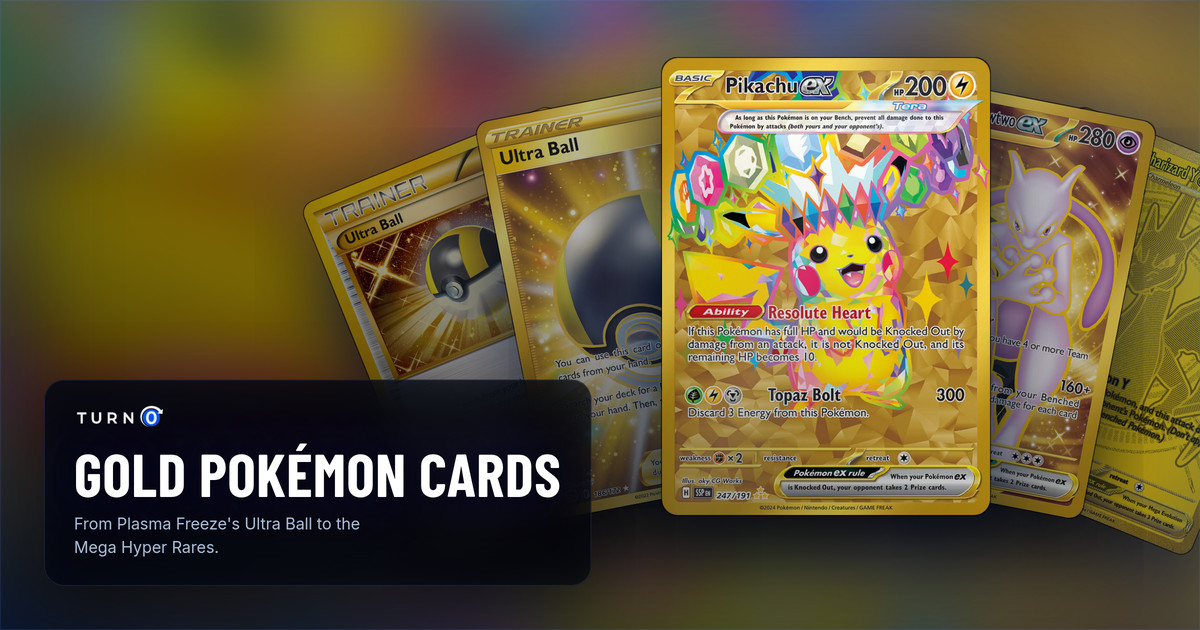
Gold cards are the secret rares at the top of a Pokémon set: a Pokémon, Trainer or Energy printed in gold foil and numbered past the set's total. They have gone by several names since the first ones in 2012. Here is how to recognize one, what they're worth, and how they differ from Gold Stars and gold-plated collectibles.
The short answer
A gold Pokémon card is a secret rare printed in gold foil, numbered above the set's printed total. In the Scarlet & Violet sets it is called a Hyper Rare and marked with three gold stars. In the Mega Evolution sets the gold card is a Mega Hyper Rare, a gold, etched Mega Evolution Pokémon ex. Older sets simply listed them as secret rares.
Hyper Rares and Mega Hyper Rares
A Scarlet & Violet set has a handful of Hyper Rares: usually Pokémon ex, and sometimes a Trainer or a basic Energy. They are the same cards as their regular printings, with the same rules text, so they are legal wherever the regular card is.
The Mega Evolution sets made the gold card scarcer. Each set so far except 30th Celebration has one or two Mega Hyper Rares, each a Mega Evolution Pokémon ex in gold with etched art. When TCGplayer counted more than 5,000 Mega Evolution packs it found one about every 1,260 packs. These are the Mega Hyper Rares so far, priced on October 2, 2026:

Mega Lucario ex
Mega Evolution #188
Mega Evolution. One of the first two Mega Hyper Rares.
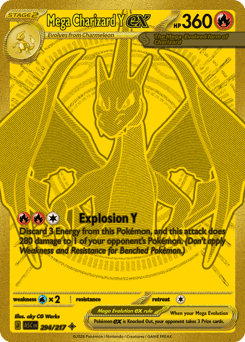
Mega Charizard Y ex
Ascended Heroes #294
Ascended Heroes.
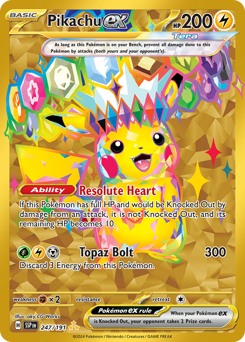
Pikachu ex
Surging Sparks #247
Surging Sparks. A Scarlet & Violet Hyper Rare.
Every Mega Hyper Rare is in the Mega Evolution series guide, with the set it came from.
A short history of gold cards
Gold arrived gradually. From 2012, the Black & White era's secret rares were Shiny Pokémon and Trainers with gold borders or gold art, such as Dark Explorers' Pokémon Catcher. Plasma Freeze's gold Ultra Ball followed in 2013, and Legendary Treasures that November printed Reshiram and Zekrom in solid gold. From Sun & Moon in 2017 to the end of Sword & Shield, nearly every set closed with gold Trainers, and the Sword & Shield sets added gold Pokémon V, Stadiums and basic Energy.

Pokémon Catcher
Dark Explorers #111
Dark Explorers, 2012. $99.69.

Ultra Ball
Plasma Freeze #122
Plasma Freeze, 2013. $1,199.51.
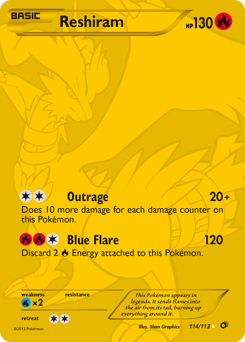
Reshiram
Legendary Treasures #114
Legendary Treasures, 2013. $347.86.
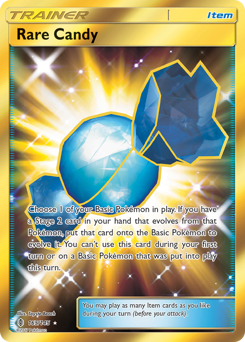
Rare Candy
Guardians Rising #165
Guardians Rising, 2017. $25.32.

Zacian V
Sword & Shield #211
Sword & Shield, 2020. $20.98.
What gold cards are worth
Gold cards are scarce, but scarcity is only half of a price. Demand for the Pokémon and its art is the other half, and collectors tend to pay more for a Special Illustration Rare's artwork than for a gold card of the same Pokémon. Mega Charizard X ex shows it: its Mega Hyper Rare was $233.78 on October 2, 2026, and its Special Illustration Rare from the same set was $659.68.
The range is wide. Surging Sparks' Pikachu ex Hyper Rare was $79.77, Shrouded Fable's gold basic Darkness Energy was $58.76, and Scarlet & Violet's Koraidon ex Hyper Rare was $5.59. Older gold Trainers can climb high: Plasma Freeze's Ultra Ball was $1,199.51, ungraded. Gold foil also shows scratches and print lines easily, so condition moves a gold card's price more than most. How to check a card's value →
Gold Stars and gold metal cards
Two other things get called gold Pokémon cards, and neither is a gold-foil card from a pack.
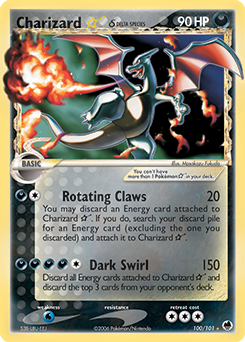
Gold Stars are cards from the EX era, 2004 to 2007, showing a Shiny Pokémon with a star after its name. The card is a regular holofoil; the star is the mark. There are 27 English Gold Star cards, from Team Rocket Returns to Power Keepers plus two POP Series 5 promos, and they are among the most valuable cards of their era. The Dragon Frontiers Charizard Gold Star was $20,000.00 on October 2, 2026, ungraded.
Gold metal cards are collectibles rather than game cards. In 1999 Burger King sold six 23K gold-plated cards (Charizard, Jigglypuff, Mewtwo, Pikachu, Poliwhirl and Togepi) with a meal to promote Pokémon: The First Movie, each in a Poké Ball with a certificate. The 2021 Celebrations Ultra-Premium Collection included metal Base Set Pikachu and Charizard cards. Most other "gold metal Pokémon cards" sold cheaply online are unofficial. A real gold card from a pack has a set symbol, a collector number past the set total, and the same layout as the rest of its set.
Frequently Asked Questions
Are gold Pokémon cards rare?
Yes. A gold card is a secret rare, the top rarity slot of its set, and only a few are printed per set. In current sets they're called Hyper Rares, or Mega Hyper Rares for a Mega Evolution Pokémon ex, and they're among the hardest cards in a pack to pull.
Are gold Pokémon cards worth money?
Many are, though less than you might expect for the rarity. A Mega Hyper Rare of a popular Mega ex can sell for a few hundred dollars, while a Hyper Rare of a less popular Pokémon can sell for under ten. The Special Illustration Rare of the same Pokémon often sells for more than its gold card.
Are gold metal Pokémon cards real?
Most gold metal or gold foil cards sold in bulk online are unofficial. The Pokémon Company has made a few metal cards, such as the 23K gold-plated cards from a 1999 Burger King promotion and the metal cards in the 2021 Celebrations Ultra-Premium Collection, but those came in specific products with packaging of their own. A gold card from a booster pack is printed card stock, not metal.
What is a Gold Star Pokémon card?
A card from the EX era, 2004 to 2007, showing a Shiny Pokémon with a star after its name. Despite the name, the card isn't gold: the star is the mark. There are 27 English Gold Star cards, and they are among the most valuable cards of that era.
Can you play gold Pokémon cards in tournaments?
Yes, if the card is legal in the format. A gold Hyper Rare is the same card as its regular printing, with the same rules text, so it is legal wherever that card is. Burger King gold-plated cards and other metal collectibles aren't legal.
Keep your gold cards counted and valued.
TurnZero HQ prices every Pokémon card you own from daily TCGplayer prices, with secret rares tracked apart in set completion. Free to start.
Create Free AccountPokémon and Pokémon character names are trademarks of Nintendo. ©Pokémon. ©Nintendo/Creatures Inc./GAME FREAK inc. TurnZero HQ is not affiliated with, sponsored, or endorsed by Nintendo, The Pokémon Company, Creatures Inc., or GAME FREAK inc. Card data comes from the open PokemonTCG dataset, and prices from TCGplayer.