Pokémon TCG Rules Explained
What Happens When a Pokémon Is Knocked Out
Everything attached to a Knocked Out Pokémon goes with it, and the Prize cards always go to the other player, even when your own card caused the Knock Out. This page walks through the Knock Out in order: when it is checked, where each card goes, who takes Prize cards and who promotes first. Rules as of October 2026.
The short answer
A Pokémon is Knocked Out when the damage on it is equal to or greater than its HP. Its owner puts it in the discard pile with every card attached to it: Energy, its Pokémon Tool, and the Basic and Stage 1 cards under an evolved Pokémon. The other player takes Prize cards for it, and the owner brings up a new Active Pokémon if the one Knocked Out was Active. If they cannot, they lose.
How many Prize cards a Knock Out is worth, and how they win the game, is covered on the winning page. This page covers the Knock Out itself. What each Knock Out is worth →
When a Knock Out is checked
The rulebook checks for Knock Outs when an attack is complete and again at the end of Pokémon Checkup. The Advanced Player's Rulebook adds that a Knock Out also happens any time a Pokémon's remaining HP reaches zero, such as from an Ability or an Item that puts damage counters in the middle of your turn. TPCi's rulings add that the effect doing it finishes first; the Knock Out is handled once it has resolved.

Team Rocket's Crobat ex
Destined Rivals #122
Biting Spree: damage counters during your turn.

Mega Absol ex
Mega Evolution #86
Terminal Period: exactly 6 counters means a Knock Out.
A Knock Out on your opponent's turn is handled during that turn. The official Q&A gives the order: you discard your Pokémon and its cards, your opponent takes Prize cards, then you send out a new Active Pokémon. A Knock Out in Pokémon Checkup is handled at once too, before the next turn starts.
The Knock Out, step by step
- Find every Pokémon at zero HP, on both sides. One attack can Knock Out several Pokémon, including the attacker.
- Apply effects that trigger on the Knock Out, such as an Ability that damages the attacker, while the Pokémon is still in play.
- Discard each Knocked Out Pokémon and all cards attached to it, unless an effect sends some of them elsewhere.
- Take Prize cards. Each player takes the Prize cards they earned from the Pokémon Knocked Out on the other side.
- Promote a new Active Pokémon if an Active Pokémon was Knocked Out. When both were, the player whose turn is next goes first.
This is the order the Advanced Player's Rulebook gives. Step 2 is why a Tool like Amulet of Hope still works: its effect applies at the Knock Out, a moment before the card goes to the discard pile with its Pokémon. When several Pokémon are Knocked Out at once and several effects trigger, the player whose turn it is decides the order, and then all the Knocked Out Pokémon are discarded together.
Where every card goes

Huntail
Destined Rivals #55
Diver's Catch: Basic Water Energy goes to your hand instead.

Heavy Baton
Temporal Forces #151
Moves up to 3 Basic Energy to your Bench on a Knock Out.

Amulet of Hope
Surging Sparks #162
Search for up to 3 cards when its Pokémon is Knocked Out.
The Energy is often the expensive part of a Knock Out. A Mega Evolution Pokémon ex with four Energy attached costs you three Prize cards and the Energy you spent turns putting on it, which is why the cards above exist. Heavy Baton only works for a Pokémon with a Retreat Cost of exactly 4 that is Knocked Out in the Active Spot by damage from an attack, and Diver's Catch only for Water Pokémon Knocked Out by an attack.
Who takes the Prize cards
The rulebook ties the Prize cards to whose Pokémon was Knocked Out, not to who caused it. When your Pokémon is Knocked Out, your opponent takes the Prize cards. That holds when your own attack, Ability or Item does it.

Dusknoir
Shrouded Fable #20
Cursed Blast: 13 counters, then Dusknoir is Knocked Out.
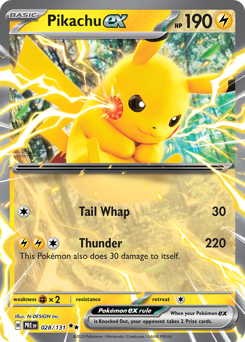
Pikachu ex
Prismatic Evolutions #28
Thunder: 220 damage, and 30 to itself.
Dusknoir is the standard example. Its Cursed Blast Ability puts 13 damage counters on one of your opponent's Pokémon, and then Dusknoir is Knocked Out, so your opponent takes a Prize card for it. Players use it when the Knock Out it gives them is worth more than the one it gives away, such as 13 counters finishing off a Pokémon ex. Recoil counts the same way, and the official Q&A says damage an attacker does to itself takes its own Weakness and Resistance into account.
When both Active Pokémon go down
Both players can lose an Active Pokémon on the same attack, most often to recoil or to an Ability that hits the attacker. Both Pokémon are discarded, both players take their Prize cards (TPCi's rulings have the player whose turn is next take theirs first), and that same player promotes first. The official Q&A gives the same order for two Active Pokémon Knocked Out in Pokémon Checkup.
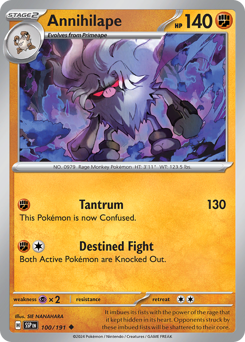
Annihilape does it on purpose: its Destined Fight attack simply Knocks Out both Active Pokémon. Each player takes the Prize cards for the other side's Pokémon, so it trades well when Annihilape is worth one Prize card and the Pokémon it takes down is worth two or three.
Pikachu ex's Thunder takes both Active Pokémon
Your Active Pikachu ex (190 HP) already has 170 damage. It uses Thunder: 220 damage to your opponent's Active Pokémon ex, which has 200 HP left, and 30 damage to itself.
The attack finishes and both Active Pokémon are at zero HP, so both are Knocked Out.
Both are discarded with everything attached. You take 2 Prize cards for their Pokémon ex, and your opponent takes 2 for your Pikachu ex.
Your opponent's turn is next, so they choose their new Active Pokémon first. Then you choose yours.
If one of you has no Benched Pokémon to promote, or took a last Prize card, the game ends here. When both players win at once, the winning page explains how it is settled.
Promoting first matters because the second player sees the first player's choice before making theirs. When both players win at once →
Cards that change a Knock Out
Three kinds of card change what a Knock Out does: some punish the attacker, some change the Prize count, and some stop the Knock Out from happening at all.

Maractus
Journey Together #8
Exploding Needles.

Mega Gengar ex
Phantasmal Flames #56
Shadowy Concealment.

Survival Brace
Twilight Masquerade #164
Survive one hit from full HP.
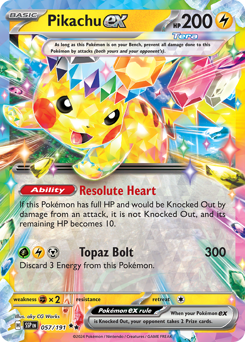
Pikachu ex
Surging Sparks #57
Resolute Heart.
The full-HP survivors only stop damage from an attack. Damage counters placed by an Ability, such as Dusknoir's Cursed Blast, are not attack damage, and a Pokémon that already has any damage on it is not at full HP.
Common Knock Out mistakes
Keeping the Energy or Tool from a Knocked Out Pokémon. Everything attached goes to the discard pile unless a card says otherwise.
Taking a Prize card when your own Pokémon Knocks itself Out. The Prize cards go to your opponent.
Forgetting to check the attacker after recoil. Every Pokémon the attack touched is checked.
Waiting until your turn to promote after a Knock Out in Pokémon Checkup. It happens right away.
Promoting before your opponent after a double Knock Out on your turn. The player whose turn is next goes first.
Treating 100 damage on a 100 HP Pokémon as one short. Equal to its HP is a Knock Out.
Frequently Asked Questions
What happens to Energy when a Pokémon is Knocked Out?
It goes to the discard pile with the Pokémon, along with its Pokémon Tool and every Evolution card in its stack. A few cards change that, such as Huntail's Diver's Catch, which puts Basic Water Energy from a Knocked Out Water Pokémon into your hand instead.
Who takes a Prize card if my own attack Knocks Out my Pokémon?
Your opponent. When a player's Pokémon is Knocked Out, that player's opponent takes the Prize cards, whatever caused it. Recoil damage, an Ability that Knocks Out its own Pokémon, or Poison all count.
What happens if both Active Pokémon are Knocked Out at the same time?
Both are discarded, both players take their Prize cards, and then the player whose turn is next chooses their new Active Pokémon first, followed by the other player. If either player has no Pokémon left to promote, that player loses.
Can a Pokémon be Knocked Out between turns?
Yes. Pokémon Checkup ends with a check for Knock Outs, so Poison or Burn damage can Knock Out a Pokémon there. The Prize cards are taken and a new Active Pokémon is chosen right away, before the next turn starts.
Does a Pokémon with exactly as much damage as its HP get Knocked Out?
Yes. A Pokémon is Knocked Out when its damage is equal to or greater than its HP, so 100 damage on a 100 HP Pokémon is a Knock Out.
Does my Active Pokémon move after it Knocks Out my opponent's?
No. As long as it has HP left, your attacking Pokémon stays in the Active Spot. Only the player whose Pokémon was Knocked Out brings up a replacement.
Let TurnZero HQ count the Prize cards.
In a two-player game, TurnZero HQ's board takes the right number of Prize cards on each Knock Out, tracks each Pokémon's damage, Special Conditions and Energy, and runs Pokémon Checkup. Free on iPhone, Android and the web.
Create Free AccountPokémon and Pokémon character names are trademarks of Nintendo. ©Pokémon. ©Nintendo/Creatures Inc./GAME FREAK inc. TurnZero HQ is not affiliated with, sponsored, or endorsed by Nintendo, The Pokémon Company, Creatures Inc., or GAME FREAK inc. Card data comes from the open PokemonTCG dataset, and prices from TCGplayer.