Pokémon TCG Rules Explained
Retreat vs. Switch in the Pokémon TCG
Retreating and switching both move your Active Pokémon to the Bench, but the rules treat them as different things. Retreating is a once-per-turn action that costs Energy. Switching is a card effect that costs the card. This page covers what that difference changes, and how cards move your opponent's Pokémon too. Rules as of October 2026.
The short answer
Retreating is one of the actions you can take on your turn: once per turn, discard Energy from your Active Pokémon equal to its Retreat Cost, and swap it with a Benched Pokémon. Switching is what a card does when its text says "switch your Active Pokémon with 1 of your Benched Pokémon." It costs no Energy, it is not a retreat, and it does not use up the retreat you get each turn.
The difference matters most when retreating is blocked. An Asleep or Paralyzed Pokémon cannot retreat, and neither can one hit by a "can't retreat" attack, but all of them can be switched out by a card. The retreat basics are on the card types page; this one covers how the two interact. Retreating, in brief →
Retreat, switch and gust side by side


How retreating works
- Announce it, before you attack. It has to be your turn, and you can retreat only once.
- Check you can. The Pokémon can't be Asleep or Paralyzed, can't be under a "can't retreat" effect, and needs at least as much Energy attached as its Retreat Cost.
- Discard the Energy from the retreating Pokémon, one for each symbol in its Retreat Cost at the bottom right. No symbols means it retreats for free.
- Swap it with one of your Benched Pokémon. Damage counters, the remaining Energy, its Tool and the cards beneath it all go with it.
Two details trip people up. The Energy must already be on the retreating Pokémon: the official Q&A says you cannot make up a shortfall by discarding Energy from your hand. And a full Bench does not stop a retreat, since the two Pokémon trade places, but an empty Bench does.
Retreating does not use your Energy attachment, and the order is up to you. You can attach to your Active Pokémon and then retreat it with that Energy, or retreat first and attach to the Pokémon that came up, but not both: the official Q&A confirms the one-per-turn attachment from hand still applies. The new Active Pokémon can attack that turn.
Changing the Retreat Cost
Many cards lower or raise Retreat Costs, and decks built around retreating run several. Effects that raise a cost stack: the Advanced Player's Rulebook adds them all together.

Air Balloon
Mega Evolution #166
Retreat Cost is 2 Colorless less.

Rescue Board
Twilight Masquerade #225
1 less, and free at 30 HP or less.

Latias ex
Surging Sparks #76
Skyliner: your Basic Pokémon have no Retreat Cost.

Gravity Gemstone
Stellar Crown #137
While Active: both Active Pokémon cost 1 more.
Latias ex's Skyliner is an Ability, so it works from the Bench and covers every Basic Pokémon you have in play, including itself. Gravity Gemstone works the other way, on both Active Pokémon while the one wearing it is Active, which is why it suits a Pokémon that is happy to stay put.
Switching cards
A switching effect can come from any kind of card: an Item, a Supporter, an Ability or an attack. Each one moves your Active Pokémon to the Bench and brings up the Benched Pokémon you choose, with no Energy discarded. Because none of them is a retreat, you can switch and still retreat in the same turn.

Mega Latias ex
Mega Evolution #100
Strafe: 40 damage, then you may switch it out.
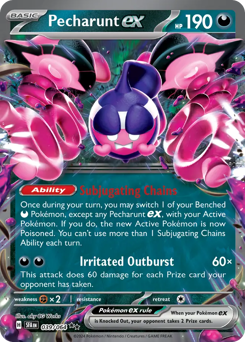
Pecharunt ex
Shrouded Fable #39
Subjugating Chains: an Ability that switches, then Poisons.

Keldeo ex
White Flare #30
Gale Thrust: 90 more if it moved up from the Bench this turn.
Some attacks reward the move itself. Keldeo ex's Gale Thrust does 90 more damage if Keldeo ex moved from your Bench to the Active Spot this turn, and the Advanced Player's Rulebook says it does not matter how: a retreat, a Switch or an Ability all count. Moving it back and forth several times still gives the bonus once.
Getting out from under a Paralysis
Your Active Pokémon was Paralyzed by your opponent's attack, so it can't retreat or attack this turn.
You play Switch and bring up Keldeo ex from your Bench. The Paralyzed Pokémon goes to the Bench and recovers.
You haven't retreated yet this turn, so you still could, but you want Keldeo ex in front.
Keldeo ex already has a Water Energy, and you attach a second Energy for Gale Thrust's cost. It moved up from the Bench this turn, so it does 30 plus 90, for 120.
What moving to the Bench clears
Whenever an Active Pokémon goes to the Bench, by retreating or any other way, the rulebook says it loses all Special Conditions and all effects of attacks on it. Damage counters and attached cards stay. That makes the Bench the answer to two kinds of problem.
The Mega Lucario ex line is worth knowing. Mega Brave does 270 damage and stops Mega Lucario ex from using Mega Brave on your next turn. That effect sits on the Pokémon, so if it goes to the Bench in between, the effect is gone, and it can use Mega Brave again the next time it is Active.


Moving your opponent's Pokémon
Cards that move your opponent's Pokémon come in two wordings, and they decide who picks the new Active Pokémon. Players call this "gusting."
Either one needs your opponent to have a Benched Pokémon. The Pokémon that leaves the Active Spot recovers from its Special Conditions, just as yours would, so pulling up a fresh target with Boss's Orders also frees the Pokémon you had Poisoned.
When the switch comes from an attack, it is an effect of that attack, so a Pokémon that ignores attack effects cannot be moved by it. Skeledirge's Unaware Ability prevents all effects of attacks done to it, so an Active Skeledirge cannot be pushed out with Push Down. It can still be pulled up from the Bench by Boss's Orders, which is a Trainer card, not an attack.


Common retreat and switch mistakes
Treating a Switch as your retreat for the turn. You can play Switch and still retreat once.
Leaving an Asleep or Paralyzed Pokémon stuck. It can't retreat, but a switching card moves it and clears the condition.
Paying a Retreat Cost with Energy from your hand. It comes from the retreating Pokémon only.
Retreating after attacking. The attack ends your turn.
Removing damage when a Pokémon goes to the Bench. Only Special Conditions and attack effects go away.
Choosing your opponent's new Active Pokémon after a "switch out" effect. On that wording, they choose.
Frequently Asked Questions
Does playing Switch count as your retreat for the turn?
No. Retreating is the once-per-turn action of discarding Energy equal to the Retreat Cost. A Switch, or any other card that switches your Active Pokémon, is a card effect, so you can play one and still retreat once that turn.
Can an Asleep or Paralyzed Pokémon be switched out?
Yes. Asleep and Paralyzed stop a Pokémon from retreating, but a card like Switch is not a retreat. Moving it to the Bench that way also clears the Special Condition.
Can you discard Energy from your hand to pay a Retreat Cost?
No. The Energy has to come from the retreating Pokémon, and it must have at least as much Energy attached as its Retreat Cost. If it doesn't, it can't retreat, though a switching card can still move it.
Can you retreat after you attack?
No. Attacking ends your turn, so retreating has to happen before the attack. You can retreat and then attack with the Pokémon that came up in its place.
Can you retreat if your Bench is full?
Yes. Retreating swaps two Pokémon, so a full Bench of five is no obstacle. What you can't do is retreat with an empty Bench, because there is nothing to bring up.
Who chooses the new Active Pokémon when an opponent's card switches mine out?
It depends on the wording. "Switch in 1 of your opponent's Benched Pokémon," as on Boss's Orders, means the player of that card chooses. "Switch out your opponent's Active Pokémon to the Bench" means the Pokémon's owner chooses the replacement, and the card says so in a reminder.
Track your Pokémon games.
TurnZero HQ's board keeps the once-per-turn actions (Energy, Supporter and retreat) beside End turn in a two-player game, along with each Pokémon's damage, Special Conditions and Energy. Free on iPhone, Android and the web.
Create Free AccountPokémon and Pokémon character names are trademarks of Nintendo. ©Pokémon. ©Nintendo/Creatures Inc./GAME FREAK inc. TurnZero HQ is not affiliated with, sponsored, or endorsed by Nintendo, The Pokémon Company, Creatures Inc., or GAME FREAK inc. Card data comes from the open PokemonTCG dataset, and prices from TCGplayer.