Pokémon TCG Rules Explained
Pokémon Special Conditions: How They Stack and How They End
A Pokémon can have more than one Special Condition, but not in any combination you like. This page covers which ones can share a Pokémon, what each one stops, the order Pokémon Checkup handles them in, and every way each one ends. Rules as of October 2026.
The short answer
The five Special Conditions are Asleep, Burned, Confused, Paralyzed and Poisoned. Three of them (Asleep, Confused and Paralyzed) are shown by turning the Pokémon card, and a card can only point one way, so a Pokémon has at most one of those three. The newest one replaces the old one. Burned and Poisoned are shown with markers instead, so they sit alongside each other and alongside whichever of the other three is in effect.
That gives a ceiling of three at once: Burned, Poisoned and one of the turned conditions. The rulebook's own example is an "unfortunate Pokémon" that is Burned, Paralyzed and Poisoned at the same time. The basics of each condition are on the attacking page, and this one goes into the cases that come up at the table. The five Special Conditions in brief →
Which conditions can stack
A Pokémon cannot have two Burn markers or two Poison markers. If it is Burned again, the new Burned condition replaces the old one, and the same goes for Poisoned. That only matters when the two versions differ, which the section on stronger conditions below covers.

Dangerous Laser
Shrouded Fable #58
An ACE SPEC Item: Burned and Confused at once.

Magnezone
Surging Sparks #60
Mighty Magnetism: Confused, and it can't retreat next turn.

Onix
Mega Evolution #70
Bind: flip a coin, heads Paralyzed.
Dangerous Laser shows the stacking rule on one card: it leaves the opponent's Active Pokémon Burned and Confused, one marker and one turn. If Onix's Bind then Paralyzes the same Pokémon, it is Burned and Paralyzed, and no longer Confused.
What they stop, and what they don't
Each condition stops one or two specific things. Anything it does not name, the Pokémon and its player can still do. The official Q&A is direct about this: Special Conditions affect the Active Pokémon, not its player, so you still draw at the start of your turn and can still attach Energy, evolve and play cards as usual.
Three things surprise new players. A Confused Pokémon can retreat, and retreating is how most players clear it. Asleep and Paralyzed say nothing about Abilities, so a Pokémon that cannot attack can usually still use its Ability. And Special Conditions only exist in the Active Spot: the rulebook says they can only happen to an Active Pokémon, and moving to the Bench clears them all.
Confusion's coin flip happens when you try to attack, after any effect that might stop the attack outright and before the attack does anything. On tails the attack does not happen at all, so none of its effects apply, and your turn ends.
How Pokémon Checkup handles them
Pokémon Checkup runs after every turn, yours and your opponent's, and belongs to neither player. Both players' Pokémon are checked. The Special Conditions always go in the order below; other effects come after them or before them, and Knock Outs are always last.
- Poisoned: put 1 damage counter on the Pokémon.
- Burned: put 2 damage counters on it, then its owner flips a coin. Heads, it recovers.
- Asleep: its owner flips a coin. Heads, it wakes up.
- Paralyzed: it recovers in the Checkup after its owner's next turn.
- Other effects that say they happen during Pokémon Checkup or between turns (these can go first instead).
- Knock Outs: any Pokémon with no HP left is Knocked Out, and a new Active Pokémon is chosen.
The other effects can go before the Special Conditions or after them, but not in the middle. TPCi's February 2026 rules update gives the order of Checkup effects to the player whose turn is next, as the Advanced Player's Rulebook already did. The Pokémon's owner flips its coins, and a Pokémon that is both Burned and Asleep gets two separate flips.
How long Paralysis and Sleep last
On your opponent's turn, their Onix uses Bind and flips heads. Your Active Pokémon is Paralyzed.
Pokémon Checkup after their turn: your Pokémon stays Paralyzed, because you have not had your turn yet.
Your turn: your Active Pokémon cannot attack or retreat. You can still play a Switch, which brings up a Benched Pokémon and clears the Paralysis.
Pokémon Checkup after your turn: if your Pokémon is still Active and Paralyzed, it recovers now.
Had Bind made it Asleep instead, you would flip in the very first Checkup, right after your opponent's turn, and keep flipping after each turn until heads.
Every way a condition ends
Moving to the Bench and evolving clear all five, which is why most conditions are short-lived in practice. The difference between them is what else ends them, and whether they end on their own.
Asleep and Paralyzed are the two that trap a Pokémon in the Active Spot, because retreating is off the table. For those, a card that switches your Active Pokémon is the usual answer, and evolving works too. Why a Switch works when retreating doesn't →

Pokémon Center Lady
Mega Evolution #123
Heals 60 and removes all Special Conditions.

Festival Grounds
Twilight Masquerade #149
Pokémon with Energy attached recover and can't be affected.
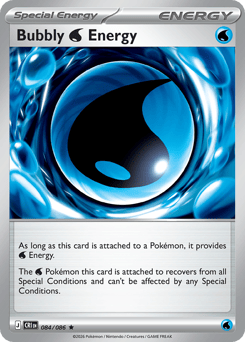
Bubbly Water Energy
Chaos Rising #84
Protects the Water Pokémon it is attached to.

Hoothoot
Prismatic Evolutions #77
Insomnia: this Pokémon can't be Asleep.
Some cards prevent conditions rather than cure them. Festival Grounds clears and blocks every Special Condition on any Pokémon with Energy attached, both players', for as long as it stays in play. A few Pokémon are immune to one condition, like Hoothoot, and the Antique Fossil Items, played as Pokémon, cannot be affected by any.
One Stadium undoes the evolving rule for a single condition. Dizzying Valley says Confused Pokémon, yours and your opponent's, do not recover from Confusion when they evolve or devolve. While it is in play, a Confused Pokémon stays Confused until it goes to the Bench, meets a card that removes Special Conditions, or is made Asleep or Paralyzed instead.
Stronger Poison, Burn and Confusion
Some cards change how many damage counters a condition places, and the wording decides how they combine. An effect that says "put 8 damage counters instead of 1" changes the condition's base number. An effect that says "put 5 more damage counters" adds to it. The Advanced Player's Rulebook applies the base change first, then adds every "more" effect, and several "more" effects add up.

Team Rocket's Nidoking ex
Destined Rivals #119
Tainted Horn: Poisoned, 8 counters instead of 1.

Lanturn
Stellar Crown #49
Disorienting Flash: Confused, 8 counters instead of 3.
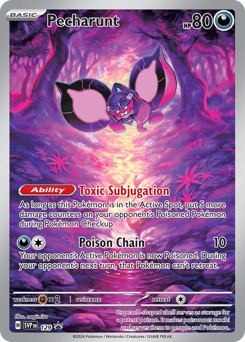
Pecharunt
Scarlet & Violet Black Star Promos #129
Toxic Subjugation: 5 more on Poisoned Pokémon while Active.

Magmortar
Journey Together #21
Magma Surge: 3 more on Burned Pokémon.
A stronger condition is still the same condition, so it ends the same ways. It is also replaced the same way: if a Pokémon Poisoned by Tainted Horn is then Poisoned by an ordinary attack, the newer, ordinary version is the one in effect, and it takes 1 counter a turn again. When two effects both change the base number, only the highest one applies, once.
Special Conditions on your own Pokémon
Most conditions come from your opponent's attacks, but some cards put one on your own Pokémon as a cost or as part of a plan. The rules for them are exactly the same.

Okidogi ex
Shrouded Fable #36
Poisons itself, then Chain-Crazed does 130 more while Poisoned.

Conkeldurr
Twilight Masquerade #105
Tantrum Confuses it; Gutsy Swing is free while it has a condition.
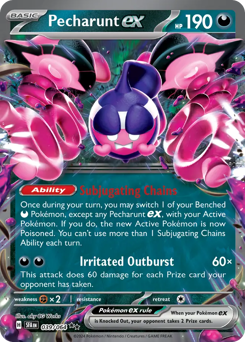
Pecharunt ex
Shrouded Fable #39
Subjugating Chains: the Pokémon it switches in is Poisoned.

Janine's Secret Art
Shrouded Fable #59
Energy attached to your Active Pokémon also Poisons it.
Okidogi ex is the clearest example. Its first attack attaches up to 2 Basic Darkness Energy from your deck to itself and, if it attached any, leaves it Poisoned, and its Chain-Crazed attack does 130 more damage if it is Poisoned. The Poison costs a damage counter each Checkup, and retreating or switching it out cures it, which here means losing the bonus. Conkeldurr runs the same plan with Confusion: Tantrum Confuses it, and Gutsy Swing ignores all Energy in its cost while Conkeldurr has any Special Condition. A Confused Conkeldurr still flips before Gutsy Swing, and tails means the attack doesn't happen.
Pecharunt ex's Subjugating Chains moves a Darkness Pokémon up from your Bench and Poisons it. On most Pokémon that is a cost. On one that rewards being Poisoned, such as Okidogi ex (a Darkness Pokémon), or one holding the Tool Binding Mochi (40 more damage while its Pokémon is Poisoned), it is part of the plan.
Common Special Condition mistakes
Keeping Confused when a Pokémon becomes Asleep or Paralyzed. Only the most recent of the three turned conditions stays.
Removing Paralysis in the Checkup right after your opponent Paralyzed your Pokémon. It lasts through your next turn.
Skipping the Asleep flip in that same first Checkup. You flip after every turn, starting with the one in which it fell Asleep.
Thinking a Confused Pokémon cannot retreat. Only Asleep and Paralyzed stop retreating.
Waiting for Poison to wear off. It never does; retreat, switch, evolve or play a card that removes it.
Forgetting Checkup after your own turn. It runs after every turn, and both players' Pokémon are checked each time.
Frequently Asked Questions
Can a Pokémon be Asleep and Poisoned at the same time?
Yes. Asleep is shown by turning the card and Poisoned by a marker, so they do not interfere. A Pokémon can carry Burned, Poisoned and one of Asleep, Confused or Paralyzed all at once.
Can a Pokémon be Asleep and Paralyzed at the same time?
No. Asleep, Confused and Paralyzed are all shown by turning the card, so only the most recent one applies. If a Paralyzed Pokémon is made Asleep, it is now Asleep and no longer Paralyzed.
Does Confusion go away on its own in the Pokémon TCG?
No. There is no coin flip in Pokémon Checkup for Confused, and it never wears off by itself. It ends when the Pokémon moves to the Bench, evolves or devolves, or when a card removes it. Poisoned works the same way.
How long does Paralysis last in the Pokémon TCG?
Until the Pokémon Checkup after its owner's next turn. If your opponent Paralyzes your Active Pokémon, it stays Paralyzed for the whole of your next turn and recovers in the Checkup that follows it.
Can a Benched Pokémon have a Special Condition?
No. Special Conditions can only affect an Active Pokémon. A Pokémon that moves to the Bench, by retreating or by any card effect, recovers from all of them.
Can an Asleep Pokémon use its Ability?
The rulebook lists what each Special Condition stops, and Abilities are not on that list: Asleep and Paralyzed stop attacking and retreating, and Confused adds a coin flip to attacking. Unless a card says otherwise, an Asleep Pokémon's Abilities still work.
Let TurnZero HQ run Pokémon Checkup.
In a two-player game, TurnZero HQ's board tracks each Pokémon's damage, Special Conditions and Energy, runs Pokémon Checkup between turns, and takes the right number of Prize cards on each Knock Out. Free on iPhone, Android and the web.
Create Free AccountPokémon and Pokémon character names are trademarks of Nintendo. ©Pokémon. ©Nintendo/Creatures Inc./GAME FREAK inc. TurnZero HQ is not affiliated with, sponsored, or endorsed by Nintendo, The Pokémon Company, Creatures Inc., or GAME FREAK inc. Card data comes from the open PokemonTCG dataset, and prices from TCGplayer.