Pokémon TCG Beginner Series
Pokémon TCG Turn Structure
A Pokémon TCG turn has three parts: draw a card, take your actions, then attack. Attacking ends the turn, and a short step called Pokémon Checkup runs before the next one starts. This page covers each part, the limits on each action, and the first-turn rules. Rules as of October 2026.
What happens on a turn in the Pokémon TCG?
- Draw a card. Every turn starts with drawing the top card of your deck.
- Take your actions, in any order: put Basic Pokémon on your Bench, evolve, attach one Energy, play Trainer cards, retreat once and use Abilities.
- Attack, or say you are done. Either one ends your turn.
Then both players go through Pokémon Checkup, and the other player's turn begins. There are no separate phases to announce beyond these, and the middle step is where nearly all of a turn happens.

1. Draw a card
Draw the top card of your deck. This is not optional, and it is one of the three ways to lose: if your deck is empty when your turn starts and you cannot draw, your opponent wins. A card that tells you to draw more than you have left only makes you draw what remains, and does not make you lose. Every way a game ends →
2. Take your actions
After drawing, you can do any of the following in any order. The left column is limited to once a turn; the right column you can repeat as long as you have the cards.
Energy and the Supporter are the two limits that shape most turns. One Energy a turn is why attacks that cost three Energy take planning, and one Supporter a turn is why players hold their draw Supporter until they have played the cards it would shuffle away. Energy attached by an Ability or an attack does not use up your one attachment from hand.

Lillie's Determination
Mega Evolution #119
A Supporter: your one for the turn.

Ultra Ball
Mega Evolution #131
An Item: play as many as you like.
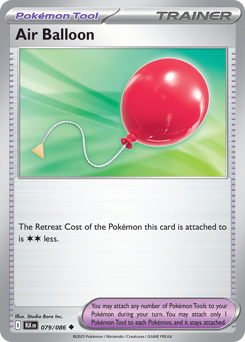
Air Balloon
Black Bolt #79
A Tool: one on each Pokémon.
Retreating costs Energy equal to the Pokémon's Retreat Cost, discarded from the retreating Pokémon, and you can still attack with the Pokémon that comes up in its place. An Asleep or Paralyzed Pokémon cannot retreat. Items, Supporters, Tools and Stadiums explained →
3. Attack and end your turn
Choose one attack your Active Pokémon has the Energy for and announce it. Its damage goes to your opponent's Active Pokémon, after Weakness and Resistance, and any Knock Outs are checked as the attack finishes. Your turn is then over, even if you had cards left to play, so finish everything in step 2 first. You can also end your turn without attacking.
An Asleep or Paralyzed Pokémon cannot attack, and a Confused one has to flip a coin first. How attacking and damage work →
Pokémon Checkup, between turns
Pokémon Checkup happens after every turn and belongs to neither player. Both players handle their Special Conditions in a fixed order: Poisoned (one damage counter), Burned (two damage counters, then flip a coin to recover), Asleep (flip to wake up) and Paralyzed (it wears off after its owner's turn). Abilities and Trainer cards that act "during Pokémon Checkup" are applied in the same step, and then any Pokémon with no HP left is Knocked Out.
A Knock Out in Checkup counts like any other: the opponent takes Prize cards, and the player whose Pokémon was Knocked Out promotes a new Active Pokémon before the next turn starts.
The first-turn rules
Before anyone draws, a coin flip decides who chooses to go first or second. Going first is an advantage, so the first turn of the game is limited to make up for it.
The Supporter limit has applied since Sword & Shield became tournament legal on February 21, 2020. Rare Candy follows the same rule as evolving: it cannot be played on your first turn. Some cards are built for the first turn, such as Fan Rotom's Fan Call Ability, which works only during your first turn.
Whether to go first depends on your deck. A deck that needs to set up a Stage 2 Pokémon usually wants the extra turn of Energy and Bench building that going first gives. A deck that can attack hard right away, or that needs a Supporter on turn one, often chooses to go second.
A good order to play your cards
The rules let you take your actions in any order, but the order changes how much you get out of a turn. This is the habit most experienced players settle into, and the reason for each step.
- Search first. Play Items such as Ultra Ball that find cards, so you know what you have before you commit to anything.
- Bench and evolve. Put down Basics and evolve, because some Abilities trigger when a Pokémon is played or evolves.
- Use Abilities that draw or search, while your hand can still change your plan.
- Play your Supporter. Play it after the cards it would shuffle away or discard, so you keep their value.
- Attach Energy. Do it late, once you know which Pokémon will attack this turn or next.
- Retreat if needed, then attack.
There are exceptions. A Supporter that draws cards may come first when your hand has nothing else to play, and an attachment may come first when an Ability needs Energy in play.
Common turn mistakes
Frequently Asked Questions
What are the steps of a turn in the Pokémon TCG?
Three: draw a card, then take any of your turn's actions in any order (play Basic Pokémon to the Bench, evolve, attach one Energy, play Trainer cards, retreat once, use Abilities), then attack, which ends your turn. Pokémon Checkup follows between turns.
Can you attack on the first turn in the Pokémon TCG?
Only if you went second. The player who goes first cannot attack or play a Supporter card on their first turn. The player who goes second can do both on their first turn. Neither player can evolve on their own first turn.
How many Energy cards can you attach per turn?
One Energy card from your hand, to any one of your Pokémon, Active or Benched. Card effects such as Abilities or attacks can attach more, and those do not count toward the one from your hand.
Do you have to attack on your turn?
No. You can end your turn without attacking. Attacking always ends your turn, so do everything else you want to do first.
Do you draw a card on the first turn if you go first?
Yes. Under the current rules both players draw at the start of every turn, including the player going first on the first turn of the game.
Track your Pokémon games.
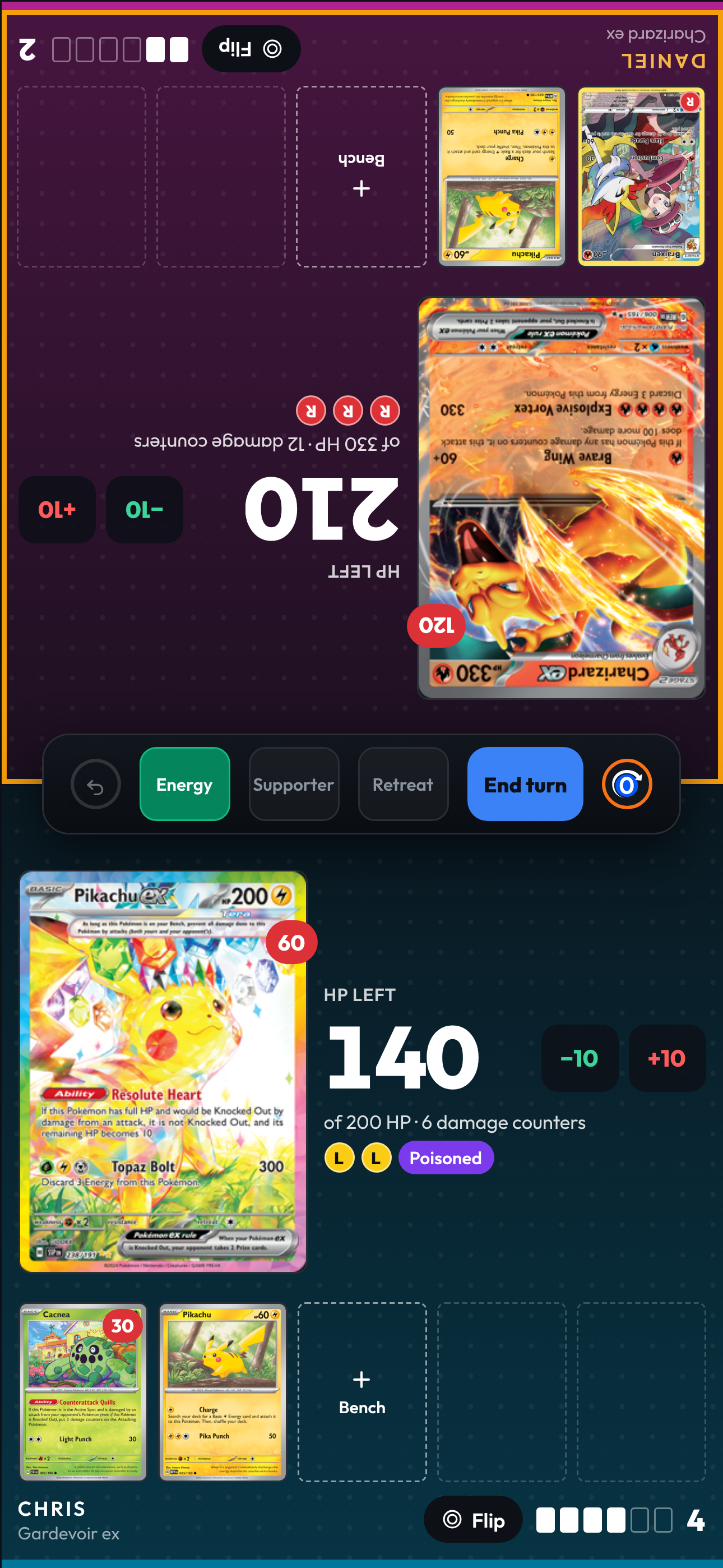
TurnZero HQ keeps the board for a two-player game: each Pokémon's damage, Special Conditions and Energy, the Prize cards each Knock Out gives, and Pokémon Checkup. Free on iPhone, Android and the web.
Create Free AccountPokémon and Pokémon character names are trademarks of Nintendo. ©Pokémon. ©Nintendo/Creatures Inc./GAME FREAK inc. TurnZero HQ is not affiliated with, sponsored, or endorsed by Nintendo, The Pokémon Company, Creatures Inc., or GAME FREAK inc. Card data comes from the open PokemonTCG dataset, and prices from TCGplayer.