Pokémon TCG Beginner Series
Pokémon Card Types and Mechanics
Every card in the Pokémon Trading Card Game is one of three types: a Pokémon, a Trainer or an Energy card. This page explains each one, the subtypes printed in the top corner, and the mechanics a new player meets in the first few games. Rules as of October 2026.
What are the three types of Pokémon cards?
A Pokémon deck holds 60 cards, and each one is a Pokémon, a Trainer or an Energy card. The type is printed at the top of the card: Pokémon show their Stage at top left, and Trainer and Energy cards name their kind in the top banner.

Mega Lucario ex
Mega Evolution #77
A Pokémon: it attacks, takes damage and is Knocked Out.

Boss's Orders
Mega Evolution #114
A Trainer: a Supporter, one per turn.
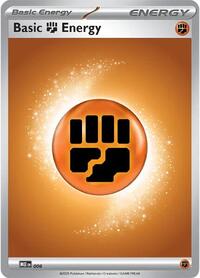
Basic Fighting Energy
Mega Evolution Energies #6
An Energy: it pays for Mega Lucario ex's attacks.
A few cards carry tighter limits than four, printed on the card: one ACE SPEC card per deck and one Radiant Pokémon per deck, for example. Every deck building rule →
Pokémon cards
Pokémon cards are the only cards that attack, and the only cards that can be Knocked Out. You have one Active Pokémon, the one in front that attacks and takes attacks, and up to five more on your Bench. Each Pokémon card shows the numbers that matter in a fight: its HP (how much damage it can take), its type, its attacks and their Energy costs, and along the bottom its Weakness, Resistance and Retreat Cost.
There are 1,781 different Pokémon cards legal in Standard as of October 2026 (counting a card once however many times it was reprinted), so you will meet a lot of names. The parts of the card are always in the same place, which is what makes a new card readable on sight. Where each part sits on a card →
How evolution works
A Pokémon card is a Basic, a Stage 1 or a Stage 2. Basic Pokémon go straight from your hand to your Bench. A Stage 1 card is played on top of the Basic it names ("Evolves from Ralts"), and a Stage 2 on top of the Stage 1. The evolved Pokémon keeps its damage, Energy and Tool, loses any Special Conditions, and can only use the attacks printed on the top card.

Ralts
Mega Evolution #58
Basic: played from your hand.

Kirlia
Mega Evolution #59
Stage 1: evolves from Ralts.

Mega Gardevoir ex
Mega Evolution #60
Stage 2: evolves from Kirlia.
Two timing rules catch new players. Neither player can evolve on their own first turn, and a Pokémon cannot evolve on the turn it was put into play or the turn it already evolved. So a Ralts played this turn becomes Kirlia next turn at the earliest, and Mega Gardevoir ex the turn after. The Item Rare Candy shortens that: it puts a Stage 2 straight onto its Basic, skipping the Stage 1, though not on your first turn or on a Basic put into play that turn. What counts as a Basic Pokémon →
Pokémon ex and the rule box
Some Pokémon have a rule box: a strip of text that changes how many Prize cards your opponent takes when that Pokémon is Knocked Out. A Pokémon ex gives up two Prize cards instead of one, and a Mega Evolution Pokémon ex gives up three. In return they have far more HP and stronger attacks than an ordinary Pokémon. Mega Lucario ex, above, has 340 HP.
A Tera Pokémon ex, such as Dragapult ex, carries a second rule: while it is on your Bench, it takes no damage from attacks, yours or your opponent's. Mega Evolution Pokémon ex are not a separate Stage. Mega Absol ex is a Basic, Mega Lucario ex is a Stage 1 and Mega Gardevoir ex is a Stage 2, and each evolves like any other card of its Stage. Pokémon ex, EX, GX and V compared →
Attacks and Abilities
An attack is something your Active Pokémon does once, at the end of your turn, and using it ends your turn. An Ability is printed above the attacks with the word "Ability," and it is not an attack: using one does not end your turn, and unless it says otherwise it works from the Bench as well as the Active Spot. 291 of the 1,781 Pokémon in Standard have one.
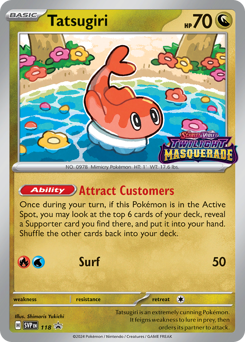
Tatsugiri
Scarlet & Violet Black Star Promos #118
Attract Customers: an Ability that works only in the Active Spot.

Mega Venusaur ex
Mega Evolution #3
Solar Transfer: an Ability you can use as often as you like.
Abilities come in two kinds. Some you announce and use, and the text usually says "you may" and how often, such as "once during your turn." Others are always on and need no announcement while the Pokémon is in play. The card's own words decide which kind it is.
Trainer cards: Items, Supporters, Tools and Stadiums
Trainer cards are where most of a deck's searching, drawing and switching comes from. There are four kinds, and the difference between them is how many you can play in a turn.

Ultra Ball
Mega Evolution #131
Item: discard 2 cards, search your deck for a Pokémon.

Lillie's Determination
Mega Evolution #119
Supporter: shuffle your hand in and draw 6.
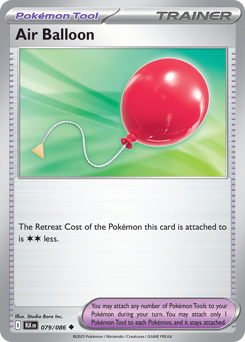
Air Balloon
Black Bolt #79
Pokémon Tool: Retreat Cost is 2 less.
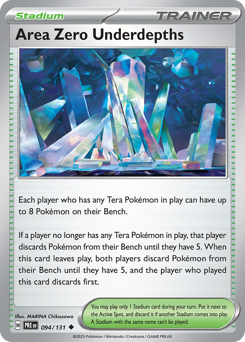
Area Zero Underdepths
Prismatic Evolutions #94
Stadium: a bigger Bench with a Tera Pokémon in play.
Only one Stadium is in play at a time. When either player plays a different one, the old one is discarded, and you cannot play a Stadium with the same name as the one already in play. Some Items and Tools are also ACE SPEC cards, which are stronger and limited to one per deck. What an ACE SPEC card is →
Energy cards
Energy pays for attacks. Once per turn you may attach one Energy card from your hand to one of your Pokémon, and it stays there until that Pokémon is Knocked Out or a card moves or discards it. Each attack's cost is printed as Energy symbols to its left, and the Pokémon needs at least that much attached to use it. A Colorless symbol in a cost can be paid with Energy of any type.
Basic Energy cards come in eight types today (Grass, Fire, Water, Lightning, Psychic, Fighting, Darkness and Metal), and a deck can run any number of them. Special Energy cards add an effect while attached, such as Prism Energy, which provides every type on a Basic Pokémon, and they follow the four-copy rule. All 11 Pokémon types and what each is weak to →
Retreating
Retreating moves your Active Pokémon to the Bench and brings up a Benched Pokémon in its place. You can do it once per turn, before you attack, by discarding as much Energy from the retreating Pokémon as its Retreat Cost shows at bottom right. The Pokémon keeps its damage, and it loses any Special Conditions. An Asleep or Paralyzed Pokémon cannot retreat.
Most Retreat Costs are small. Of the Standard Pokémon, 891 cost one Energy to retreat and 52 retreat for free. Retreating is not the only way to switch: Supporters and Items such as Boss's Orders and Prime Catcher move Pokémon in and out of the Active Spot without the cost.
Terms you will hear at the table
These pieces come together on a turn: draw, play your Trainers, attach your Energy, evolve, then attack. What you can do on a turn →
Frequently Asked Questions
What are the three types of Pokémon cards?
Pokémon, Trainer and Energy. Pokémon cards are the creatures that attack and get Knocked Out. Trainer cards are one-time effects or cards that stay in play, split into Items, Pokémon Tools, Supporters and Stadiums. Energy cards attach to your Pokémon and pay for their attacks and Retreat Costs.
What is the difference between an Item and a Supporter?
You can play any number of Item cards on your turn, but only one Supporter. Supporters have stronger effects, such as drawing a new hand or pulling an opponent's Benched Pokémon into the Active Spot, and the player who goes first cannot play one on the first turn of the game.
Does using an Ability end your turn?
No. Only attacking ends your turn. You can use Abilities before you attack, and most Abilities work from the Bench as well as the Active Spot. Read the card: many say "once during your turn" or only work in the Active Spot.
How many Pokémon can you have on your Bench?
Five. With your Active Pokémon, that is six Pokémon in play at most. A few cards, such as the Stadium Area Zero Underdepths, raise the limit while their condition is met.
How many Pokémon Tools can a Pokémon have?
One. You can attach as many Tools as you like in a turn, but each Pokémon holds only one, and it stays attached until a card effect removes it or the Pokémon leaves play.
Keep your Pokémon cards in one place.
Scan them in, see what each one is worth, and build a deck that is checked against Standard or Expanded. Free on iPhone, Android and the web.
Create Free AccountPokémon and Pokémon character names are trademarks of Nintendo. ©Pokémon. ©Nintendo/Creatures Inc./GAME FREAK inc. TurnZero HQ is not affiliated with, sponsored, or endorsed by Nintendo, The Pokémon Company, Creatures Inc., or GAME FREAK inc. Card data comes from the open PokemonTCG dataset, and prices from TCGplayer.