One Piece Card Game · Color Pairs
Green/Blue in the One Piece TCG
Green/Blue is a tempo pair: Green rests your opponent's cards and readies yours, and Blue returns Characters to hand. Its Leaders return your own Characters on purpose, to play their effects again.
Green/Blue is a deck led by a Green/Blue Leader, so it can play any Green card and any Blue card. Green's resting and readying with Blue's bounce, replaying your own Characters for value.
As of October 2026, Bandai has printed four Green/Blue Leaders. Three are legal in Standard, one has rotated out with block 1.
How Green/Blue Plays
Roronoa Zoro & Sanji (ST12-001) is the clearest example. When the Leader attacks with a DON!!, you can return one of your 2-cost or larger Characters to hand to set a 7000-power-or-less Character active, which both readies an attacker and lets you replay the returned card's [On Play]. Green's rest effects keep the opposing side from blocking or attacking back.
Monkey.D.Luffy (OP16-022) sets 2 DON!! active each turn as long as every Character you control is Impel Down, and Donquixote Rosinante (OP05-022) is a Leader with [Blocker] that sets itself active at the end of your turn when you hold 6 or fewer cards. That makes Rosinante a Leader built to defend.
What each color does on its own, counted from the card text, is in Green and Blue on the colors page.
What It Does Well, and What It Doesn't
Strengths
- Repeatable [On Play] effects: return a Character, replay it.
- Tempo: Green rests opposing Characters and Blue sends them back to hand, so your opponent loses whole turns.
- Rosinante's [Blocker] gives the pair a defensive Leader option.
Weaknesses
- Few K.O.s. Blue's single-color cards never K.O., and Green K.O.s mostly rested Characters.
- Replaying a card costs DON!! again, so the value comes slowly.
- Impel Down Luffy wants only Impel Down Characters, which narrows the deck.
Green/Blue Leaders
Your Leader is the only two-color card in a Green/Blue deck: every two-color card Bandai has printed is a Leader. These are the ones legal in Standard as of October 2026, with what each one asks of the deck.
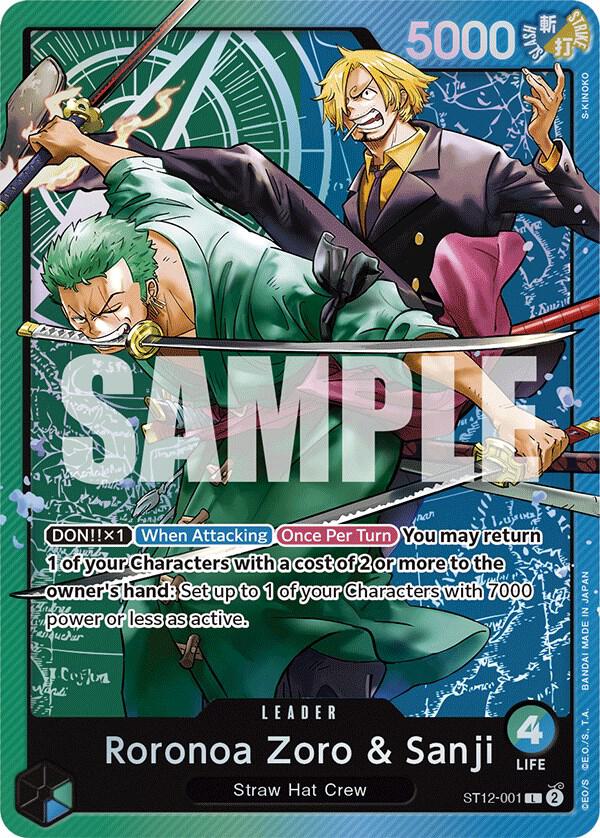
Roronoa Zoro & Sanji
ST12-001
Return a Character to set a 7000-power-or-less one active
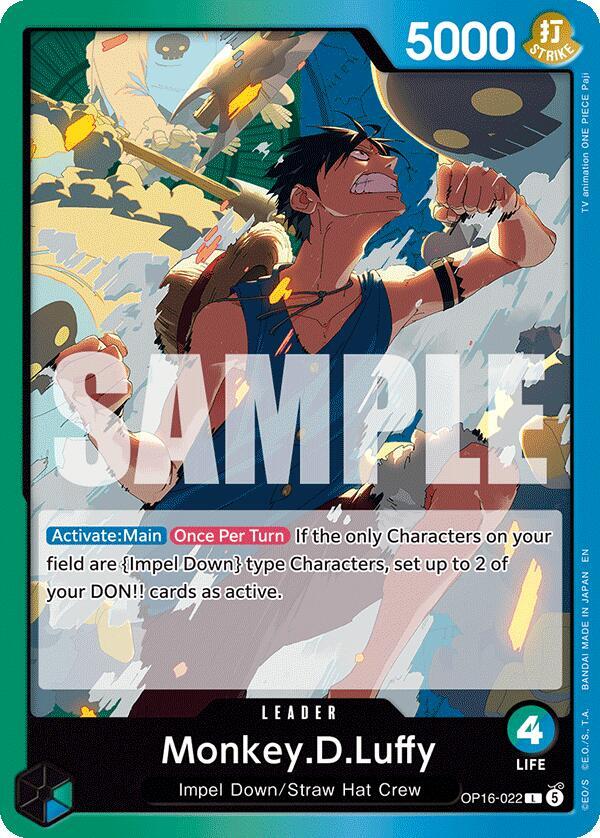
Monkey.D.Luffy
OP16-022
Sets 2 DON!! active with only Impel Down Characters
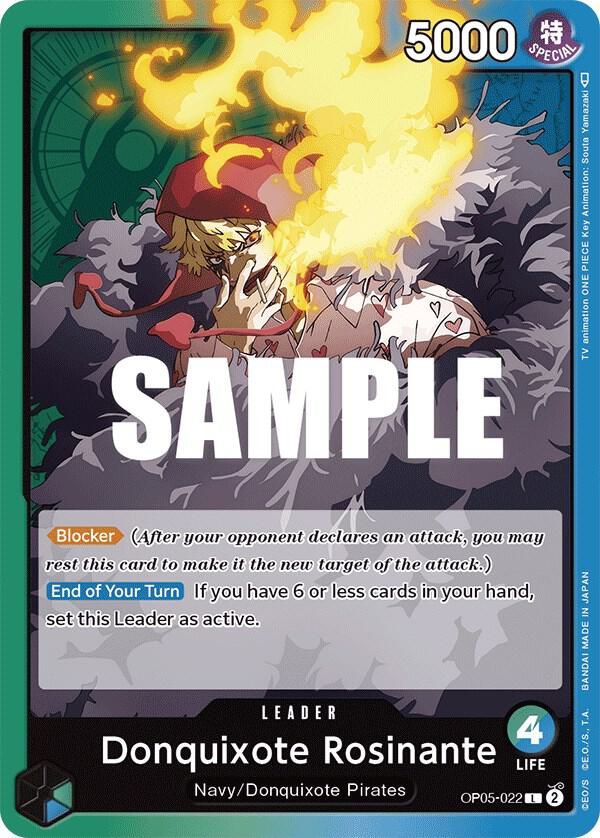
Donquixote Rosinante
OP05-022
A [Blocker] Leader that sets itself active at end of turn
Rotated out of Standard with block 1 on April 1, 2026, and still playable in casual games: Sanji (OP02-026).
How Leaders work, and the ones that change deckbuilding rules, is in One Piece Leader cards.
Cards Worth Knowing
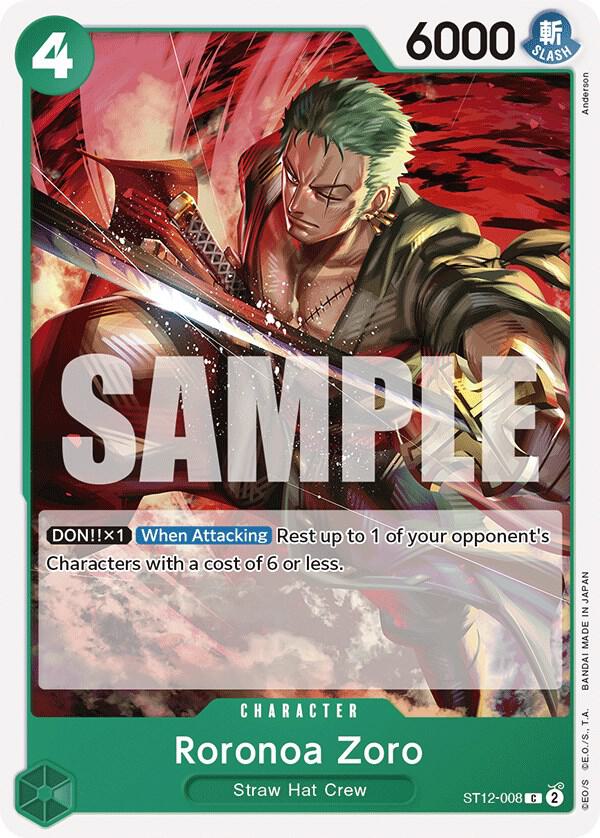
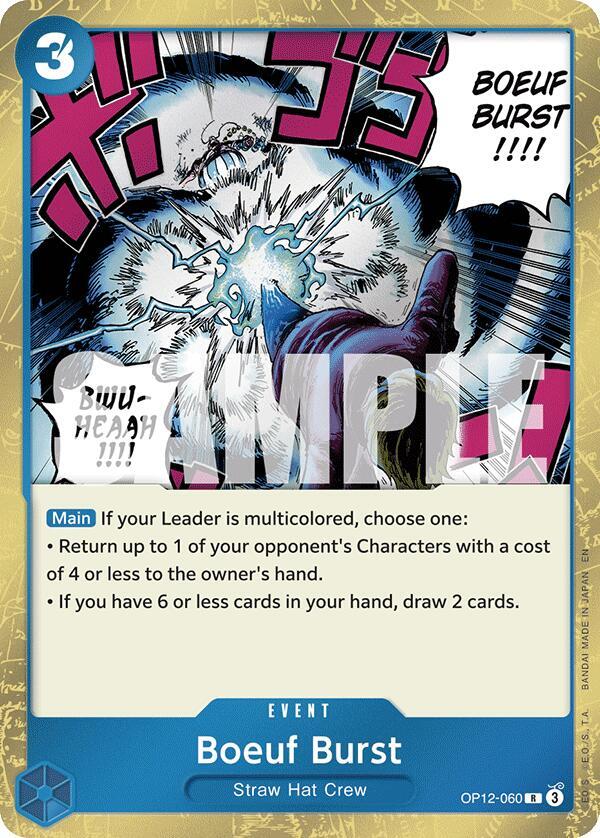
The rest of the deck is single-color cards. These show what the pair's Leaders are built to use; they are examples from Standard-legal sets, not a list of the best cards.
Where to Start
The fastest start is a starter deck with a Green/Blue Leader: ST-12 Zoro and Sanji (Standard legal, difficulty 4 out of 5). Each guide covers the deck as sold and the upgrades worth buying first.
To build one, pick the Leader first and fill the 50 cards in its colors; the steps are in how to build a One Piece deck. TurnZero HQ's One Piece Deck Lab flags any card that doesn't share a color with your Leader, and decks players have published are at One Piece decks, searchable by deck name or by a card in the deck.
Pairs That Share a Color
Frequently Asked Questions
What is the Green/Blue starter deck?
ST-12, Zoro and Sanji, led by Roronoa Zoro & Sanji (ST12-001). All 17 of its different cards are legal in Standard as of October 2026.
What are the Green/Blue Leaders in the One Piece TCG?
As of October 2026 there are 4: Roronoa Zoro & Sanji (ST12-001), Monkey.D.Luffy (OP16-022), Donquixote Rosinante (OP05-022) and Sanji (OP02-026). 3 are legal in Standard; OP02-026 rotated out with block 1 on April 1, 2026.
Build your Green/Blue deck.
Pick a Leader, build a deck in its colors and check it against the rules, then keep score at the table. Free on iPhone, Android and the web.
Create Free AccountONE PIECE CARD GAME card names and images are the property of Bandai and their respective owners. ©Eiichiro Oda/Shueisha, Toei Animation. TurnZero HQ is not affiliated with, sponsored, or endorsed by Bandai, Shueisha, or Toei Animation. Card data and prices come from TCGplayer.