For Game Stores
Running a Draft Night at Your Store
Booster, cube, sealed or team draft. Pods, Swiss rounds, a clock and standings — and an honest account of which half of it runs on the counter machine and which half runs on a phone.
Read this first: which half runs where
A draft night is the one thing TurnZero HQ splits across two devices, and it is better to know that before your first Friday than to find out at 6pm.
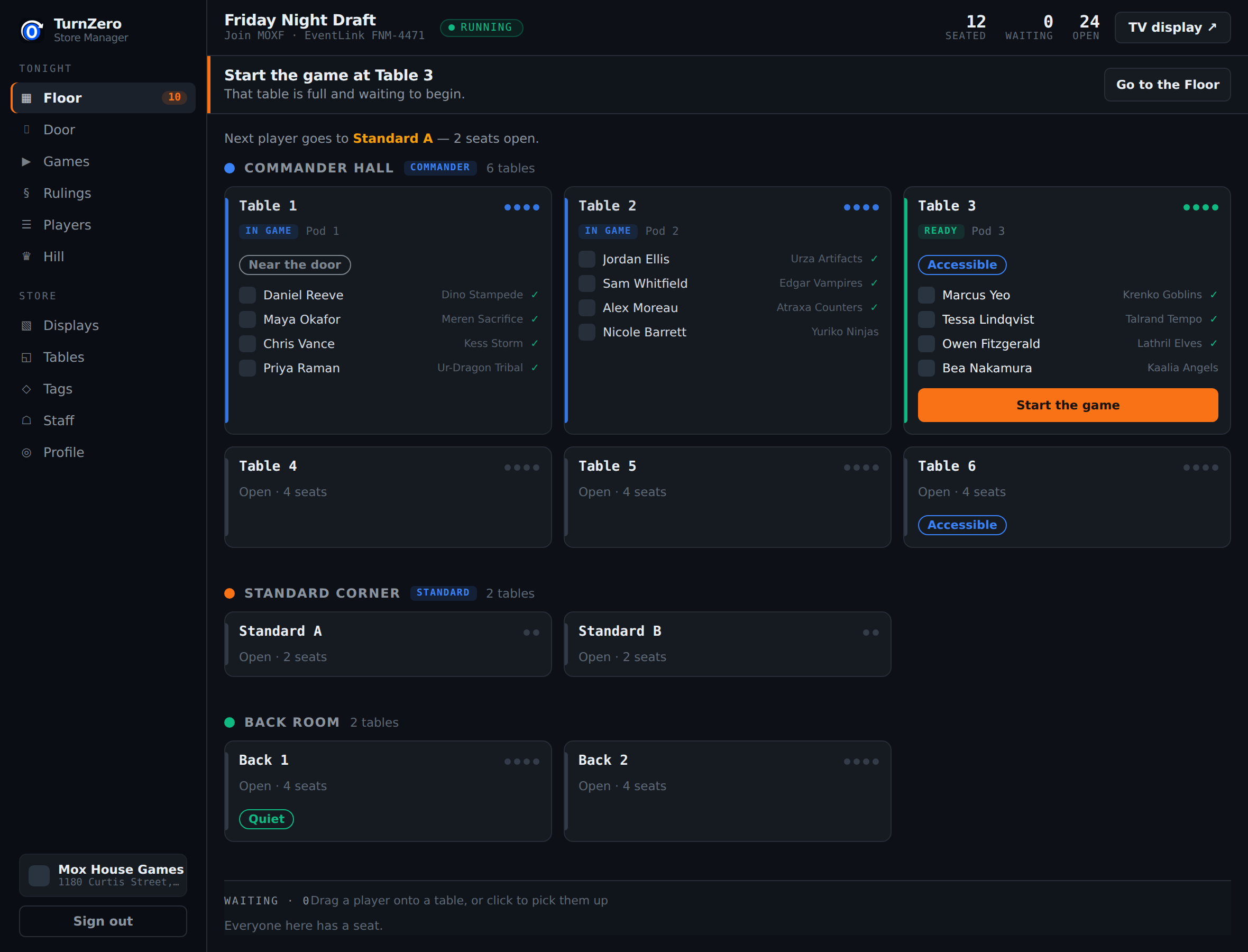
The store console runs the night and the room: starting the night, the join code, who has arrived, the tables, the wall display, and the record afterwards. The app runs the draft itself: the pods, the Swiss pairings, the round clock, the match results and the standings.
That is a real gap rather than a design preference — the person running FNM is standing at a counter, and the pairings should be on the screen in front of them. It is the largest thing still missing from the console. Until it lands, run the draft from a phone or a tablet on the counter, which is what a shop running EventLink is doing anyway.
Before the doors open
Start the night from the console exactly as on any other evening, and put the join code where people can see it. Getting Your Game Night Started covers that half; nothing about it differs for a draft.
The one thing worth doing while it is quiet: if the event is sanctioned, note your EventLink event code against the night. It sits in the console's own header beside the join code all evening, which is what makes reconciling the two lists at the end a reading exercise rather than a hunt.
Splitting the room into pods
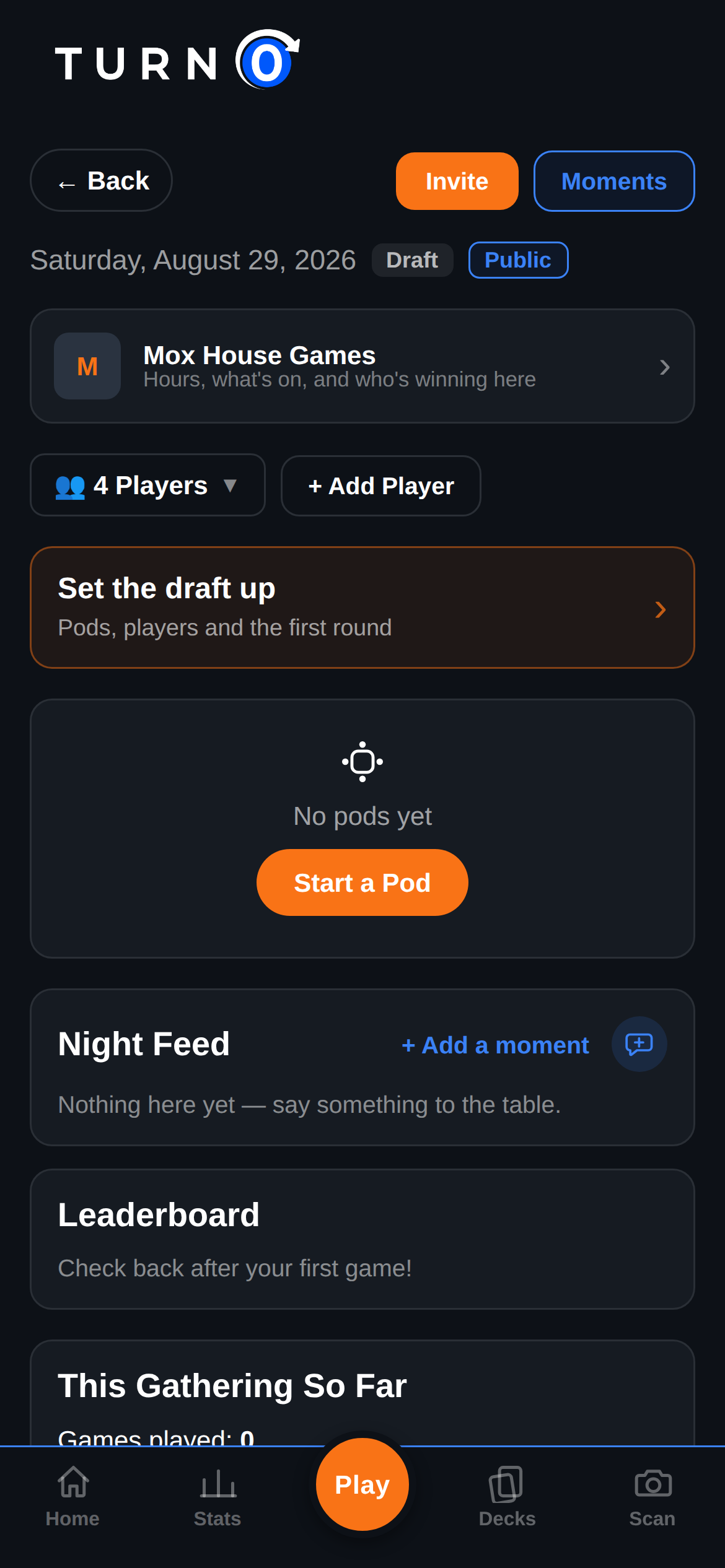
A draft pod is the group that opens packs together, and it is not the same thing as a table. Eight is the standard pod; the split happens once, at the start, and the pairings afterwards happen inside it or across the whole event depending on how you set it up.
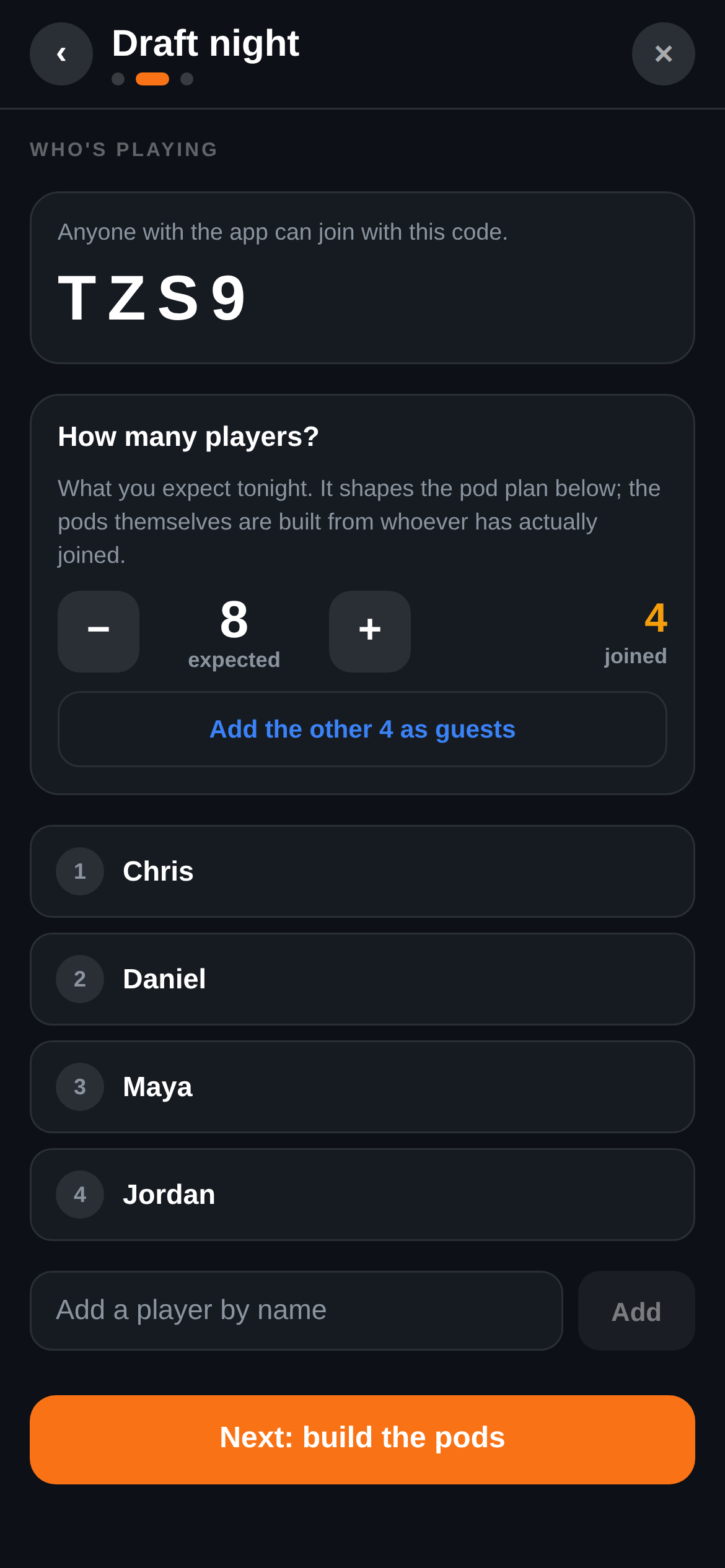
Three things about the split that are worth knowing rather than discovering:
Pods are levelled, not filled. Eleven players at a pod size of eight is six and five, never eight and three. A three-person draft is a materially worse evening than the eight-person one next to it, and levelling is what stops one existing.
The order is random, and it has to be. Nobody has a deck yet — everyone opens the same packs — so seeding a draft pod by anything at all would be seeding it by a fact about a different format.
Sealed has no pods. Everybody opens their own pool, so a sealed event skips this step entirely and goes straight to pairings.
Rounds, pairings and the clock
Pairings are Swiss: nobody is eliminated, everybody plays every round, and players on the same record meet each other so the field sorts itself out. Generate a round and the pairings appear; generate the next one when the last match reports.
Always read the notes under the pairings. They carry the things you can actually do something about: a forced rematch, who got the bye, somebody sitting in no pod. A round with a rematch in it is a normal evening at a shop with nine regulars — the software pairs it and says so rather than refusing to pair, which would be a far worse answer at 7pm.
Start the clock once people have found their tables, not when the pairings go up. Starting it with the pairings charges the room the two minutes it takes to walk to a table, every round. You can add or take five minutes mid-round, which is what a judge ruling that ate four minutes needs.
Time running out does not end the round. The clock passes zero and counts up, because Magic's rule is to finish the turn and play five more turns, and only the person standing in the room can apply that. Nothing here ends a round or invents a result.
Reporting a match
A best-of-three has exactly five endings, so reporting one is five buttons rather than a form: 2-0, 2-1, 1-2, 0-2, or a draw. Somebody is standing at the counter telling you one of them, and that is the whole interaction.
The unit is the match rather than the game, which is the thing a spreadsheet gets wrong. A player who went 2-1 and a player who went 2-0 both won one match; counted as game wins they are three against two, and the standings stop meaning anything.
Standings are Magic's own: three points for a match win, one for a draw, and the published tiebreakers in order — match points, then opponents' match-win percentage, then game-win percentage. Nothing invented, so a player who wants to check the top table by hand can.
A table that wants to play the match in the app rather than on paper can. That gives them the life counter and gives you the game-by-game record for free, and it is entirely optional — the organiser's reported result is always the one that wins, so opening a game that somebody has already reported cannot rewrite the standings under them.
Where EventLink fits
Plainly: TurnZero HQ does not submit anything to EventLink, and no third-party software can. Wizards publishes no public API for Companion or EventLink. Anything advertising itself as syncing your results into EventLink is describing something that does not exist.
What it does instead is make the reconciliation short. You end the evening with the attendance list and every match result in one place, with the EventLink event code sitting beside them, so the typing you do into EventLink is a copy rather than an act of memory.
In practice most shops running both find the division falls out naturally: EventLink for sanctioning, TurnZero HQ for the part of the evening that happens in the room. If your draft night is unsanctioned — a cube night, a chaos draft, a Thursday for regulars — then there is no EventLink half at all and this is the whole of it.
The room around the draft
Everything else the console does on a Commander night carries over unchanged. The door screen still shows who has arrived, walk-ins still get a seat with just a name, the rulings screen still catches questions from players' phones, and the wall display still shows the join code and what is happening.
A shop that runs both formats gets one more thing worth having: sections. Put your draft tables in one section and your Commander tables in another, each with its own format, and a game started in either is recorded under the right one without anybody choosing. That is part of setting the store up and takes a couple of minutes once.
Does TurnZero HQ submit results to EventLink for me?
No, and neither does anything else. Wizards publishes no public API for Companion or EventLink, so no third-party software can report into it — anyone claiming otherwise is describing something that does not exist. What TurnZero HQ gives you is the attendance list and the results in a form you can reconcile against EventLink while it is still fresh.
So do I still need EventLink?
For a sanctioned event, yes. Run the two side by side: EventLink for sanctioning, TurnZero HQ for the room. A lot of shops find the draft itself is the part EventLink handles worst and the part this handles best, so the split ends up feeling natural rather than like duplicate work.
Where do the pairings actually happen?
In the app, not the console. That is a real limitation and it is worth knowing before your first draft: the pods, the Swiss pairings, the round clock and the standings are all driven from a phone. The console still runs the door, the room and the results.
How does it handle an odd number of players?
Somebody gets a bye, which is a real match win recorded like any other rather than an absence. It is remembered, so the same player cannot be handed a second one while somebody else has had none — which is the one thing anybody notices about byes.
What happens when the clock runs out?
Nothing automatic, deliberately. The clock passes zero and counts up, because Magic's own rule is to finish the turn and play five more, and the person standing in the room is the one who decides how that applies. Nothing here ends a round or reports a result on its own.
Does a draft move anybody's deck rating?
No. Ratings are for constructed decks with a history; the deck being played tonight is forty cards somebody opened an hour ago, and scoring the second against the first says nothing true about either. A draft night never touches a deck's rating.
Can I run team draft?
Yes. It is the same pods, the same Swiss and the same reporting, with two seats a side instead of one. There is no second pairing algorithm to learn.
Run your draft night on TurnZero HQ.
Pods, Swiss pairings, a round clock and standings, with the door and the room handled on the counter machine.
Open the Store Console